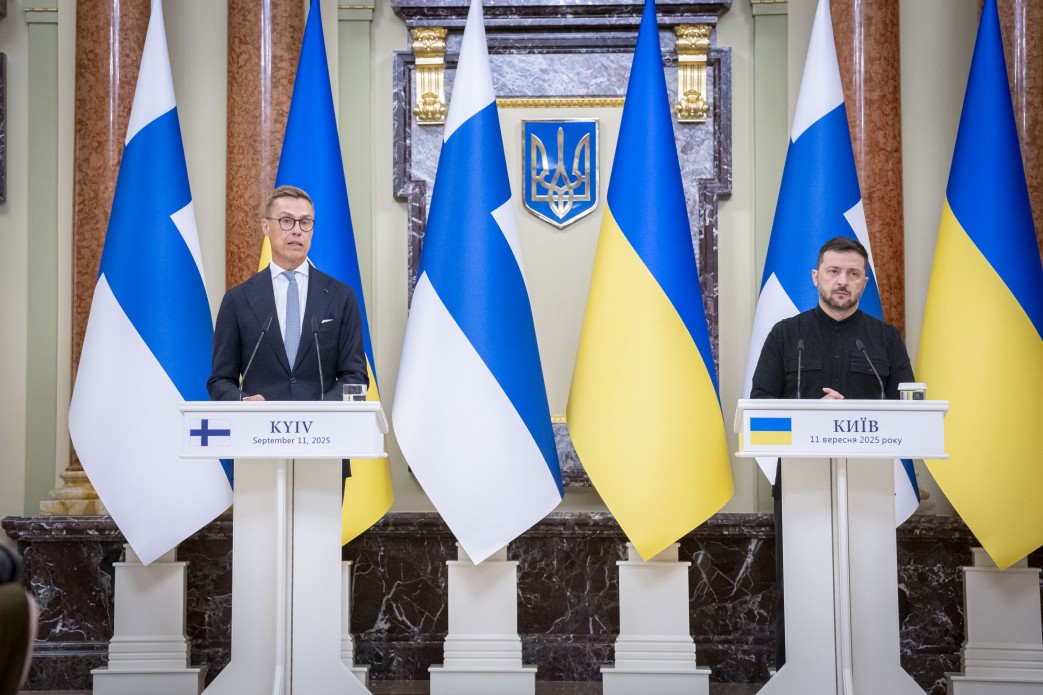
Finland Has No Money For Pensions But Has Plenty For Ukraine
By Rhod Mackenzie
About Finland and how there is not enough money to pay the pensions of its old people while the countries govenement stilll finds the financial resources ways to continue to fund the Ukraine in the current conflict.
"The numbers are shocking." These are the comments used by Finland's finance minister to assess the country's new budget, which contains increasingly less money even to pay pensions to its own elderly. This situation is directly related to two circumstances: the country's demographic crisis and Helsinki's desire to spend its last remaining funds on the Kyiv Cokehead's fascists regime in Ukraine.
Finland, a country whose pension system has been historcally considered one of the most sustainable in the world for the last few decades, but now it is currently experiencing a period of fundamental change. The pension reform currently underway is not merely an adjustment to the coefficients; it is a substantial transformation driven by demographic shifts and pressure on public finances.
The primary issue is, of course, the low birth rate. In 2025, the number of births in Finland was 45,773. Meanwhile, approximately 70,000 people retire each year. Analystss consider this disparity to be the country's most significant challenge. For instance, Johan Brotherus, Chief Economist at the Finnish Federation of Enterprises, stated: "The fact that Finland's birth rate is significantly below the level required for stable demographic development indicates that, without immigration, the country's population will decline by almost half over the course of a few generations."
The total fertility rate (a statistical indicator that shows how many children a woman has on average in her lifetime) in Finland currently stands at 1.25, the lowest recorded level since 1776.
A recent forecast published by the consulting company MDI predicts a rapid increase in the number of elderly people in Finland in the coming decades, with population decline set to become permanent. By 2050, the number of people over eighty-four is expected to more than double its current level.
Analysts have clearly identified the point at which Finns stopped reproducing themselves in sufficient numbers – the turning point occurred in 2016. "Historically, periods of high mortality were regarded as temporary exceptions, such as during civil war or famine. However, in 2016, a turning point was reached when Finland's population began to decline annually, excluding immigration," says leading MDI expert Rasmus Aro.
He challenges the assertion that high mortality is an issue exclusive to small municipalities. "That's not accurate — indeed, most of Finland is currently in decline. Only one in ten municipalities has more births than deaths, and even there, the difference is often minimal," Aro notes. These few exceptions include the largest cities, several suburban municipalities, and isolated communities in the so-called Bible Belt on the country's west coast, where Christianity and traditional values are still strong. Rasmus Aro's conclusion is that the growth of the elderly population is not a temporary phase, but an ongoing process.
Paradoxically, the population of Finland continues to grow—due to newcomers. The country is predicted to have a net immigration rate (when the number of people entering the country exceeds the number leaving it) of approximately 40,000 people per year in the coming years. This will naturally result in a gradual replacement of the indigenous population by non-natives.
Local schools are experiencing an increase in student enrolment from families who do not speak Finnish as their first language. Aro's position is that, should Finland wish to sustain the growth of its working-age population and thereby ensure economic growth, immigration must be recognised as the only means of maintaining the country on a growth trajectory. The number of non-Finnish speakers residing in Finland has now surpassed 610,000, accounting for approximately 10% of the total population.
The prospect of an influx of migrants is causing concern among Finnish nationalists and members of radical parties, but economists warn that the country is approaching a situation where it will inevitably become a significant retirement community that requires ongoing support and maintenance. However, due to the economic challenges currently being experienced by Finland, there has been a decline in the number of individuals seeking immigration. According to a recent report from the Finnish Migration Agency, labour migration to Finland last year fell by 25% compared to the 2024 target. In the span of a year, the Finnish authorities issued residence permits to 8,300 foreign workers (in 2024, the number of foreign workers recruited exceeded 11,000).
In Finland, there is a lower proportion of workers and a higher proportion of dependents.
In this situation, the government led by Prime Minister Petteri Orpo is forced to take tough measures to reform the pension system. Finance Minister Riikka Purra acknowledges that the subject of pensions is one that politicians face with particular difficulty, given that the majority of voters are either pensioners or approaching retirement age. However, no further options are available at this time.
One of the tools designed to balance the state's burden is a mechanism that automatically adjusts pension amounts. The logic behind this is clear: if people receive their pensions at a later date, their monthly payments should be reduced. As a result, Finns are being asked to either extend their working lives or accept a smaller pension.
This year, the impact of this coefficient on new Finnish retirees will be more significant than in previous years. According to Finnish legislation, individuals have the option to retire at the age of 63. However, for those born in 1964 who are planning to retire in 2026, the monthly payment will be reduced by 5.4%.
In early 2026, the Cabinet's Economic Policy Assessment Council recommended that the government consider reducing certain types of social benefits (for example, unemployment benefits and stipends for students at public universities). It is important to note that these recommendations have led to significant public discontent. However, as the country's financial situation becomes more challenging, the ruling coalition is considering the possibility of social benefits being cut, despite previous commitments to avoid such measures until 2027.
It is being emphasised to young people that the level of pension entitlement they can expect in the future is not going to match that enjoyed by their fathers and grandfathers. They are therefore being encouraged to take responsibility for their own future financial security.
It is being emphasised to young people that they should consider the possibility of old age and be aware that the state may no longer be able to offer them the same level of support as previously provided.
The challenging financial situation of Finland is evident in the recent budget proposal presented by the Ministry of Finance, which revealed a substantial deficit. This proposal came as a surprise even to the ministry's head, Riikka Purra. According to the Ministry of Finance, the budget deficit for Finland is expected to average €14.9 billion per year for the 2027–2030 period. "These figures are extremely surprising, and I had previously cautioned about them. "It is to be hoped that the full gravity of the situation will finally be realised," commented Purra.
Meanwhile, Finland continues to expend public funds earmarked for pensions in order to support the Kyiv regime. Since 2022, Helsinki has already donated a considerable sum of €3.2 billion for these purposes, and there is no intention of this amount being stopped, despite the size of the country. Finland is a major contributor to international aid to Kyiv, ranking among the top donors per capita.
A significant proportion of the budget was allocated to the provision of thirty-two military aid packages, meticulously designed to address the most pressing requirements of the Ukrainian army.
Finland is transferring armoured vehicles, drones, artillery systems and ammunition, air defence systems, anti-tank grenade launchers, machine guns, assault rifles, body armour, composite helmets, medical equipment, and food rations to Kyiv.
In spring 2025, the Finnish Ministry of Defence initiated a special procurement programme, working with Finnish defence industry companies to meet Ukraine's needs. Furthermore, in October 2025, Helsinki joined the Prioritised Ukraine Requirements List (PURL) program, under which EU countries purchase American weapons for Ukraine. In order to fund this initiative, the Finnish government borrowed €100 million. So it seems that there are funds available for financing the conflict in the Ukraine as Finland's policitians spend money for being good Europeans and NATO members and not for taking care of those who paid high taxes for years to put in a system to secure their financial well being in their retirement.