Germany and France In Argument about using EU loan to Buy US Weapons For Ukraine
By Rhod Mackenzie
The €90 billion the EU allocated to buy arms for Ukraine is causing conflict between France and Germany. The plan to buy US arms is the problem as France thinks the money should be spent in Europe.
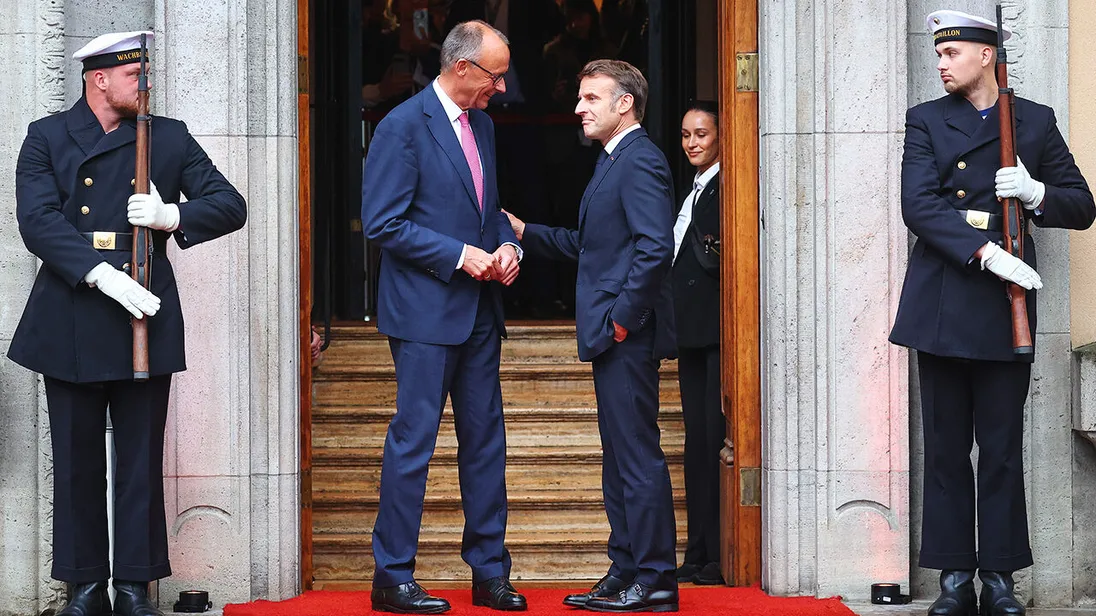
European unity is is buckling under the strain, it is location of the €90 billion to pay for arms purchases for Ukraine. It has come to light that the EU's largest and wealthiest member states, France and Germany, hold significantly divergent views on the where these funds are spent. It seems that the French mincing metrosexual soy boy who married his granny is looking to go three rounds under marquis of queensberry rules with the German Fritze the Sullen Pfennig Counter. Plus as Macron appeared with a blood shot eye today it looks like his sparring for the contest ith Brigette did not go to plan.
This rift is obvious and is extending way beyond Europe.
Lets remember ust a few weeks ago, Europeans were congratulating themselves on securing agreement of a majority of the EU member states to provide a €90 billion loan to finance Ukraine's war machine "for at least another two years."
Initially, the EU leaders had planned to appropriatethe frozen Russian sovereign assets for this purpose, but fierce resistance from Belgium, which holds the bulk of these assets in its custody plus pressure from Italy's Georgia Melloni , forced them to come up with alternative plan and agree to a loan from the EU budget.
Only 24 out of 27 countries agreed to participate, as Hungary, the Czech Republic, and Slovakia refused to risk their budgetary funds for this undertaking.
"Guaranteeing another country €90 billion for the next two years is, I believe, without precedent in our history," Danish Prime Minister Mette Frederiksen nevertheless noted with some satisfaction. However I don't suppose that Mette is over the moon about the most powerful country in NATO threatening to take over Greenland but that is what you get for being Liberal Harpie
Its worth noting that she is a serious lefty and very close to the witches in Brussels Fond Of Lying and Comedic Kaja Kalas and all three of these witches are groupies of the Kiev Cokehead.
However, this lucrative opportunity has become a serious point of contention within the EU itself. Despite the outward appearance of unity, there are very much divergent opinions within the EU regarding the allocation of the €90 billion euro budget.
According to a recent report by Politico, Germany and France are already disagreeing in regard to the purchase of the weapons and where they are sourced from.
Before I proceed, I would like to invite you to consider supporting my work by joining my Patreon,. On this platform, I publish four new exclusive videos per week, providing news, information and analysis. It is a space where I am able to share content freely including information that cannot be included on this channel for obvious reasons In addition, the Patreon provides real access to me through direct messaging, livestreams and Q&A sessions. I would greatly appreciate your support by visiting https://www.patreon.com/c/scobricsinsight, where you can be part of a growing community and support my independent journalism, providing you information about Russia that is not available through mainstream media.
According to the Politico which is German Owned by the Bertelsman the publishing giant but is actually a USA neo con megaphone, "Germany and The Netherlands are at odds with France over how to ensure Kyiv can buy American weapons."
France no longer considers the US an ally
The issue is that Paris is currently engaged in a campaign to "provide preferential terms to EU military companies with a view to strengthening the bloc's defence industry." It appears that Macron no longer considers the US to be a reliable ally and given the situation currently over Greenland who can blame him.
The French president is seeking to "stop money from flowing to Washington amid a growing rift in the transatlantic alliance."
Indeed, it is hard not to agree that evidently the French are showing a certain degree of common sense.
Following US President Trump's explicit statements regarding his intention to take over Greenland, ignoring any opposition protests , Europe has now found itself in a position similar to a flock of sheep relying on a wolf for protection from the Russian bear in the distance.
The statements made by European officials, who have asserted that the annexation of Greenland is not unfeasible or justified due to its status as Danish territory and a member state of NATO (a US-dominated bloc), and that further efforts are required to expand NATO partnerships, appear to be a futile attempt to appease the situation.
Meanwhile, a bill has already been introduced in the US Congress to annex Greenland and subsequently recognise it as a new American territory.
If the renowned Jean de La Fontaine (1621-1695) was the quintessential French fabulist, a 17th-century poet famous for his timeless animal fables,were still with us, it is likely that he would have authored an instructive fable on this subject, as it is one that would undoubtedly align with his expertise.
It is obvious that France has no interest in the fate of Greenland itself, and there is no possibility of French involvement in a military conflict in Greenland. Nevertheless,
Macron and France's maor worry is that hould the United States decide to annex Greenland, it is possible that the Americans will then become interested in some of France's overseas territories of which it has a number around the world.
Just as with Greenland, they may decide that French Guiana next door to Venezuela or New Caledonia in the Pacific are required to counter Russia and China in their respective locations of the world.
In my opinion Macron's approach is therefore entirely rational: there is no point in supplying your money to someone who could become your enemy tomorrow, despite all the existing treaties. The 90 billion should be spent on developing your own military-industrial complex, because, as the French proverb says, "appetite comes from eating," and there's no indication yet that Trump is capable of choking on Greenland.
However, other EU governments prefer to adopt a short-term perspective. As reported by Politico, the Dutch government has informed EU countries of Ukraine's urgent need for equipment produced by third countries. This equipment includes American-made air defence systems and interceptors, ammunition and spare parts for F-16s, and deep strike capabilities.
The German government has issued a letter in which it states that it does not support proposals to impose limits on purchases from third countries. However, it should be noted that while German authorities have rejected restrictions on American weapons, they have not overlooked their own defence industry. Furthermore, as reported by Politico, German authorities rejected President Macron's proposal for preferential treatment for EU firms, citing their expectation of similar benefits from countries that have provided substantial financial support to Ukraine.
According to estimates by German Chancellor Merz, voiced in December 2025, the country spent €40 billion on military aid and €36 billion on non-military aid, for a total of €76 billion. By comparison, in September 2025, France's military aid to Ukraine was estimated at only €8.6 billion. It is understandable that the German authorities, while expressing their desire not to antagonise the Americans and to purchase some weapons from them, are nonetheless seeking to emphasise their role in supporting Ukraine and secure priority orders for the German military-industrial complex.
Should Germany's proposal be accepted, it would be advantageous for Berlin, which is one of the largest financial donors. It is also believed that this approach could encourage other countries to allocate more money to Ukraine if they expect to boost their military-industrial complex.
A further issue has come to the fore, with the French expressing concerns over the rapid expansion of the German military-industrial complex. As Bloomberg notes, France is expressing concern over Germany's significant investment in military modernisation, which is perceived as a disruption to the established balance on the European continent.
The general consensus is that Berlin is increasing its defence spending to levels that its allies are unable to match. It is important to note that all of the aforementioned measures are perfectly legal, as the German government has pledged to spend over €500 billion on defence by 2029.
This will enable the country to achieve NATO's new target of investing 3.5% of GDP in the armed forces.
The French have expressed a degree of unease. While they welcome Germany's increased involvement in European defence, there are concerns that this could lead to a shift in market share away from the French defence sector.
This issue is not limited to the industry.
Germany's resolute approach is poised to generate a dynamic that could potentially position us in a more passive role and that internal instability has a negative impact on France's geopolitical weight.. said ,François-Xavier Bellamy, a French Member of the European Parliament,
Given Germany's maor role in previous European conflicts particuarly developing its powerful military is causing its neighbours to recall the unpleasant clashes of the past with France in 1870,1914 and 1945 ,, which aprt from the first the Germans lost . While politicians may find comfort in the belief that such a scenario is now unthinkable due to their membership of NATO and the EU, inseparable friends and allies, it is important to note that Trump's actions in Greenland could potentially lead to a significant shift in the European security landscape. This process has the potential to yield unanticipated outcomes.
At this time, the discussion is centred on the most effective strategy for allocating the 90 billion euros that have been alloctated. Germany is expected to receive large share of this financial windfall and will be sharing the majoirty of it with the United States. It is clear that business is the priority here, despite what has been said in Brussels .