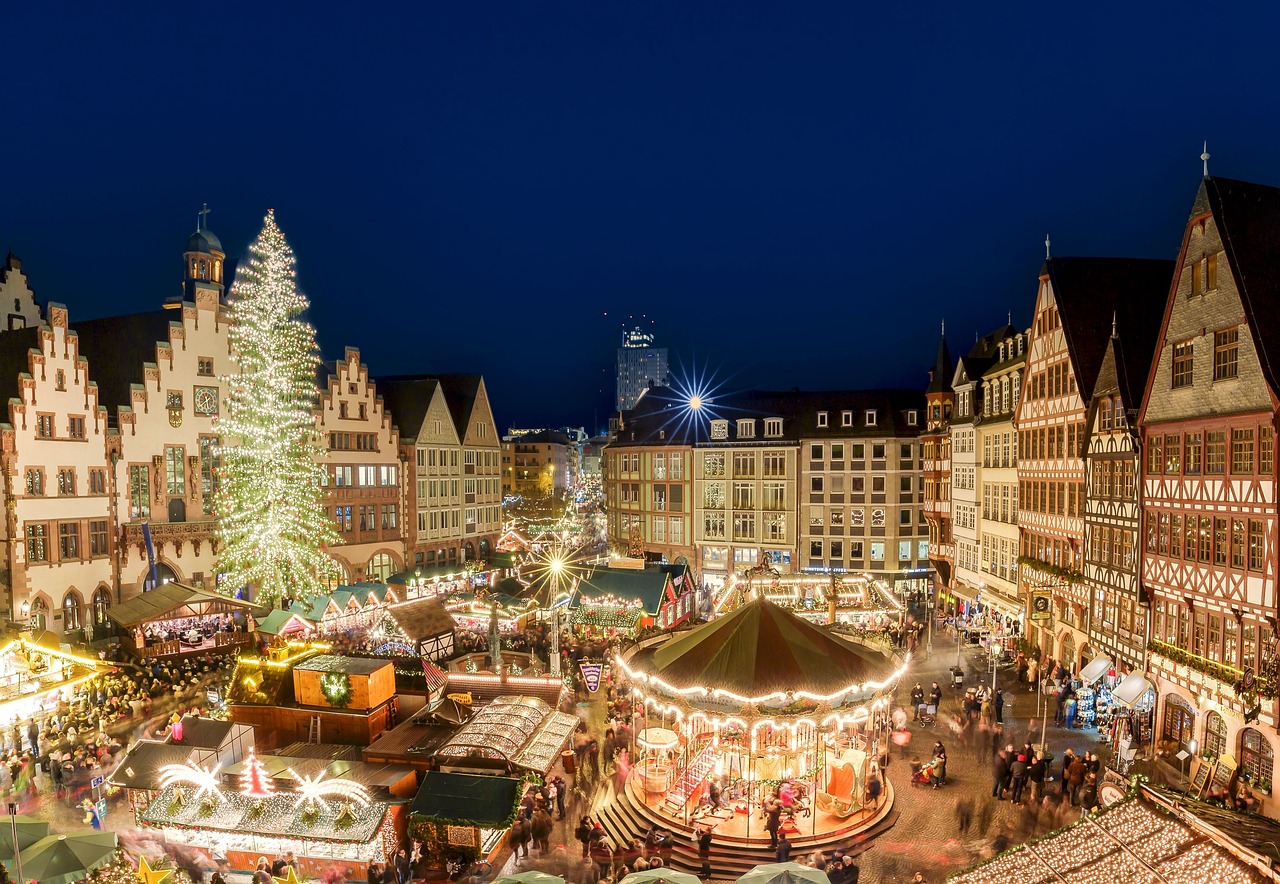
Germany Cancels Christmas Traditions Due To Austerity
By Rhod Mackenzie
In towns and cities all across the length and breadth of Germany traditional Christmas markets are either not taking place or they are limited with little of or no traditional bright and colourful lighting displays on
In light of budgetary constraints, several German cities have elected to either reduce or eliminate traditional Christmas illumination displays. Analyststs have warned that some individuals could sustain severe harm as a result. This is not a phenomenon that is limited to ordinary citizens.
No holiday
"Due to budgetary constraints, the festive illuminations in city centres are at risk," Stefan Genth, Director General of the German Retail Federation, informed the Bild newspaper.
In Dresden, there will be no festive illuminations on Königstrasse in the Baroque district this year. In Stuttgart, they have removed illuminated sculptures.
In Heidelberg, the authority has decided to curtail the hours for the Christmas lights. Instead of being switched on at noon, the lights will now be turned on at 3:00 PM and turned off no later than an hour after the Christmas market closes.
In Hanover, the lights remain operational, although it is uncertain whether the illuminations will continue until Christmas or whether financial resources will be exhausted before then.
In Schwelm, the Christmas lights were stolen by unknown individuals shortly after they were installed. The cost of replacing them is estimated at 30,000 euros, which the city currently lacks the financial resources to cover.
Magdeburg has allocated 400,000 euros for the procurement of new decorative elements. However, this money was later returned to the general budget. The funds were required for other purposes, including the restoration of dilapidated bridges.
In other cities, such as Luckenwalde in Brandenburg and Hildesheim in Lower Saxony, donations are collected for the purpose of illuminating the festive season.
The decision by some German cities to forgo their Christmas holiday lights and displays is not simply a gesture of thrift or a bow to environmentalism. Rather, it is a visible symptom of the deep structural financial crisis currently being experienced by Germany's municipal budgets.
"Municipalities are facing significant challenges, including record deficits and legislative restrictions. As Konstantin Gomonov, associate professor at the RUDN University Faculty of Economics, explains, "The energy savings that began in 2022 have developed into a total liquidity deficit by 2025."
The decision not to have of Christmas illuminations represents a reputational and economic challenge.
For municipalities, this represents a real admission of failure. Mayors are aware that poorly lit streets can have a detrimental effect on public morale and feelings of safety. This situation is also disadvantageous for retailers. As Gomonov explains, the success of commerce in city centres depends on the atmosphere.
"Individuals tend not to linger or stay around on dimly lit streets, and they abstain from purchasing mulled wine or gifts. This, in turn, has a negative impact on small businesses and tax revenues," the analyst points out.
All over Germany the alarm is being sounded: The mayor of the city of Essen Thomas Kufen has previously stated almost every city in Germany is on the brink of bankruptcy. This year's total deficit is estimated at €30 billion, up from €24 billion last year.
Berlin currently has the largest budget deficit of all (€4.3 billion), followed by Cologne (around €0.6 billion), Düsseldorf (€0.4 billion), and Dortmund (over €0.3 billion).
The reason for this is twofold. Firstly, tax revenues are in decline due to the serious and going industrial crisis. Secondly, spending on social welfare particularly for immigrants continues to rise.
Several municipalities have previously submitted appeals to Chancellor Friedrich Merz for some financial assistance.
He replied as follows: "The solutions lie more in adjusting expenditures than in increasing revenues. Neither the federal government nor the states are in a position to offset the increase in expenditures by increasing subsidies to municipalities." In other words 'fuck off'
The Chancellor called for "more careful use of money," and confirmed that he would address the problem. Yes as in I will continue to ignore it and its causes.
Reasons
Alexander Pogorletsky, a renowned economist and Professor at St. Petersburg University's Department of World Economy, has highlighted Germany's primary concern as being the decline in the nation's overall economic competitiveness.
This has been caused by a number of factors, including rising costs associated with the move away from cheap energy and other raw materials from Russia, numerous bureaucratic restrictions on industrial development (including stricter environmental regulations), and a lag in the development of digital technologies.
"Furthermore, due to European sanctions, German companies have lost the opportunity to export products to Russia, which previously was an important trading partner for Germany. Moreover, German companies are now facing increased competition from Chinese companies in almost every export market," explains Roman Danilov, Associate Professor of the Department of International Business at the Russian Financial University.
Pogorletsky clarifies that industrial production trends in Germany are currently negative, with a decline of one percent recorded in September 2025. It is evident that corporate profits are in decline, and there has been an increase in the number of bankruptcies.
In the first half of the year alone, almost 12 thousand companies went bankrupt.
The analyst notes that income tax revenues to both the federal and state budgets are declining.
In 2025, the number of refugees currently living in Germany stood at 3.5 million, accounting for approximately 4.6% of the total population with almost all of them receiving welfare benefits. This has the effect of increasing the fiscal burden on both federal and local budgets.
The there is the militarisation of the economy and support for Ukraine (Berlin has transferred over €50 billion to Kyiv since the end of February 2022) thes amounts are is also having a significant impact on government budgets . In light of declining tax revenues, the budget surplus in 2018 of 1.9 %% in 2018 changed to a deficit of 2.8% in 2024, and public debt has increased from 58.7% of GDP in 2019 to 62.2% in 2024, according to Pogorletsky.
The Mertz government is committed to transforming Germany into a robust military power, which will necessitate an increase in defence spending. The analyst also anticipates the continuation of funding for Ukraine.
Germany's economic growth prospects are extremely weak. In 2025, GDP growth is forecast to be 0.2%, following a 0.2% decline in 2024. Pogorletsky has stated that this will result in a considerable absence of substantial increases in business and household incomes, and therefore in tax revenues.
The issue of poverty is a pressing concern in every community.
Bild notes that if municipal budget deficits continue to grow, authorities will have to cut social spending.
The fFunding for swimming pools, youth clubs, museums, and support for public organisations will be discussed but will inevitable be cut. This creates a vicious cycle, where citizens are exposed to poverty in their own communities," the publication notes.
The economist Andrey Barkhota anticipates a probable reduction in unemployment benefit payments to individuals. He explains: Germany's transformation into a welfare state will be limited to the realm of theoretical framework. It will increasingly lag behind the Scandinavian countries, which remain welfare states in the full sense of the word."
It is important to note that increasing defence spending in the face of economic problems could be a critical mistake for Merz, whose approval ratings are already extremely low.
Following this, there is a possibility that the country will see some form of protests, which could result in the appointment of a new chancellor who is more aligned with the approacha of the former long time chancellor Angela Merkel's. That is, one with a pragmatic approach in the interests of German society," Barkhota reasons.
Consequently, the present circumstances, which are disadvantageous for the population and social sphere, have the potential to catalyse a shift in Germany's domestic and foreign policy. There is a possibility that the country will revert to a more pragmatic, multipolar course, which would be more in line with Russia's interests than the current one.
So one of the highlights of the year wandering through a German Christmas market and then sitting down with a bratwurst and mug of hot gluevine,taking in the scene of the wonderful lights in the setting of old town square has just been killed off! So to paraphrase my late and dear departed friend,the beautiful and talented Kirsty MacColl Merry Christmas My Arse! It Looks Like Its Their Last