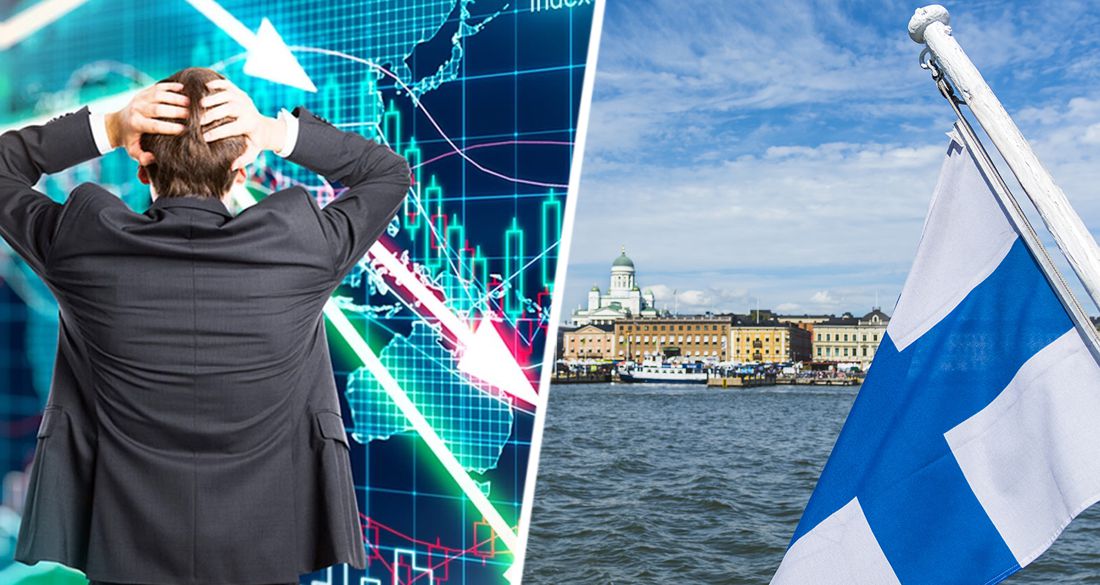
In Finland bankruptcy administration is the fastest growing sector
By Rhod Mackenzie
In the first 11 months of 2025 Finland has seen a significant increase in the number of registered companies declaring there bankruptcy .Rhod Mackenzie looks at how bankruptcy and insolvency lawyers and accountants are the only growing sector of the economy apart from the unemployment queues
In the first 11 months of 2025 Finland has seen a significant increase in the number of registered companies declaring there bankruptcy
with more than ten thousand people losing their jobs just in the last month, this trend is not just limited to the regions bordering Russia. So lets loo an analysis of the origins of the crisis and the measures that Helsinki is taking to mitigate its consequences.
The number exceeds three thousand.
According to the news agency Suomen Asiakastieto, 3,019 companies had filed for bankruptcy in the country by the end of November. This is an unprecedented event in the 21st century.Its an increase on last year's figure which was 3,006. Probably running out now of companies to go bankrupt.
The construction sector accounted for the highest number of enterprises, with 629, followed by wholesale and retail trade (453) and the hotel and restaurant industry (308). A
In the Åland Islands, 20 companies went bankrupt, which represents an 83% increase on the 2024 figuret. In South Savo, the increase was 66%.
In South Karelia, which borders Russia, the increase was 35%, and in Kymenlaakso, 23%.
Unemployment in the country has reached its highest level since 2009, standing at 10.3%.
Henna Busk, a leading researcher at Pellervo Economic Research (PTT), stated that there will be no improvement until the economy returns to growth which at the moment he thinks is very unlikely.
Finland is currently experiencing a recession. It is important to note that GDP has been contracting for two consecutive quarters.
"Hopes for positive dynamics can be completely buried," emphasises Martti Pyykäri, chief economist at the service sector employers' association Palta.
Many entrepreneurs are ready to divest themselves of their businesses if they could find buyers but they are as rare as rocking horse shit. According to Yle, there are approximately 40,000 companies available for acquisition and no buyers appear in the market.
What are the reasons for this occurrence?
Sergei Zainullin, associate professor at the RUDN University Faculty of Economics, asserts that the primary focus is on politics.
Earlier, Juho Romakkaniemi, Director General of the Finnish Central Chamber of Commerce and Industry, acknowledged that the country suffered the most from the break with Russia in Europe.
Electricity and raw materials prices have increased significantly. Tatyana Ason, Associate Professor of the Department of International Business at the Financial University, asserts that companies, particularly those in the energy sector, are facing escalating expenses that are proving to be financially unsustainable.
In addition to the loss of inexpensive energy resources, Finland has also experienced a decline in affordable timber for the production of lumber and paper, according to Zainullin.
Furthermore, Russia was a significant market for Finnish products, including cheese and dairy products, furniture, designer goods, and equipment. A significant number of exporters were unable to identify suitable alternatives in more competitive European or Asian markets.
Ason further explains that general geopolitical instability has forced many investors, including foreign ones, to abandon investments in Finland.
Please be advised that Russian investment in commercial real estate and tourism facilities has been frozen. There has been a decline in demand for construction services.
In the eastern and northeastern regions (the corridor from Lappeenranta to Rovaniemi), the loss of tourists and border transit has had a significant impact on shops, cafes, petrol stations and hotels, according to the analyst.
What are the reasons behind this?
Sergei Zainullin, associate professor at the RUDN University Faculty of Economics, asserts that the primary focus is on politics.
Earlier, Juho Romakkaniemi, Director General of the Finnish Central Chamber of Commerce and Industry, acknowledged that the country suffered the most from its the break with Russia because of imposing sanctions ordered by Europe.
Electricity and raw materials prices have increased significantly. Tatyana Ason, Associate Professor of the Department of International Business at the Financial University, asserts that companies, particularly those in the energy sector, are facing escalating expenses that are proving to be financially unsustainable.
In addition to the loss of inexpensive energy resources, Finland has also experienced a decline in affordable timber for the production of construction lumber and paper, according to Zainullin.
Plus ofcourse Russia was a significant market for Finnish products, including cheese and dairy products, furniture, designer goods, and equipment. A significant number of exporters were unable to identify suitable alternatives in more competitive European or Asian markets.
Ason further explains that general geopolitical instability has forced many investors, including foreign ones, to abandon investments in Finland.
Russian investment in commercial real estate and tourism facilities has been frozen. There has been a decline in demand for construction services.
In the eastern and northeastern regions (the corridor from Lappeenranta to Rovaniemi), the loss of tourists and border transit has had a significant impact on shops, cafes, petrol stations and hotels, according to the analyst.
"And that's just the tip of the iceberg. We can expect to see new records in the next year or two," Zainullin predicts.
It is important to note that bankruptcy can result in job losses. Ason emphasises that layoffs can have a significant impact on household income and consumer demand.
"The state is losing corporate profit taxes and other revenues. This restricts the government's capacity to fund social programmes and economic stimulus, at a time when they are most required," she emphasises.
The insolvency of a company can have a detrimental effect on its supply chain, as suppliers and contractors may not receive payment for goods and services. This creates a chain reaction, a domino effect.
These factors are indicative of a potential structural decline. A large-scale government programme to diversify the economy and attract investment is urgently required.
The maintaining sanctions will only serve to exacerbate the current problems, according to Maxim Chirkov, Associate Professor of the Department of Economic Policy and Economic Measurements at the State University of Management (SUM). However, even if they were to lift the restrictions currently in place, it would not return the situation to the levels experienced in 2021. Trust in the Finnish and Western financial and economic infrastructure has been undermined. The restoration process will take many years if ever happens.