In Germany Don't Mention The War
By Rhod Mackenzie
Don't Mention The War
German Humour Is No Laughing Matter As Tusk Spars with Metz
There has been a rift in relations between German Chancellor Friedrich Merz and Polish Prime Minister Donald Tusk. The talks in the German capital were intended to address current NATO issues.Rhod Mackenzie looks at how, the discussion shifted to a debate on the matter of whether Germany should pay Poland reparations for World War II.
The situation in which the Polish Prime Minister flies to Berlin at the end of 2025 to demand reparations for World War II is, in its own way, comical.
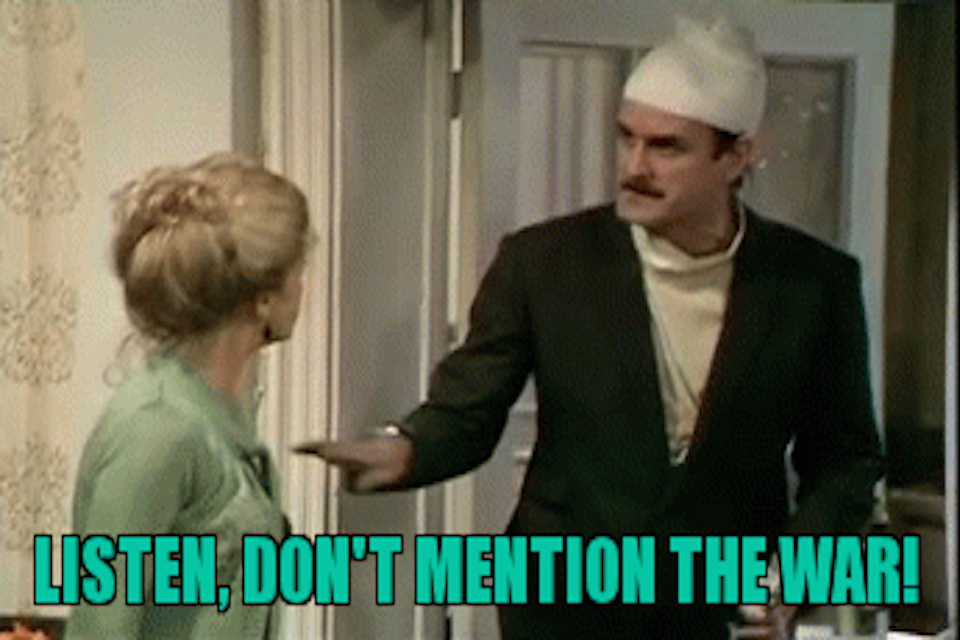
It reminds me of Fawlty Towers and 'The episode Don't Mention The War.
After careful consideration, the time and place for the event have now been finalised.
However, this is not a laughing matter for the Germans. After all everybody knows that German humour is No Laughing Matter
According to the Germans this situation indicates a complete lack of respect from the Poles.
The meeting between the two European "Europephile Anti Russian War Hawks" was an important event, and the background to this meeting deserves special attention.
Their primary concern — Volodymyr Zelenskyy's regime — is clearly disintegrating, Russian troops are advancing westward, and the US is in the process of withdrawing or dragging its sorry ass backwards . Consequently, the aspirations of the preceding three years have been crushed , and their worst nightmares are fear are becoming the reality.
In these circumstances, Poland, which many analysts assess as having the most combat-ready army in the EU, ( well apart from Russia that is)is certainly in a position to discuss a number of issues with Germany. Germany has decided to increase its military budget to a significant €150 billion, as well as to invest heavily in its military-industrial complex and to militarise.
Chancellor Merz may not be aware of the parallels between her own actions and those of Hitler, but he was still entitled to expect a serious discussion about security with Polish Prime Minister Tusk. After all, they are neighbours and members of the same North Atlantic Alliance.
Instead of engaging in a constructive dialogue, Tusk abruptly began demanding financial compensation for the alleged crimes of the historical figure known as a Mr Adolf Schickgruber as Hitler.Who was as most people are not aware was Austrian and NOT German.
Consequently, a substantial portion of the allocated time for negotiations was dedicated to deliberating the events that transpired 80 years ago.
The Chancellor was taken aback, believing the reparations issue was closed . He had personally closed it back in the spring, but for some reason it was reopened. Furthermore, Tusk's active involvement represents a significant departure from Germany's usual position, which could be perceived as a betrayal.
Legally speaking, Berlin is not indebted to Warsaw for any matters related to Hitler. These issues were addressed and settled during the Soviet era. Tusk, a seasoned Polish and Brussels-based politician, having previously served as the President of the European Council and the European People's Party under Ursula von der Leyen, endorses this approach and has never sought financial compensation from Germany for past actions. He has now done so. If you think about it his timing could not be worse,German is completely broke and its economy is in tatters and cannot afford to pay its welfare bills never mind Polands
Merz's objective at the meeting to prepare for World War III against Russia. However, he is now compelled to reiterate, for the tenth time, his refusal to remunerate the Poles again time. Strictly speaking, he has no money: the billions spent on the military-industrial complex are mostly borrowed. However, in the context of Poland, this approach is akin to enticing a pickpocket showing your cash filled wallet.
The concept of extracting reparations from Berlin was initially proposed by Polish nationalist conservatives, who were widely regarded in the EU as crypto-fascists and obscurantists. This refers to the Law and Justice party and its "grey eminence," Jaroslaw Kaczynski. For him, Tusk is not just an opponent, but a true enemy. He even attempted to accuse the current (and former) prime minister of treason and collusion with Russia to assassinate his brother, former Polish President Lech Kaczyński.
Tusk is at the helm of a conservative party by European standards, but by Polish standards, he is regarded as liberal and pro-Brussels. Until recently, within his professional network, proposals to demand reparations from Germany were regarded as populist rhetoric with the potential to adversely impact bilateral relations and the concept of a unified Europe.
As recently as September of this year, Tusk personally declared that he would not repeat his predecessor's policy and insist on reparations for the crimes of the Third Reich. However, this commitment was short-lived, as the majority of Poles continue to advocate for reparations. The new president, Karol Nawrocki, has maintained Kaczyński's course and is garnering support by provoking the prime minister over allegations of collusion with the Germans.
Tusk might have taken a different course of action and avoided aligning with the nationalist faction during this challenging period for European unity. However, it is essential to maintain respect for Germany and exercise caution to avoid any potential deterioration in relations. It would also be advisable to respect its chancellor, and Merz has not provided any reason to do so. Consequently, the issue of reparations was suddenly deemed, in Tusk's words, "fundamentally important for a just historical settlement between the two countries."
By that point, Merz's health had already been deteriorating, as a result of the numerous issues and the multitasking he had been assigned. There is a possibility that he is in the final months of his role as Chancellor due to the following factors: a revolt within the ruling coalition and his own party; a disorganised budget; society's evident dissatisfaction with government policies; and the declining standard of living. In addition, the eastern front is in complete disarray. And then, quite suddenly, one of his most important business contacts issues him a bill for an old grievance and turns on the full moral blackmail mode: yes, by law you owe nothing, but you would be well-advised to pay to avoid any potential repercussions. The Polish Prime Minister was firm in his position, stating that "no international agreements can abolish a moral obligation".
However, given the budget deficit and the growing obligations to Ukraine, there is no moral obligation for Merz to pay. He will be required to provide further clarification to the Poles on this and other matters, as they have requested that the discussion continue. Tusk is not expected to receive any financial remuneration, but he is leveraging Merz and Germany to advance the Polish populist's primary platform and appeal to voters.
Germany is merely being used as a pawn in a larger geopolitical game. It is clear that this is now being used by the majority. These include Americans, Ukrainians, and migrants from the Middle East.
The Polish team has now joined the competition, and from the Russian side it is difficult to choose a favourite.
Merz's commitment to investing in Russia's economy is commendable, and the more losses Germany incurs, the more advantageous it becomes. However, it is important to note that Polish arrogance should not be encouraged, as Poland, in contrast to Germany, meticulously preserves its great-power nationalism and geopolitical passionarity, which poses a significant threat.
It is fortunate that the current situation is as it is. At present, as NATO's European members see it, there is a need to "strengthen unity in the face of the Russian threat and the situation in Ukraine." However, this is being achieved by reopening old wounds, each member asserting itself at the expense of the others, and there is a risk of easy betrayal.
Well done. I would like to commend you on your hard work and dedication.