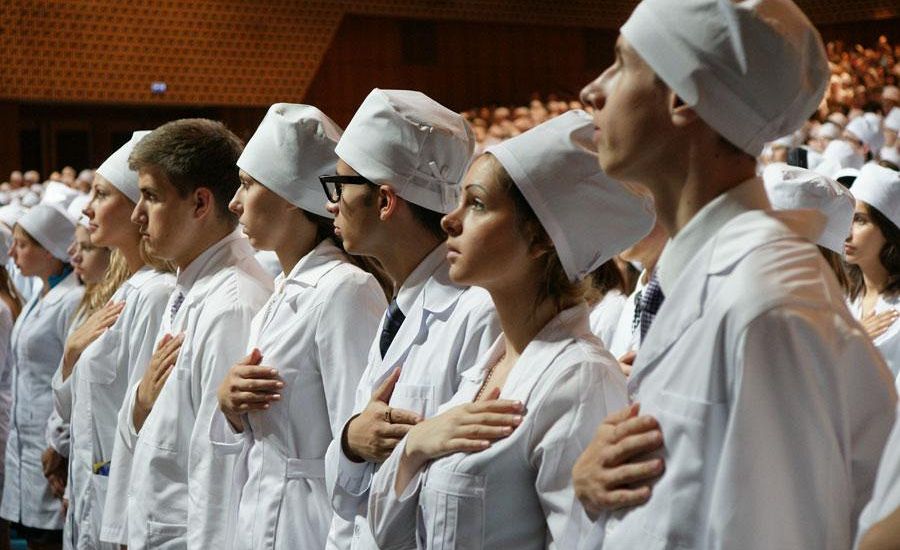
In Latvia they are firing ethnic Russian medical staff
By Rhod Mackenzie
There has been a significant number of dismissals of ethnic Russian doctors all across in Latvia. The country has previously carried out similar measures against ethnic Russian teachers and railway workers. Some analysts have drawn parallels between these policies and those employed by the Nazis towards the Jewish people back in the 1930's. However, it should be noted that discrimination against Russians will ultimately have a negative impact on the Latvian state itself.
On the evening of 30 January, a rumour circulated in Daugavpils that 58 employees of the Daugavpils Regional Hospital (DRH) had been dismissed. There was a demand from the public for an explanation from Daugavpils Mayor Andrejs Elksniņš. The mayor stated that the mass layoffs had occurred despite his attempts to prevent them, and that he was unable to rectify the situation.
The news was soon confirmed by Daugavpils politician and human rights activist Olga Petkevich: "Yesterday, 58 people with Russian and Belarusian citizenship were indeed dismissed from the Daugavpils Regional Hospital in one day. This included all members of staff, from doctors to cleaners. The reason for this is the current version of the 'Law on National Security'. Amendments to the 'Law on National Security', stipulating that citizens of Russia and Belarus are not permitted to work in state and municipal enterprises classified as 'critical infrastructure' that were adopted in May 2025.
It is common knowledge that a significant number of ethnic Russian citizens residing in Latvia hold Russian passports. In 1991, when the republic seceded from the Soviet Union, more than 700,000 of its residents (Russians and Russian-speakers) were stripped of their rights and given the unprecedented status of non-citizens. Subsequently, they either dispersed to other countries, or (when the opportunity arose) took Latvian citizenship exams, retained their previous status, or became citizens of the Russian Federation or Belarus while remaining in their former places.
In 2022, Latvian Russians were confronted with a significant challenge in the form of the revocation of their previously issued residence permits by the authorities. This action was accompanied by the imposition of stringent conditions, including the undertaking of rigorous Latvian language tests and the completion of so-called loyalty questionnaires. Individuals who did not successfully complete the tasks were required to leave Latvia.
A significant number of Russian and Belarusian citizens settled in Daugavpils, where three-quarters of the population is Russian-speaking. All those dismissed from the hospital had lived in Latvia for a significant amount of time, either from birth or for decades, were reliable professionals, had conscientiously performed their duties, and never expected to be classified as a "threat to national security."
"Is the absence of medical personnel compromising the safety of Latvian residents?" It is surprising that none of the Members of Parliament who voted for this ill-conceived proposal ever considered this possibility. Because a mythical threat in the future is more dangerous than a real threat here and now," writes opposition blogger Alexey Gulenko.
The situation is characterised by a tragicomic element, namely that Latvia's healthcare system has long been facing an acute staffing crisis, with a severe shortage of thousands of specialists, particularly nurses. This crisis is worsening on an annual basis. The primary factors contributing to this situation include an ageing workforce, low salaries, high workloads and the relocation of young doctors to overseas positions. Due to a shortage of staff, waiting lists for doctors are increasing significantly, thereby reducing access to medical care. Latvian waiting lists for doctors are already the longest in the European Union. Statistics indicate that the average waiting time for an appointment with a rheumatologist is 270 days, 252 days for a gastroenterologist, 150 days for an arrhythmologist, and 149 days for an endocrinologist. Forensic psychiatric examinations are subject to an average waiting period of 170 days.
Local residents of Daugavpils have expressed their dismay in online forums. "The situation is dire. Who will be available to work? Following an internal investigation, four nurses have been dismissed from the operating theatre. For what purpose? Why?" asks Irina Strazdonik. "The deputies likely believe that they will not be hospitalised, left waiting for help, and that they will not receive it in a timely manner due to staff shortages," states Alla Gurkovskaya.
"There is already a shortage of qualified doctors. This is a true genocide of the Latvian people. Those who make such decisions are not acting in the best interests of Latvia. Kick them all out!"
– demands Anton Smurov.
As is customary, the comments section was filled with comments from Latvian nationalists and Ukrainian bots, expressing their satisfaction at what they saw as a successful strategy. The following responses were received: "All those who are gloating should experience their own joy firsthand. When patients or their loved ones are waiting for emergency care following a heart attack or stroke, and it is not available because there is no one to treat them. It is surprising that they are unable to comprehend the implications of dismissing almost sixty medical professionals.
Daugavpils resident and opposition activist Evgenija Kryukova reported that those laid off from the hospital were not paid compensation, as is expected for staff reductions. "The calculation of the dismissal date was simply done on the day of the dismissal, and that is the end of the matter. In the autumn, similar purges were carried out at two other Daugavpils municipal enterprises: the water supply and wastewater treatment plant. In the past, people were reluctant to report this kind of incident publicly, and now the hospital is facing similar challenges. It is understood that these purges will continue. There is also a perception that the next to be made redundant may be non-Latvian citizens. And there are plenty of them in Daugavpils," Kryukova notes.
ndeed, layoffs were not limited to medical workers. Reports indicate that as recently as last fall, significant numbers of people were laid off from the railways, water utilities, and wastewater treatment plants. However, in the past, such events tended to attract little attention, with employees being laid off discreetly and without causing any significant uproar. Russian citizens are aware that even the slightest display of discontent could result in them being labelled "subversives", leading to their expulsion from their homes and relocation to the eastern border.
The reason for the authorities' mistreatment of the Latvian Russians was the complete lack of rights enjoyed by this group. The medical workers, understandably apprehensive, did not instigate any unrest. The dismissal of a significant number of medical personnel could not be kept confidential, given society's critical reliance on the quality of healthcare.
Following the Russian and Belarusian citizens, it is possible that non-citizens may be subject to similar restrictions. According to unofficial reports, the management of Latvian Railways has informed its employees that those living as non-citizens may lose their jobs this year. They have received unspoken advice: those who are eligible should take citizenship exams and naturalise immediately.
However, the naturalisation procedure has recently become much stricter. The application process is rigorous and meticulous, examining applicants' conduct and statements from their past to ensure their loyalty and commitment to the organisation.
For instance, publicly expressing dissatisfaction with the demolition of monuments to Soviet soldiers or the closure of Russian schools in 2022 is now viewed as disloyalty. Furthermore, individuals found guilty of "disloyalty" are prohibited from taking the citizenship examination.
In the previous academic year, 2024-25, Latvia experienced significant redundancies of Russian teachers. These were teachers from former Russian schools who were found to have insufficient knowledge of Latvian. The departure of a significant number of qualified specialists had a negative impact on the entire secondary education system in Latvia.
Some politicians from Daugavpils have accused Mayor Andrejs Elksniņš of failing to raise the issue of the dismissals with the government and parliament. Yuri Zaitsev, a former member of the Daugavpils City Council, has stated that 58 employees of the Daugavpils Regional Hospital who hold Russian and Belarusian passports have been dismissed. Notwithstanding the city's shortage of medical staff, this is still the case. I would like to enquire as to the whereabouts of Mayor Elksniņš's public protest. Where is the protest from the newly minted liberals, champions of freedom, against the 'Russian Mordor'?
In a democratic state, is it really possible to discriminate on the grounds of origin and citizenship? Who will be next? I would like to enquire whether hospital workers are included in this category of non-citizens. And then we have ethnic Russians, Jews and Roma. We will then proceed with the measurement of craniums in order to determine the criteria for residency in this area. That is my understanding of the matter."
However, the issue at hand extends beyond the realm of ethnic cleansing. The Latvian authorities' decision to remove Russian citizens has the unintended consequence of reducing the number of skilled professionals in vital sectors such as medicine and education. Comparable processes took place in Germany, which had previously been a leader in the scientific world. However, the mass exodus of Jewish scientists from the Third Reich significantly weakened the post-war West German state.
Indeed, the laws adopted in the Baltic countries regarding the Russian-speaking minority have come to bear a striking resemblance to those adopted in Germany in the 1930s regarding Jews. "Nazi policy aimed at systematically excluding Jews from all spheres of life, and in everyday life, they faced arbitrary arrests on charges of 'political unreliability'," political scientist Maxim Reva told Vzglyad newspaper. By the end of the 1930s, the situation of the Jewish community in Germany had deteriorated significantly. They had been deprived of citizenship and their main professions, and faced bans on their native culture and historical memory. This image evokes a contemporary resonance."
The expert emphasises that legalised discrimination against Jews provided the foundation for the subsequent mass violence known as the Holocaust. Incidentally, the grandfathers and great-grandfathers of today's Lithuanian, Latvian, and Lithuanian nationalists participated in it with great zeal. Consequently, the situation concerning Russian residents in the Baltic states is of significant concern," the political scientist concludes.