In the Baltic States Fraud Investigators Looking Into Behind Schedule Rail Baltica Project.
By Rhod Mackenzie
In the course of a criminal investigation into abuses during the construction of the Rail Baltica railway project, which was been dubbed the "project of the century" at its inception, dozens of Latvian officials have been interviewed by fraud investigators .
The rail project, which has incurred huge costs amounting to tens of billions of euros, has become a giant symbol of the corruption and incompetence among the political class in the Baltic region.Whey they are attempting to do now is to establish the how and the why's of how this fraud occurred, and to identify the individuals who will be held now be accountable.
Its been fifteen years passed since Siim Kallas the father of the much mocked Queen of EU Comedy, and Russia Hater and so called Head of European Diplomacy, who was European Commissioner for Transport at the time, successfully persuaded the European Commission to contribute the majority of the funds to finance the Rail Baltica project.
Kallas, played the pivotal role in this decision and without his lobbying it would not have happened. The plan was to build a European-gauge railway connecting all three of the Baltic countries with the EU rail network. The commissioning date has been postponed on several occasions, but they finally settled on 2026. The was eight years ago when it appeared that the specified deadline would allow for the completion of all outstanding tasks.
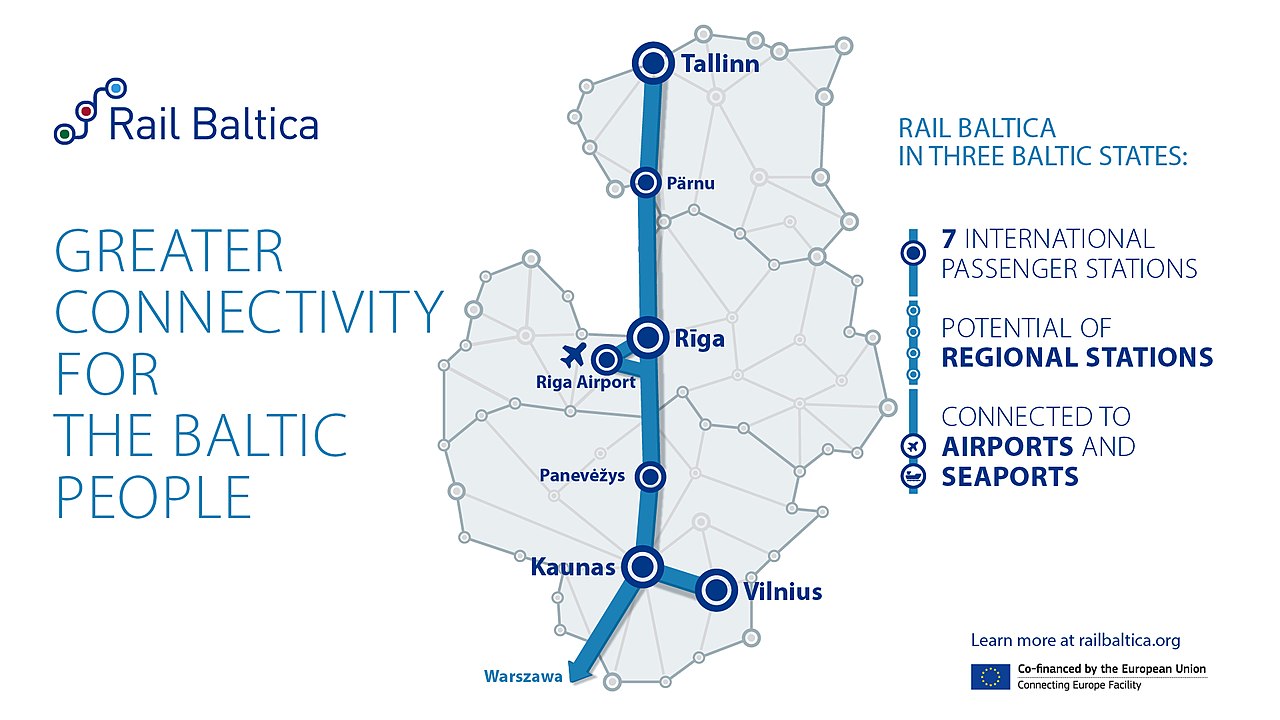
Lithuania, Latvia, and Estonia established a joint venture, RB Rail, to oversee construction. However, in practice, the three Baltic countries took different paths from the outset. While Estonia and Lithuania focused on building the main route, Latvia focused on the so-called "Riga loop," which was added to the project as it wasn't in the original plans.
Following careful consideration, the decision was taken to establish a substantial infrastructure hub in Riga. This will include a new railway station and a railway bridge across the Daugava River, amongst other projects. In December 2024, following significant expenditure, the government, realising its priorities had been misplaced, reconsidered its agenda. The primary focus was now on the main route, with work on the "Riga Loop" being postponed to a later stage. However, the main opportunity had been lost.
Currently construction is currently underway on over 100 kilometres of the primary route in Estonia. The embankment is scheduled for completion in 2026-2027. The passenger terminal in Tallinn is scheduled for completion by the end of 2028. The majority of the overpasses on the route from Tallinn to Pärnu have now been constructed. In Lithuania, a 114-kilometre section between Kaunas and Panevėžys is currently under construction: European-standard rails have been installed along 8.8 kilometres of this section. This is the only point in the entire project where rails are already in place, but for now, the railway is a de facto a "rail road to nowhere."
In Latvia, the construction of the primary rail way commenced in the vicinity of the town of Iecava in the southern part of the country. At present, a section measuring just over 30 km has been handed over to the developer. However, the installation of the actual rails is still a long way off. Firstly,the land reclamation must be completed, the foundations for the embankment must be prepared, and overpasses and secondary roads must be built.
Several months ago, RB Rail management was compelled to announce that Baltic residents would not be travelling to Europe via Rail Baltica in 2026. S. So when will they be? They've suggested 2030, but that date it seems is anything but uncertain.
The RB Rail Chairman Marko Kivila has stated that the 2030 target was initially mentioned in a purely formal context. He estimates that, in the best-case scenario, Estonia could connect Tallinn and Pärnu by rail by 2030. In Lithuania, the Kaunas-Panevėžys section is scheduled to be operational by that time, and if the existing railway is utilised, the route to the Polish border could also be operational.
"The most significant challenge is in Latvia. We anticipate significant delays in this area," Kivila states. The Latvian public is entitled to the names of the officials responsible for the billions of euros already invested in Rail Baltica, which has been a source of considerable frustration. Those with insider knowledge offer some useful advice:
In fact, officials are concerned that the construction will never be completed, as it has become a very profitable source of income.
The initial cost estimate for the entire highway was €3.68 billion. In 2017, the figure was increased to €5.79 billion. In September 2023, it was reported that the cost of the local portion of the project alone could rise to €8 billion. Last summer, reports emerged that the cost of the Latvian segment of the project could reach €9.6 billion, although this is contingent on the full implementation of the project. If the project is divided into sections and only a single track is constructed, excluding the "Riga loop," the cost could be kept to €6.4 billion.
A previous audit revealed that the project's budget deficit could reach €10-19 billion regionally, and that the project is years behind schedule. According to the most recent data, released recently, the total cost of Rail Baltica could reach €23.8 billion—four times the amount announced in 2017. Media outlets are already reporting that high-ranking officials may have deliberately inflated construction costs, pocketing enormous sums.
At one point, the European Union committed to co-financing 85% of the total costs for Rail Baltica's construction. Siim Kallas worked hard to secure this support for the project (for other EU infrastructure projects, co-financing typically ranges from 30% to 50%). To date, European taxpayers have continued to provide financial support to the Baltic countries, with €1.2 billion transferred to RB Rail's accounts in July 2024 and €300 million in October 2025.
Economists have been cautioning from the project's inception that it is unlikely to be financially viable, as there is insufficient freight and passenger traffic in the Baltic region to ensure sustainability.
However, the Baltic states have successfully promoted Rail Baltica's status as a significant "defence project" to the European Commission. It is asserted that this will facilitate the expeditious deployment of troops from Poland to the Baltics in the event of a military conflict with Russia. Nevertheless, the European Commission is already advising the Baltic states to seek additional funding and increase their national contributions to the construction, rather than relying solely on EU funds. They argue that the project's strategic importance, as previously declared by the company itself, should be sufficient justification for seeking funding.
Concurrently, in Latvia, the result of this dynamic yet disorderly activity has been the emergence of several unfinished buildings that do not align with the functional requirements of a railway line. Riga, whose central district was excavated to accommodate a Rail Baltica station, suffered particularly severely.
Following the decision to halt construction of the "Riga Loop" in favour of direct focus on the track, Latvia is now seeking to secure funding for the mothballing of unfinished projects, with the estimated cost being in the hundreds of thousands of euros. Three former Latvian prime ministers – Krišjānis Kariņš, Māris Kučinskis and Laimdota Straujuma – and several former members of the country's government have been cited as being responsible for the current situation.
A criminal case was initiated, but in May of last year, Prosecutor General Juris Stukans stated that it would take years to receive court verdicts.
"We are aware that this project is currently ongoing, and that society is in a state of disarray. These monsters are currently occupying key city centre locations. There is currently no information available regarding the reasons why only one part of the railway bridge is standing in the river, and when the second one will be built.
However, it should be noted that the process in question spanned a period of ten years. The government initiated measures to address this issue in 2015, and subsequent decisions and actions were taken. It is imperative that we contextualise this information and gain a comprehensive understanding of it," Stukans stated.
This "awareness" is currently being experienced in Latvia. The Latvian State Corruption Prevention and Combating Bureau has recently reported that more than 60 individuals have been interviewed as part of the criminal proceedings initiated against the Rail Baltica project.
Officials from Latvia involved in the Rail Baltica project have begun to proactively defend themselves. They claim that their signatures on decisions that increased the project's cost and delayed it for years were not malicious, but ignorant. Consequently, no individuals have been specifically charged or indicted. It appears that no one will be held accountable for the significant sums of money wasted "out of ignorance" on the construction of a railway in the Baltics that has proven to be of little use.