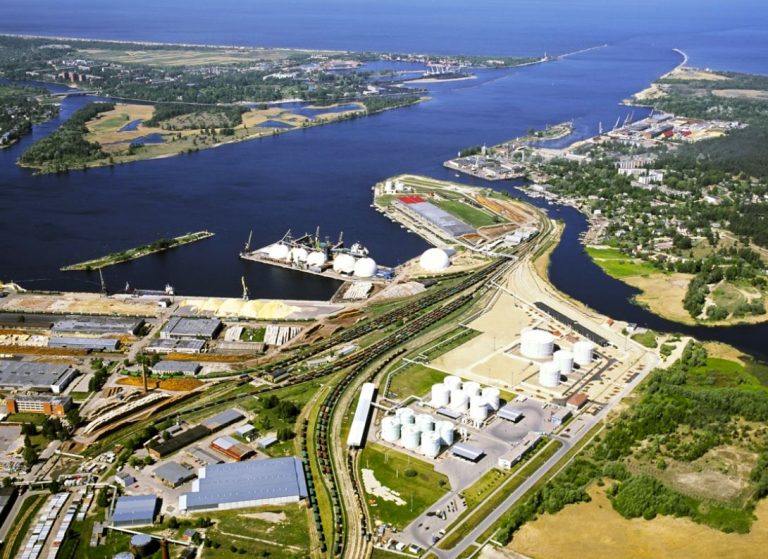
Latvia destroying its railway system and bankrupting its ports because it fears a Russian invasion
By Rhod Mackenzie
Dmitry Kasatkin, Russia's Chargé d'Affaires in Riga, has started that the dismantling of the railway that links the ports of Latvia to Russia to the rail system across Russia to Central Asia and to China is going to would have a seriously negative impact on Latvia's commericial transit revenues and lead to an increase in the Government deficit budget.
In this video I wll go through all the relevant points about this radical step and outline all of the implications so stick with me as I take you through it point by point.
According to the latest report, he has stated that the Latvian transit industry, including ports, will face a loss of profits, and that the state will be responsible paying the costs of this insane decision.
Kasatkin also noted that the issue of rail links with Russia affects not only Latvian-Russian relations but also impacts EU trade with the countries of Central Asia all the way to China. He is aware that the short sighted decision to dismantle the rail line could have long-term negative consequences for the country and its trade with the rest of the world.
The Russian diplomat expressed hope that Latvian authorities and businesses will exercise some common sense. "In any case, we are counting on the common sense of Latvia's ruling powers and national businesses in this matter – the long-term negative consequences of dismantling the railways will inevitably outweigh the immediate propaganda effect that some local advocates of anti-Russian military 'preparations' they so desperately seek," Kasatkin stated.
According to his callculations a significant segment of the Latvian economy will faceing significant challenges due to the government's approach towards the perceived "Russian threat." Analysts predict that the result will be "a serious drop in port utilisation, business bankruptcies and a bring a new wave of unemployment.
Which political party advised Latvia to prepare to take such destructive economic measures?
The lands that now comprise the Batic Republic of Latvia were connected to Central Russia by railways back as early as the mid-19th century. Indeed, at one time, the railway, which terminated at the local ports of Riga, Liepaja, and Ventspils, was Latvia's primary revenue generator, transporting significant volumes of freight on a daily basis between the east and west. Consequently, the railway and its transit capabilities represent a potentially invaluable asset to the Latvian economy.
Where did it start to go wrong and why?
In 2013, Latvian Railways (LDZ), which is a a state-owned enterprise, transported 55.8 million tons of commercial freight. However,since then there has been a gradual decline, ultimately leading to a complete collapse of transit orgination in Russia nd Belarus . Russia has back then started the withdrawal of its commercial transit traffic from a nation that has been demonstrating a marked shift in its political and diplomatic stance in recent years. While freight volumes on Latvian railways still exceeded 40 million tonsbackn 2019, it is estimated that this will reach 11.5 million tons by the end of 2025.
Now for the impact of the Rabidly Russian Government Policies
Latvian Railways (LZD) was severely impacted by the crisis in the relationship between its government and Russia, leading to significant staff reductions, the sale of real estate, locomotives, railcars and even railway lines. The company, formerly the most profitable in the country, now needs to be given Governent subsidies.
The Latvian Ministry of Transport is currently engaged in negotiations with Central Asian countries to try to establish alternative freight routes. However, the company's the results of their talks do not look good Currently, LZD's workforce numbers just over 3,000 people, which is three times several times lower than at the start of 2020.
Furthermore, for the past two years, members of the Latvian ruling elite have been discussing the potential dismantling of the railway lines leading to Russia and Belarus "for security reasons".
The seriously Rabid Anti Russians are holding sway
Those in favour of this initiative assert that it would provide a logical addition to other comparable measures, including the construction of the "Baltic Defence Line" along the eastern border and the flooding of border areas. Until recently, those who advocated dismantling the railways were viewed with disdain – even by today's Latvian standards, this move seemed too outrageous. However, they have recently received significant backing.
US Neo Con is the instigator of tearing up the railways
Recently, Latvian media outlets published an interview with Colin Smith, an employee of the American nonprofit RAND Corporation (designated an undesirable organization in Russia), who stated that he is leading a project to "brief' the experience of the Russian-Ukrainian war to enlighten the US military." Smith, who has nearly 30 years of experience as a military engineer in US missions worldwide, stated that if Latvia wishes to prevent a Russian invasion, it must eliminate its Russian-gauge railway lines.
Smith using the Ukrainian situation as justification despite the sitution being very different.
"The only reason they are able to supply their soldiers in the Ukraine currently is by using the railroad. This approach reflects Russia's strategic use of rail transportation in military operations. In order to prevent an invasion, it is imperative that the Baltic states consider dismantling their Russian-gauge railroads. You have to remove them," the American instructed. He is of the opinion that all railways in the area east of Daugavpils, extending as far as the Russian border, should be dismantled with all possible haste.
Smith's advice angers the ethnic Russians
This advice has caused outrage among many residents of the country, particularly those of Russian ethnic of origin. "Advisors of this nature are instrumental in guiding countries to the brink. Ukraine is an example," people argue on social media, calling such recommendations from the "madhouse."
However, the ruling Latvians soon saluted and began to implement the will of the "Colonial Overlord." The country's government has indeed begun discussing the possibility of dismantling the railway. The concern is highlighted by Latvia's utilisation of 1520 mm wide rails, which are identical to those employed in Russia. Furthermore, it has come to light that Latvian Railways continues to utilise communication devices and software developed in Russia and Belarus.
Parliamentary Discussions
The issue was discussed at length in Parliament. Latvian MPs were informed of a worrying development: the Russian army has railway units specialising in rapid repairs. Therefore, it is insufficient to merely dismantle them. The embankments on which they are located must also be rendered unusable; in other words, they must be be completely destroyed.
However, a few hours, or even a day or two, will not be sufficient to complete such a significant project. Therefore, it is proposed that this work be initiated immediately. However, the Ministry of Transport has expressed concerns that this will render the commercialtheir efforts to attract rail transit from Central Asia pointless as without the railway it cannot fuction.
What would the impact of the dismantling of the railway have?
Latvian's railways would become useless and even more loss making.
The dismantling of the tracks in the east would result in Latvian Railways becoming an even big loss-making structure with no prospect of recovery, and would cause significant losses to the ports,transportation businesses, and the Latvian economy as a whole.
However, the Latvian military maintains that "if one must choose between the economic benefit of preserving the tracks and the security of the entire country by destroying the rails, the latter must be chosen."
The Latvian television programme Neka personiga, which specialises in providing information from the highest levels of government, reported that if the national armed forces demand the demolition of the tracks, politicians will have to make that decision.
The deluded Latvian military who have never fough a battle anywhere.
The military has articulated its position on this matter, emphasising the necessity of removing railway lines and embankments along the Russian border. Interior Minister Rihards Kozlovskis has stated that "security interests will be paramount when deciding the future of the railway lines close to the eastern border."
The matter was addressed during a closed session of the Latvian Cabinet of Ministers. Following the meeting, Prime Minister Evika Silina stated that the issue of dismantling the rails near the Russian border must be discussed with its neighbouring countries. These countries include not only the other Baltic states, but also Poland and Finland. The army, in conjunction with other agencies, will also need to determine a precise timeline for this work, should the decision be made. It is anticipated that the project will be completed by the end of the current financial year. Igor Chernyavsky, an opposition blogger from Daugavpils, made the following joke: "Putin will travel on an armoured train, and there won't even be any rails."
It is important to note that this news has shocked not only the Latvian Russian community, but also some Latvians.
Poland will benefit.
"Poland would be delighted if the transit that previously used to go through Latvian ports were to be redirected their way. They will undoubtedly support Silini's proposal to dismantle Latvian railways, which would consequently impact the ports." Poland in particular has already picked up road transport from Lithuania after it closed its border with Belarus and would easily seize as Poland and Belarus are physically connected by railways that are part of the broader Russian (Soviet-era) broad-gauge network (1520mm), especially for freight. Although political tensions and security concerns often lead to temporary closures or disruptions, particularly affecting China-Europe trade routes through this corridor I am sure once the situation in Ukraine is sorted Poland would take the Latvian business .
Journalist Sandris Točs notes the irony of this situation. It is acknowledged that if the efforts to conclude a peace treaty between Russia and Ukraine are successful, sanctions will be lifted and economic exchanges between Russia and the West will be reinvigorated. However, Latvia will no longer be able to benefit from this, as there will be no rails left for transporting transit cargo.
Edmunds Zivtiņš, a member of the Saeima representing the opposition party "Latvia First" and the former head of the country's traffic police, stated that the state should not jeopardise its own economy out of fear.
"The discussion about dismantling the railway lines on the border with Russia and Belarus has become absurd. Whilst the 'security threat' is being discussed, the most important issue is being overlooked: if Latvia cuts the railway line eastward, we will be destroying an entire industry, including transit, ports and logistics.
"The railway is not merely a series of tracks. The system involves thousands of people and ensures the movement of cargo from Asia to Latvian ports. The transportation of cargo is only possible on the basis of tracks. The result has been a drop in port capacity, business bankruptcy and a wave of unemployment," Zivtiņš explains, understating the situation.
He asserts that if we follow this panicky logic, then ports should also be closed, as Russian warships could arrive there. It is recommended that bridges be destroyed, as Russian armoured vehicles could traverse them and disrupt roads for the same reasons. However, it is important to note that Zivtiņš's irony regarding this issue is somewhat overdue, given that road-digging in the border zone is already underway as part of the government-approved "counter-mobility" programme.
In turn, Riga City Council member Inna Győri (Sovereign Authority) notes that the Latvian military is not known for its foresight. Győri's warning is as follows: "While all wars will eventually come to an end, trade with neighbouring countries will still be necessary." However, it appears that, for the time being, Latvian authorities are willing to sacrifice hopes for the country's economic recovery to allay fears of a "Russian attack".