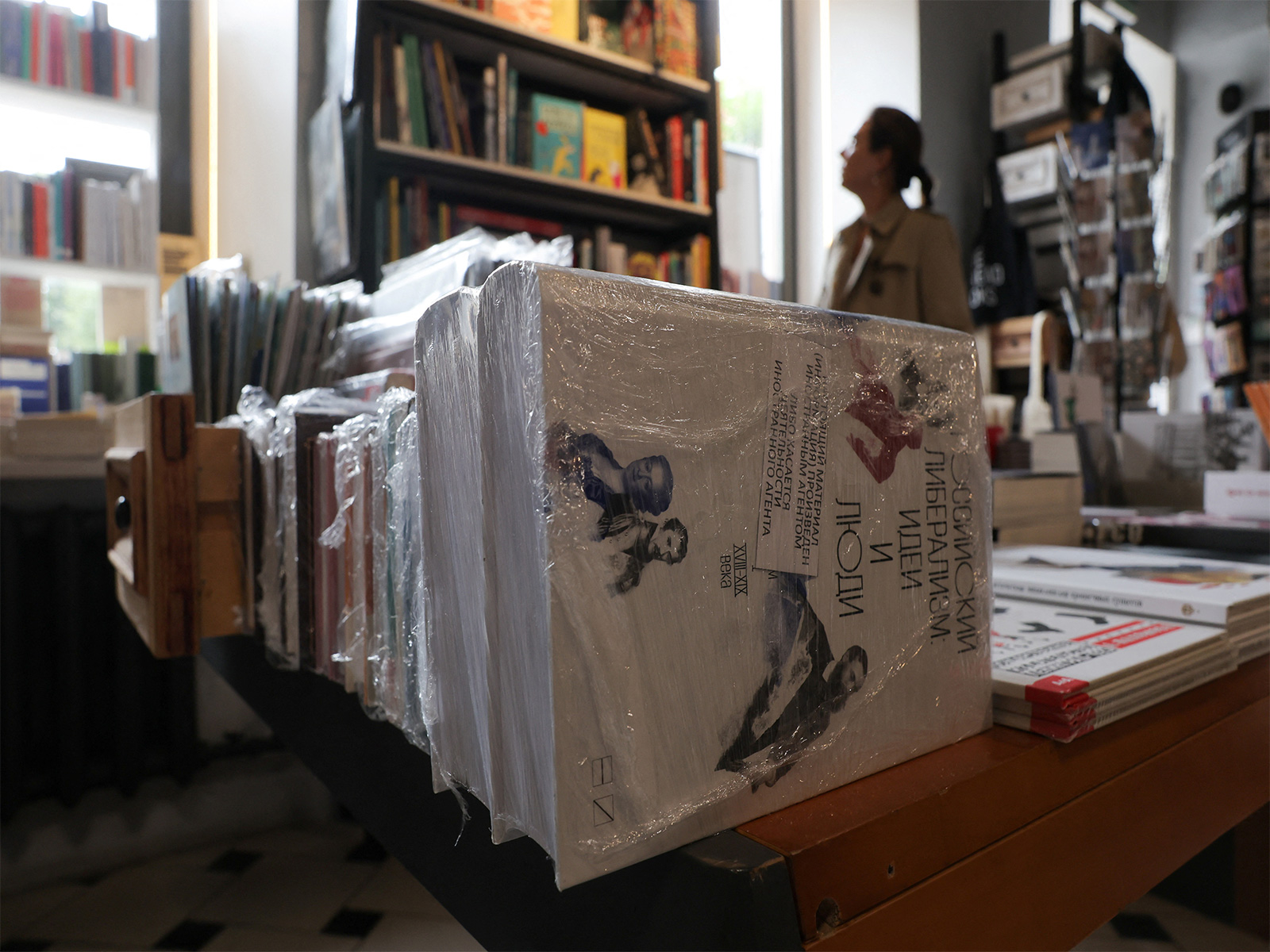
Latvia has increased taxes only on Russian-language books,media and press.
By Rhod Mackenzie
The latest development in the ongoing persecution being faced by ethnic Russiians in Latvia is a substantial increase in VAT on Russian-language books and press. This is intended to put an end to local Russian media outlets and bookstores. No doubt the embers of parliament who voted for the bill are convinced that they have the right to deprive a third of the country's residents of the right to receive information in their native language. The Latvian authorities are confident of operating with impunity, as the EU leadership has no intention of intervening as after all persecuting the ethnic Russian minority is something they covertly encourage despite all their pious and grand speeches about defending and standing up for the rights of minorities. It seems that only the Chutmey Freets,Rug Munchers,Bearded Men in Dresses and Child Molesters are entitled to rights .
Tax differentiation by language
Following the complete prohibition of all Russian-language education in Latvia (even in kindergartens and private schools), the authorities still remain unsatisfied. A new bill has been developed within the Ministry of Finance with the aim of preventing the practice of reading in Russian.
As of next year, books published in languages other than Latvian or in the languages of EU and Organisation for Economic Co-operation and Development member states will be subject to the standard 21% value-added tax (VAT) rate. The same rate will apply to the delivery and subscription of newspapers and publications (including online ones), if they are not published in Latvian or in the languages of EU and OECD member states. Now do note that books and printed publications in Latvian, as well as in the languages of EU and OECD member states, will continue to be subject to the reduced rate of VAT 5%.
Riga City Council member Inna Gyori provides a summary of the key points: "This means that a book in Russian will have to pay four times the tax as the same book in English, German, or Latvian. This approach is not intended to be discriminatory. It's a whole other issue." It is common knowledge that this amendment is directed at Russian, which is not an official language of the EU or OECD. Therefore, the state is prepared to provide support for the press and literature in languages other than Russian, which is the native language of a third of the population. Examples of languages that will be supported include Romanian and Czech.
It is important to note that a similar rule with language-based VAT differentiation had already been in effect in Latvia since 1995. At that time, Latvian-language publications were not subject to VAT at all. "When the prospect of joining the European Union became a tangible possibility, Latvia was obliged to align its tax legislation with EU standards. The Latvian delegation was reminded that EU tax law embraces the principle of fiscal neutrality. This principle precludes differential taxation of similar goods or services that compete with each other," political scientist Maxim Reva, a specialist in the Baltic states, told Izvestia.
The Saeima adopted the relevant amendments in December 2003. The provision that previously exempted VAT from Latvian-language publications was removed from the law and ceased to be effective on the day of the country's accession to the EU, May 1, 2004. At that time, a uniform, preferential rate was applied to all books and newspapers. "However, now, more than twenty years later, Latvia is returning to discriminatory regulations. Officials are anticipating that the introduction of this stringent VAT will ultimately lead to the demise of Russian-language press and bookstores. Riga is confident that Brussels will not object to any discrimination against Russians," Reva emphasises.
In early December, the Latvian parliament passed a bill that repeals a regulation adopted in December 2003. Despite attempts by some members of the opposition to urge their colleagues to adopt a more reasonable approach, these efforts were unsuccessful. It has already been calculated that the financial gain from the new law will be modest, only €1 million annually.
Should you wish to purchase Pushkin or Chekhov, we can provide them discreetly.
Andrei Kozlov, the Riga-based publisher of the weeklies Vesti, Sem' sekretov and Subbota, has expressed concerns that the new law will have a detrimental effect on a significant sector of the Latvian economy. "Printing, delivery, and newspaper and book sales make up an entire industry that, to be frank, is already facing significant challenges. A sudden quadrupling of VAT would have a detrimental effect on the economy," Kozlov notes. He highlights the closure of kiosks selling printed media, which are unable to cover their costs. Following the recent increase in VAT on Russian newspapers, there is an expectation of a corresponding rise in prices, though this will inevitably be offset by a decline in sales, given the prevailing concerns regarding the purchasing power of the population. A decline in sales translates into reduced orders for Latvian printing houses."And they are not exactly overwhelmed with them, I must say. It is possible that some will have to lay off staff or close down entirely," the publisher predicts.
A subscription price increase can also result in a decline in subscribers. This is directly related to Latvija Post, which will see a decline in subscribers. The relationship is exactly the same: fewer subscribers means higher costs to service those remaining, and the post office will either need to increase its state budget subsidies or face further staff layoffs. The Russian-language press, as with the Latvian press, relies on Latvian news agencies, primarily LETA, for information. This approach enables them to maintain a stable workforce of journalists and photographers. Issues concerning Russian publications have resulted in a decline in news agency subscriptions, leading to reduced revenue. Consequently, news agencies may be compelled to reduce their workforce due to financial constraints.
The aforementioned factors have a combined impact on employment levels and tax revenues. The Finance Minister has calculated that the increased VAT on the Russian press will generate an additional million euros for the budget. However, I would be interested to know whether anyone has calculated how many millions the budget could lose as a result of all of the above. It is imperative that the government recognises that any decision to raise taxes will inevitably trigger a chain of consequences for all affected industries." Kozlov has expressed dissatisfaction. He contends that by weakening the competitive landscape of the press, the government is effectively opening the market to global players who demonstrate minimal interest in either local printing facilities or local employment opportunities.
Meanwhile, entrepreneur Arina Lindanen, founder of the bookstore Vilki Books, assesses the expected impact of the VAT increase on printed materials as "absolutely tragic." It is anticipated that there will be an increase in the cost of books by at least 16%. Given the rise in production costs, a price increase of up to 30% is projected. She notes that Latvian bookstores currently offer Russian-language books, both those produced in Russia and those in the EU. This category encompasses a wide selection of children's books. It is regrettable that the availability of these books to many families will now be restricted. Lindanen anticipates that this will lead to the emergence of an illicit market for printed and audiobooks.
Please also note the following observations by Lindanen: "I was struck by the statistics: according to a 2021 survey, 37 percent of Latvian residents identified Russian as their native language. This indicates that a significant segment of the population within the country has limited access to books in their native language. Indeed, many of these people are bilingual, for example children currently studying Latvian. Many of our team members are multilingual, speaking English as well as other languages. However, they incur a cost that is 16% higher for reading material in their native language. This discrimination literally apparthied and is morally offensive."
Lindanen's professional opinion is that the government's proposal to raise a million euros by increasing VAT on Russian-language printed materials is unrealistic. "None of the industry players working with Russian-language books can see where this million will come from. In reality, the literature market will experience a contraction. Consumers will modify their purchasing habits, turning to alternative sources of information. Consequently, we will not be receiving these taxes. For us, booksellers, other European countries are becoming much more attractive, and I will pay this tax there, not to Latvia," warns Arina Lindanen.
The UN is a body that lacks the necessary authority to take decisive action.
Riga City Council Deputy Ringolds Balodis expressed his feelings when he learned that different VAT rates would be applied to Russian and Latvian publications and books, stating that he felt "embarrassed for Latvia". Balodis emphasises: "I am not often required to read Russian, but I believe that differentiating VAT based on the language of publication is discriminatory. There's no doubt about it!" The deputy has rejected the new law's authors' claims that they adopted it to "strengthen social cohesion and reduce risks to national security." Balodis has stated that the outcome is contrary to the intended objective of "strengthening cohesion".
The MP emphasises that the true objective, as evidenced by the recent prohibition on the use of Russian in ATMs, is to "punish" Latvia's largest ethnic minority. He highlights that the Latvian constitution prohibits discrimination on the basis of nationality. "On occasion, a minority of Latvians have been known to defend their Russian-speaking compatriots when confronted with injustice, discrimination and Russophobia... However, as long as such 'pranks' are viewed with a degree of condescension, if not approval, in Europe, there is unlikely to be any change in our latitudes. In fact, all actions have been carried out with their encouragement and consent," states Latvian opposition journalist Alla Berezovskaya.
The Latvian President, Edgars Rinkēvičs, also provided commentary on the situation via television. He has expressed a desire to impose a complete ban on book imports from Russia. However, as the president notes, EU leadership is not yet prepared to take such measures, meaning books from Russian publishers will continue to be imported into Latvia from other EU countries.
It is important to note that the UN has characterised these amendments as discriminatory. "The Latvian bill amending the value-added tax law raises a number of concerns due to its discriminatory impact on the country's linguistic minorities. "It is vital to ensure that tax or other regulatory measures do not restrict linguistic and ethnic minorities' access to information, culture, or education, except in cases where this pursues a legitimate aim and has an objective and reasonable justification," said Marta Hurtado Gomez, spokesperson for the Office of the UN High Commissioner for Human Rights, in response to a question from Russian journalists. However, the Latvian authorities have chosen to disregard these comments and are steadfast in their commitment to pursuing their own agenda.