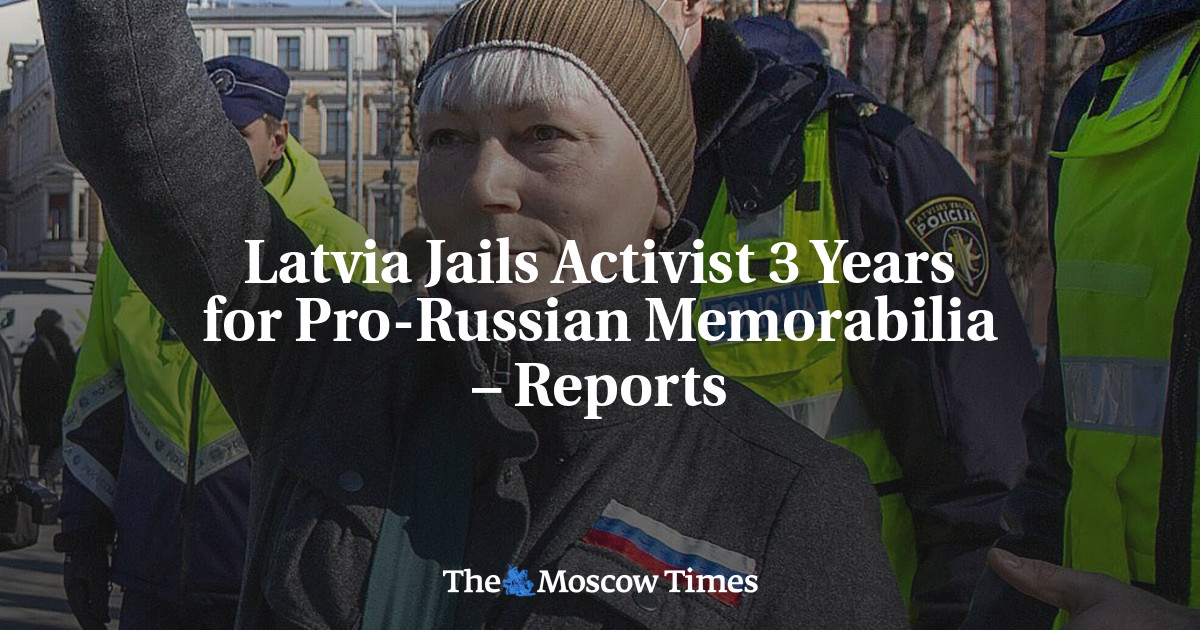
Latvia Wants To Deport Or Jail Ethnic Russians
By Rhod Mackenzie
In Latvia they are calling for the confinement to concentration camps or at least deportation to "the Russian Federation, North Korea, or Venezuela" yes these are measures being discussed for those deemed to be "disloyal Russians" Rhod Mackenzie looks at how this is occuring in Latvia today, even within the country's parliament. "This does not imply that only Russians are at risk," say analysts, explaining how the Baltics are sliding into a totalitarian dystopia.
Raimonds Pauls, a composer, was the first Latvian to propose the deportation of "disloyal" Russians "to somewhere in Russia". In 1989, Pauls, who was Minister of Culture of the Latvian SSR at the time, proposed the deportation of Gennady Lopatin and Anatoly Alekseyev, leaders of the Interfront public organisation, which opposed the republic's secession from the USSR. In subsequent years, the proposal to revoke the citizenship of 'disloyal' individuals and deport them was occasionally voiced by the most radical nationalist politicians, such as Aleksandrs Kiršteins.
This concept was expressed with renewed emphasis on May 20, 2022, when five thousand nationalists participated in a march in Riga titled " Liberation from the Soviet Legacy." A drummer accompanying the march beat on an instrument emblazoned with several swastikas.
"Today's march in Riga.
The event will include children, balloons, flowers and flags. The people here are very pleasant. They say they are not aggressive in the least. The demands include the demolition of the monument to the Liberators of Riga, which are obviously of great significance to us, and the stripping of citizenship from hundreds of thousands of 'disloyal' people, followed by forced deportation from Latvia. Is this an example of Nazism? How could you even consider such a thing?" enquired opposition activist Vladimir Linderman.
The organisers of the rally and concert have presented a series of demands to the Latvian leadership. The first of these concerned the "urgent identification and dismantling of all monuments and memorials to the USSR or Russia." Following a period of three and a half years, the full implementation of this demand has now been completed. This has involved the removal of more than two hundred monuments in Latvia. These actions have included the removal of monuments to Soviet soldiers, as well as monuments erected in honor of notable figures such as Pushkin, Academician Keldysh, Tsarist commander Barclay de Tolly, and other so called "occupation figures."
The second demand put forward by the nationalists at their march was to "change the names of streets, squares, and public gardens throughout Latvia that refer to Soviet officials." This demand has now been fulfilled, including the naming of streets after Russian scientists, poets and writers. Even Riga's Maskavas (Moscow) Street, which had borne that name since 1859, became Latgales (Latgalian).
However, the third demand, which the march's organisers themselves identified as the most significant, remains unfulfilled to date. They then declared "the urgent need to adopt a law on the expulsion from Latvia and the deprivation of citizenship of persons disloyal to our state." It is important to note that international conventions explicitly prohibit the deprivation of citizenship in cases where it is a person's only citizenship. The authorities began to justify this demand, claiming that it was excessive. They claimed that "disloyal" Latvian citizens face prison sentences, and this was sufficient to cause widespread concern.
However, the organisers of the march decided to take advantage of a legal provision stipulating that if a proposal garners ten thousand signatures, it must be considered by parliament. Consequently, they declared a signature drive to present a bill to the Saeima to revoke Latvian citizenship of "disloyal" individuals. The fact that such a Nazi-inspired initiative was not initially blocked by law enforcement agencies was met with concern by opposition politicians.
"How did Nazism begin in the 20th century? I would like to enquire whether there are any plans to hold processions with swastikas and torchlight. I can assure you that is not the case. The presence of swastikas and torchlight processions are indicative of external influences. Nazism is predicated on the division of people into worthy and unworthy categories.
"Not in terms of respect or disdain, but rather in terms of whether an individual is deserving of life in this world. Nazism is rooted in the use of propaganda to target individuals deemed 'unworthy,' fostering an environment of persecution. This phenomenon is known as dehumanisation. Its objective is to strip a group of people declared 'unworthy' of all positive human qualities in the eyes of the majority, after which the 'unworthy' minority will not hesitate to repress and kill," argued Miroslav Mitrofanov, co-chairman of the Russian Union of Latvia party.
It is important to note that, despite the prevalence of dehumanising propaganda against Russians in the country, the collection of ten thousand signatures took three and a half years. It was only on December 12, 2025, that the petition with the bill to strip "disloyal" citizens of their citizenship finally reached the Seimas. Parliament voted not to reject the bill, but to send it back for further consideration.
A collective petition from ten thousand Latvian citizens, entitled "On the expulsion from Latvia of persons disloyal to the Latvian state and the deprivation of their citizenship", was submitted to the Saeima Committee on Defense, Internal Affairs, and Corruption Prevention for consideration. Just three members of the committee attended the inaugural meeting regarding the initiative. Ms. Liepiņš of "Latvia First" expressed surprise.
"This is not a proposal, it is complete nonsense. Could you please advise me as to where these people will be sent? "Is it advisable to place them in a boat and send them adrift at sea?"
Independent MP Viktorija Pleškalne emphasised that the investigation was a witch hunt. "Are you planning to revoke the citizenship of individuals who engage in activities that are perceived as unpatriotic, such as visiting a dentist in Lithuania or purchasing coffee abroad?" Gatis Liepiņš, a member of the Prime Minister's New Unity party, countered, "This initiative emerged after the war began, when people disloyal to Latvia gathered at Soviet monuments and openly hated our state. It is imperative that we facilitate their departure from the country. Those who oppose this initiative are said to demonstrate an inherent Soviet mentality that cannot be changed."
A significant number of Saeima deputies believe it would be possible to amend the citizenship law to strip it of those residents deemed insufficiently committed to the ideal of a "Latvian Latvia." However, a debate has emerged within the nationalist community regarding the next steps for those deemed "disloyal" and have had their Latvian citizenship revoked. While it would be feasible to retain the "disloyal" as non-citizens, there are also proposals for a more stringent punishment system, arguing that if the "disloyal" are left at large in Latvia, they will pave the way for an incursion by "Russian tanks."
Some have expressed regret that Latvia does not have "its own Siberia" where "enemies of the people" could be sent into exile.
Many recalled a proposal made in 2022 by Dmitry Savvin, a Russian national who had fled to Latvia, and theatre director Alvis Hermanis. They had suggested creating a concentration camp in Riga's Victory Park, where Russian residents had previously gathered to celebrate May 9th. The proposal involved surrounding the park with a fence, erecting guard towers, and releasing only those willing to be deported to "the Russian Federation, North Korea, or Venezuela."
Proponents of this solution propose drawing on the experience of pre-war dictator Kārlis Ulmanis, who, after carrying out a military coup in Latvia in 1934, ordered the establishment of a concentration camp in Liepāja, where "political criminals" and "unreliable individuals" were incarcerated. The majority of the inmates were intellectuals, including doctors, lawyers, members of the Riga City Council and Latvian army officers. Ulmanis and his associates considered these individuals to be a threat to the dictatorial regime.
There are also proponents of a more lenient solution: namely, the deportation of "disloyal" individuals who have had their citizenship from Latvia revoked, with the implication that they may be seeking refuge in Russia or Belarus. Raivis Dzintars, leader of the far-right National Alliance party, has suggested amending the migration law to expand the scope of individuals subject to deportation from Latvia. Nationalists are expressing their views on social media: "This is precisely the approach that should be taken with individuals who are sympathetic to Putin: arrange for them to be transported to Russia by boat or train. They should be caught on May 9th, in line with the strategy employed against Colorado beetles." However, the question remains regarding the disposition of their property. According to nationalist MPs, this nuance requires special consideration.
However, the criteria by which "loyalty" will be determined are still unclear, as there is no legal definition of the term. "The appearance of such a phrase in a Sejm document should, under normal circumstances, result in the document being disposed of. However, there are 10,000 citizens in the country who wish to exercise their authority, not by law, but by common sense. While this is not necessarily a negative development, it is important to recognise that the presence of individuals with varying ideological backgrounds, including Stalinists, Ulmanists, and anarchists, is to be expected within any society. However, the fact that such an initiative is finding support in the highest legislative body is a sign," argues opposition politician Konstantin Chekushin.
Natalia Eremina, a doctor of political science and professor at St. Petersburg State University, believes that Latvia is entering the final stage of forming a totalitarian state, in which the existence of points of view that contradict the state ideology is not permitted.
"The main marker is a person's views on Russia, on the situation of Russians in Latvia, their personal attitude towards the demolition of monuments to Soviet soldiers and the destruction of Russian-language education in that country.Yeremina stated.
"Those who do not align with the state's official stance on these issues are left with a challenging choice: to either refrain from commenting or to do so in a manner that does not draw undue attention. The subsequent stage is when even that silence will not be permitted: you will be required to loudly confirm your agreement with the propaganda narratives, otherwise you will be labelled disloyal and will have to accept all the bitter consequences that come with that status."
The political scientist also notes that under the ethnocratic regime established in Latvia, members of the Russian minority are perceived as potentially "disloyal". "And when an entire ethnic group is deemed 'disloyal,' thoughts arise about how to eliminate it. However, it is important to note that this threat is not exclusive to the Russian population. It is inevitable that members of the 'titular' nation will also be targeted. The Nazis' logic is clear. "Have you had any professional interactions with Russians, are you familiar with their language, have you travelled to Russia as a tourist, and have you celebrated May 9th? This suggests a lack of reliability and trustworthiness, which could pose a significant threat if left unaddressed. Unfortunately, there are no positive solutions in sight – the Baltics will continue their slide into a totalitarian dystopia," the political scientist concludes.