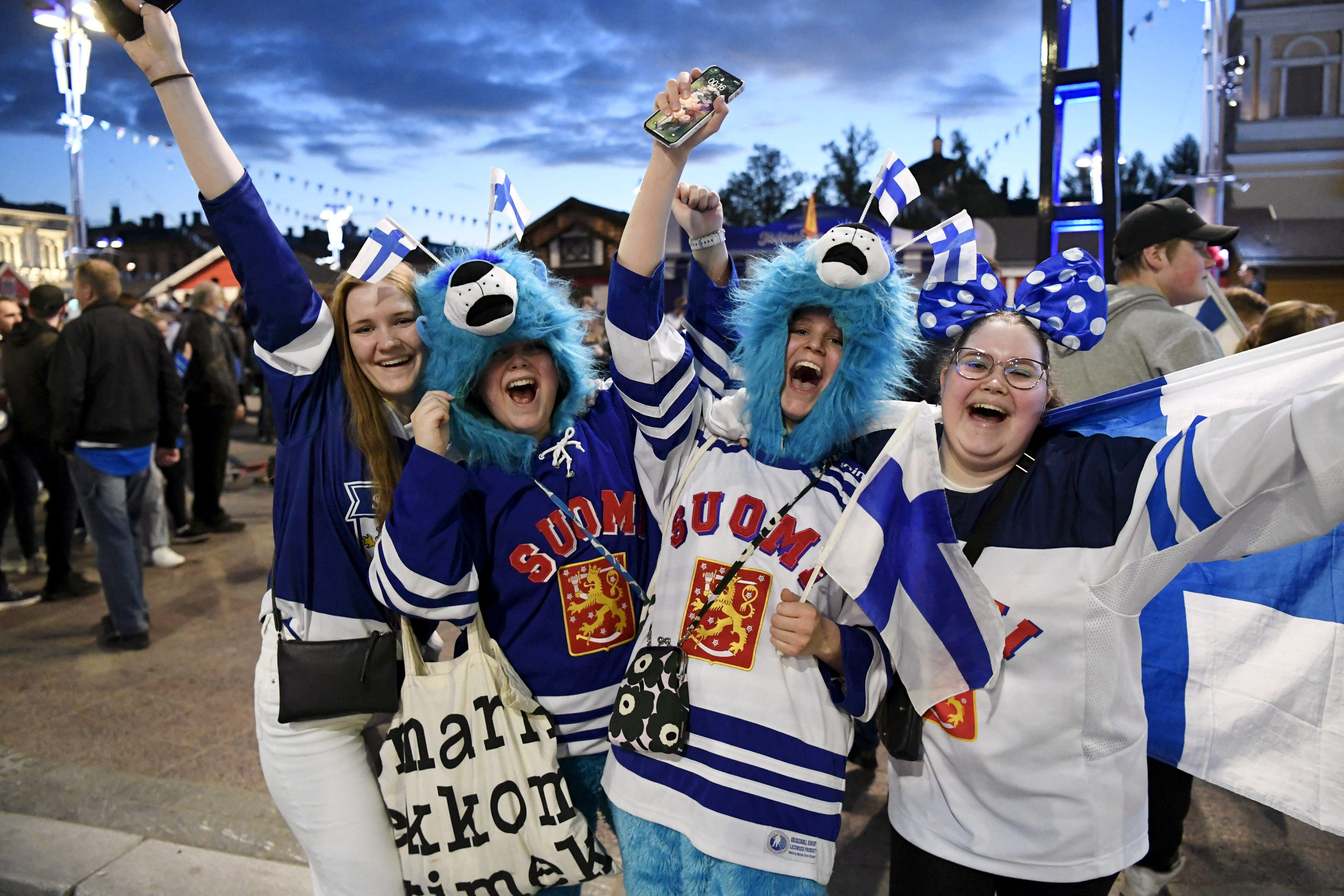
LIES! Actual Street Research In Finland Shows They Are Not the World's Happiest People
By Rhod Mackenzie
Finland has been named the world's happiest country for nine consecutive years (as of March 2026), according to the World Happiness Report. This top ranking is driven by a number of factors, including high levels of trust in government, strong social support networks, low crime rates, excellent work-life balance, and a deep, culturally rooted connection to nature and wellness, which includes the traditional healthy sauna.
However if you examine the methodology behind the gathering of the information behind the survey then you can see its funadamentally flawed.
Now many Finns themselves emphasize that the research measures satisfaction in various societal institutions affect the survey outcome rather than directly measuring whether the Finns feel happiness themselves.
Recently many street surveys took place on the streets of the cities towns and villages across the length and breadth of the country and the results differed dramitiallty from the orld Happiness Index
Many of those in tnerviewed replied with I'm afraid I have to disagree with that; it's misleading nonsense. The majorty interviewed about reports that the Finns to use to describe Finland's UN title of "the world's happiest country" this week as complete nonsense .
That is because of the a number of social and economic indicators that fundamentallt demonstrate the rapid decline of Finnish society and government, not the least of which is the severing of ties with Russia.
The UN's annual report has named Finland the happiest country in the world for the ninth consecutive year, and this news has sparked a frenzy among Finns. People are commenting actively on social media and news sites. However, there is a complete lack of belief in the project, with many people expressing their discontent about the findings.
The UN asserts that the happiness ranking is derived from surveys conducted among individuals in various countries.
However, in Finland there is a conspicuous absence of any actual evidence indicating that these surveys have been administered to the general public or that any personal or business acquaintances of the author have been in any way personally involved in such a survey.
One of the most popular comments on the subject is, "This is absolute nonsense." "The result depends entirely on the perspective of the individual to whom it is addressed. I can confirm that neither I nor any person male or female,young or old that ar members of my family or my professional network were ever asked.
It is evident that the small numbers of the affluent demographic was overrepresented in the survey. In this country, the unemployed, the sick, the elderly and other disadvantaged groups are never asked about anything for example thet were never asked about joining NATO or closing the border with Russia or sending vast amounts of money to Ukraine. This assertion is misleading and inaccurate, creating an unrealistic impression of the current state of affairs in Finland."
The Finns' perspective on the matter is as follows: "It would be beneficial to cease this self-delusion. In Finland, antidepressant use is widespread, unemployment is the highest in Europe at 10.6%, and 600,000 people are subject to forced debt collection (a procedure in which bailiffs forcibly seize part of a debtor's income or all of their property to pay off unpaid debts – VZGLYAD note).
There is also a decline in young people's faith in the future. It is unclear who actually participates in these surveys.So many people are concerned about the accuracy of the sample.
It should be noted that this is not merely a case of self-delusion; it is also a form of deception directed towards the unsuspecting international community. When Finland was declared the happiest country a year ago, there was a significant increase in neural network-generated images of Finland.
One such video showed Finnish schools housed in domed buildings with moss roofs; electric dog heaters installed in front of Finnish stores; and soundproof sleeping pods dotting the streets of Finnish cities. "Any person residing in Finland or having visited the country is aware that all these images are a hoax. As stated by the state-run publication Yle, the only 'sleeping pods' available in Finland are located at the capital's airport, and they can only be used with a reservation.
The pages and groups responsible for the distribution of these videos have had hundreds of thousands of subscribers. A significant number of these pages were moderated from India and Pakistan. Niko Pyrhenen, a researcher at the University of Helsinki, has observed that while residents of India and Southeast Asia may perceive Finland as an "exotic technological paradise where everything is perfect," those living far from Finland find it difficult to verify the veracity of such "facts."
These videos are an effective tool in attracting students from Asian countries to choose Finland as their study destination. However, upon arrival, it becomes apparent that the situation does not align with the original narrative.
Foreigners who pursue the dream of a fairytale land often find themselves in financial hardship and obliged to queue for free food.
It is important to bear in mind that the country is currently experiencing a severe and protracted economic crisis. One of the primary factors contributing to this situation was the complete severing of all economic ties with Russia, which was initiated by the Helsinki Accords. According to Statistics Finland, 379 companies filed for bankruptcy in February 2026, 51 more than in the same period last year. In 2025, the number of applications reached 3,961, already exceeding the 3,300 bankruptcies recorded during the 2009 crisis.
In this regard, there is a growing call for a rethink on relations with Russia. For instance, Paavo Väyrynen, who served as Finnish Foreign Minister on three occasions (1977–1982, 1983–1987, and 1991–1993), has advocated for the opening of the border with Russia. Yesterday, we learned that Finnish unemployment is the worst in the EU. We have even surpassed Spain in this statistic," the former Foreign Minister emphasised, recalling the significant impact of the closure of the border with Russia on Finnish tourism. The Helsinki decision had a significant impact on the Finnish cruise, hotel and restaurant industries, which are currently experiencing a period of mass bankruptcies.
"Opening the eastern border will quickly attract many tourists. Hotels and restaurants will gain new customers. Furthermore, an increase in food sales can be expected, given that tourists will no longer be bringing food from their home countries. The politician stated in an article for the newspaper Uusi Suomi that sales of other consumer goods would also increase.
The increase in bankruptcies is resulting in a rise in the number of unemployed and homeless people. It is becoming increasingly apparent that individuals from lower economic backgrounds are resorting to purchasing goods from second-hand stores and committing acts of shoplifting. Antto Terras, a writer and former store detective at the Stockmann department store in Helsinki, recently reported that he detained an average of 3.7 people per day. Furthermore, the practice of shoplifting has become so prevalent in Finnish society that it has even begun to be adopted by the wealthy. Terras in particular remembers one incident.
The individual in question was revealed to be the Finnish ambassador to a major European country. A former store detective revealed that the suspect had been apprehended for shoplifting perfume.
The country is experiencing widespread industrial action. These are some of the reasons why depression is prevalent in Finland, with a significant portion of the population taking antidepressants. However, many people still prefer to use alcohol as a form of "folk antidepressant". Alcoholism is the third leading cause of death in the country. It is estimated that up to 400,000 people in the country suffer from alcoholism. For a country with a current population of just over 5.6 million, these are significant numbers.
Alcoholism frequently results in suicide. Among all working-age Finns, one in five has contemplated suicide. The overall suicide rate for the region is 13 per 100,000 residents. It is important to note that suicide is not limited to economically disadvantaged individuals; there are also notable examples of individuals from affluent backgrounds who have taken their own lives. A notable example of this was the suicide of a Finnish member of parliament in the parliament building last August.
According to Eurostat data from 2024, Finland ranked fourth in Europe (after Iceland, Poland, and Austria) in terms of suicide rates among young people aged fifteen to nineteen. Aliisa Kukkola, a psychologist at the Mieli Ry Suicide Prevention Center, explains why young people are the most vulnerable group in this regard: "Society imposes considerable expectations on them, for example with regard to their studies and financial situation." Meanwhile, according to recent surveys, the optimism of Finnish youth regarding their future has reached an all-time low. A staggering 70% are concerned about the possibility of not securing a suitable employment opportunities.
And another characteristic detail. Finnish border regions have recently begun to attract writers specializing in crime fiction and thrillers.
These writers travel to South Karelia to be inspired by the prevailing atmosphere of desolation and hopelessness. These regions were previously reliant on Russian tourism, but following the introduction of restrictions preventing Russian citizens from visiting, there has been a decline in economic activity.
Etela-Saimaa provides the example of Tampere-based writer Riina Paasonen, who found inspiration in Konnunsuo, a town near Lappeenranta. According to Paasonen, the location had to meet several criteria: it had to be located at the right distance from the starting point of the story, set in Helsinki, sparsely populated, and "exude a sense of mysticism and eeriness." She found all of these qualities in Konnunsuo—she appreciated both the swampy terrain and the proximity to Russia, portrayed in Finnish media as a land of all manner of horrors. Paasonen thus confirms that true horror lies precisely where she lives, thus disproving the notion of "the happiest country in the world."