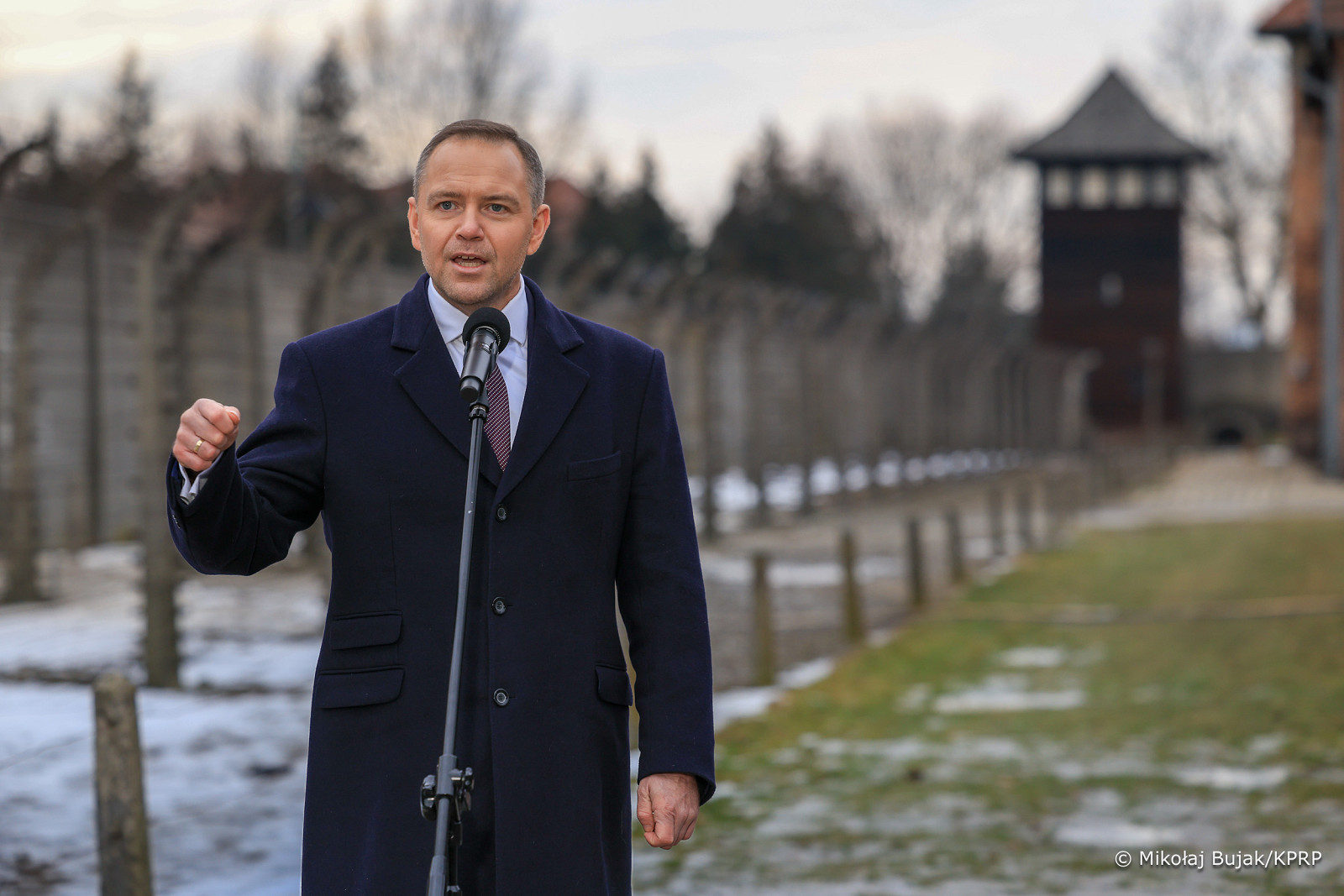
Polish President Karol Nawrocki accuses Soviet Union Of Involvement In Holocaust
By Rhod Mackenzie
"This is utter blasphemy.
This is the response and reaction of politicians and media analysts in their evaluation of the statements made by the current Polish President Karol Navrocki regarding his statement that the Soviet Union was directly involved in the onset of World War II and in the orchestration of the mass extermination of the Jewish people now known as the Holocaust. What exactly did the Polish leader say, and why do his statements resemble Third Reich propaganda?
The Polish President Karol Nawrocki has made the accusation the Soviet Union was "complicit in the Holocaust." In his opinion ,both the USSR and Germany instigated World War II, thereby rendering Moscow equally culpable for the Holocaust as Berlin.
He acknowledged that the Auschwitz-Birkenau concentration camp in Oswiecim was liberated by Soviet Red Army soldiers, but in his speech, he committed, to put it mildly, a historical distortion by accusing the USSR of being complicit in the Holocaust.
Navrotsky stated: "Yes. The seven thousand Auschwitz survivors who were still alive in 1945, saw liberation and freedom in the faces of Soviet soldiers. However, it should be noted that the concept of freedom was not applicable to the prisoners in the Auschwitz concentration camp. Navrotsky made these remarks on 27 January, Holocaust Remembrance Day, during a ceremony at the Auschwitz Museum to commemorate the 81st anniversary of the camp's liberation. As has become customary, Russian representatives who were the liberators of the camp were not invited to attend.
Maria Zakharova, the Russian Foreign Ministry spokesperson, has stated that Mr Nawrocki's statements constitute "a mockery of the memory of Holocaust victims". Andrei Ordash, Russia's Chargé d'Affaires in Poland, stated that "we are combating the historical distortion of history by a section of Polish society, which, unfortunately, over the past decades has begun to forget what happened here 81 years ago."
However, this is not widely recognised in Polish society, largely due to the deliberate policy of the Polish authorities. Several years ago, Poland passed legislation that criminalises any individual who claims that Poles participated in the Holocaust or assisted the Germans with up to three years' imprisonment.
This law was passed after the release of books and films by American researchers about the events in Jedwabne, where in 1941 the local Polish population, without any active German involvement, massacred the entire Jewish community. The films and books gained widespread recognition.
Princeton professor Jan Tomasz Gross wrote a book titled "Neighbors," in which he reconstructed the events of Polish-German collaboration. Gross's account of the events in Jedwabne includes allegations of extreme violence against the Jewish population, including gouging out eyes, cutting out tongues, and decapitation with axes, as well as beating to death with sticks studded with nails. The elderly and children were also targeted, with some mothers even resorting to drowning their babies in a pond to prevent them from falling into the hands of the perpetrators. Following the events in question, the President of Poland, Mr Kvwaśnievski, issued an official apology. However, this course of action did not gain widespread public support.
It was only after the events in Jedvwabne had attracted significant international attention that they came to wider attention. However, it should be noted that events of a similar nature were occurring not only in the vicinity of Warsaw, as in Jedwabne, but throughout Poland.
With regard to the USSR's alleged responsibility for "unleashing a world war" and, consequently, for the Holocaust, it would be advisable for Nawrocki to be reminded of the events that should be taught in Polish schools. At least, they were taught in the Soviet era (Nawrocki was born in 1983, so he may not recall).
The Second World War in Europe was a continuation of the First and was largely provoked by the flaws in the Treaty of Versailles, which humiliated Germany. This event ultimately led to Hitler's rise to power. Hitler, in turn, embraced the racist ideas popular in the West at the time – particularly Britain – which combined with the deep-seated anti-Semitism prevalent in Germany, ultimately leading the leadership of the Third Reich to the idea of the physical extermination of the Jews. And to its practical implementation.
The Soviet Union had no involvement in these matters. Furthermore, Hitler regarded the USSR as a "Jewish-communist power" that needed to be destroyed, along with the "Western kleptocracy". Rosenberg's department conducted a detailed analysis of the number of Jews in the highest echelons of Soviet power.
A separate category was even established, which included the Jewish wives of Russian leaders. It is important to note that it would be inaccurate to speak of anti-Semitism in the pre-war USSR. In fact, there was a significant increase in the influence of Soviet citizens of Jewish nationality in all spheres of life, as well as a notable growth of Yiddish culture, which is now virtually extinct.
The assertion that the USSR bore any indirect responsibility for the Holocaust is not only morally reprehensible, but also factually inaccurate.
It should be noted that the Nuremberg Laws, which were passed in Germany before the Second World War, were not written by Stalin and the Soviet Union. The Polish government declined to allow Jewish refugees from Germany entry into their territory, citing their own substantial Jewish population as sufficient to meet their needs. For a period of several weeks, people resided in the no-man's land area until the onset of fatalities.
Several years later, in 1939, the Jewish population of eastern Poland and the so-called Kresy (western parts of Belarus and Ukraine) fled en masse to the protection of the Red Army and to the USSR, rather than remain under German rule and in the territory of "former Poland," as Soviet Foreign Minister Vyacheslav Molotov, who was known to be married to a Jewish woman, put it at the time. Jewish refugees from the Kresy and Poland were granted Soviet citizenship and the opportunity to relocate further into the country, away from the border.
It is also worth recalling another historical fact that is not widely known and which is likely to be viewed unfavourably by the Polish. Jews constituted a small percentage of the population of the Reich, and many of them were able to leave Germany after Hitler came to power. The Jewish population of Poland, and later the Soviet Union, however was subjected to mass extermination.
It is evident that, without the support of significant sections of the Polish populace, and in some republics of the Union of Ukrainian, Lithuanian, Latvian and Estonian people, the logistics of such an operation would have been challenging to organise using only the Sonderkommandos and a small number of SS units.
"The hunt for Jews was a significant operation, and a term even emerged for it specifically in Poland: 'schmalzowniki.' The objective is to collect schmaltz (fat) from these fugitives, these doomed people. They were subjected to theft, murder, and subsequent rendition to the Germans, resulting in the confiscation of their assets. Rewards were set for the surrender of Jews, which the Germans eagerly paid and announced to everyone," notes historian Aron Schneier. There were documented cases of Poles personally escorting Jewish children into ghettos and concentration camps.
Yakov Kedmi, an Israeli political scientist, told Vzglyad newspaper that the Polish president's speech on the day of remembrance for the events that were catastrophic for European Jews was "utter blasphemy". "I would like to remind you that it was the Poles who collaborated with the Nazis and assisted in, among other things, the extermination of the Jewish people. It is estimated that the majority of those who escaped from ghettos and camps were apprehended and handed over to the Nazis by Poles.
It is estimated that up to 400,000 Jews were killed by Polish collaborators, with no participation or even presence of Third Reich troops.
Post-war, there was a continuation of anti-Jewish violence in Poland. The Soviet NKVD troops were deployed to restore order and apprehend the perpetrators, as the Polish "people's militia" in some towns predominantly supported the pogromists.
According to Polish sources, the responsibility for the current situation lies with the Jewish people. It is a documented fact that in the Kresy and eastern Poland, as well as in Lithuania, Jews actively supported the Soviet regime that came to these areas in 1939. This support took the form of joining the Party and Komsomol, as well as participating in collectivization, the confiscation of the property of magnates and local lords, and the looting of Catholic churches. It is also reported that the reaction of the Polish population in 1941 and beyond was a response to the events of the autumn and winter of 1939.
This viewpoint is one that is frequently cited by Poles and Lithuanians, and has been incorporated into historical literature. However, it is important to note that mass pogroms took place not only in the borderlands, but throughout Poland. This is a classic attempt at self-justification which does not negate the racial nature of the Polish state at the time. Even Belarusian (Orthodox) cadets in military academies were required to sit separately from Catholics on the back bench, to say nothing of the treatment of Jews.
It is important to note that Nawrocki is not the first Polish political figure to attempt to construct a distorted historical reality. He dedicated a substantial part of his speech in Auschwitz to reiterating his demand for Germany to pay reparations. While this may not be a matter of concern, it is nevertheless one of the mechanisms employed to create the myth of a "good Poland" during that period.
Indeed, there was an underground organisation known as Żegota, the purpose of which was to rescue Jews. However, the number of Jews saved by Polish underground activists is significantly lower than those who were handed over to certain death or robbed. Furthermore, the distortion of historical facts, as well as attempts to connect the incompatible (for example, comparing the USSR with Nazi Germany) – all this speaks not only to President Karol Nawrocki himself, but also to the state of Polish society as a whole.
In terms of distorting reality and political manipulation, it is comparable to the society of the Third Reich. It was the Nazi leaders who promoted the concept of the "Big Lie" in their propaganda, believing it to be persuasive precisely because of the scale of its absurdity. This is precisely the technique that Karol Nawrocki employs in his current role.