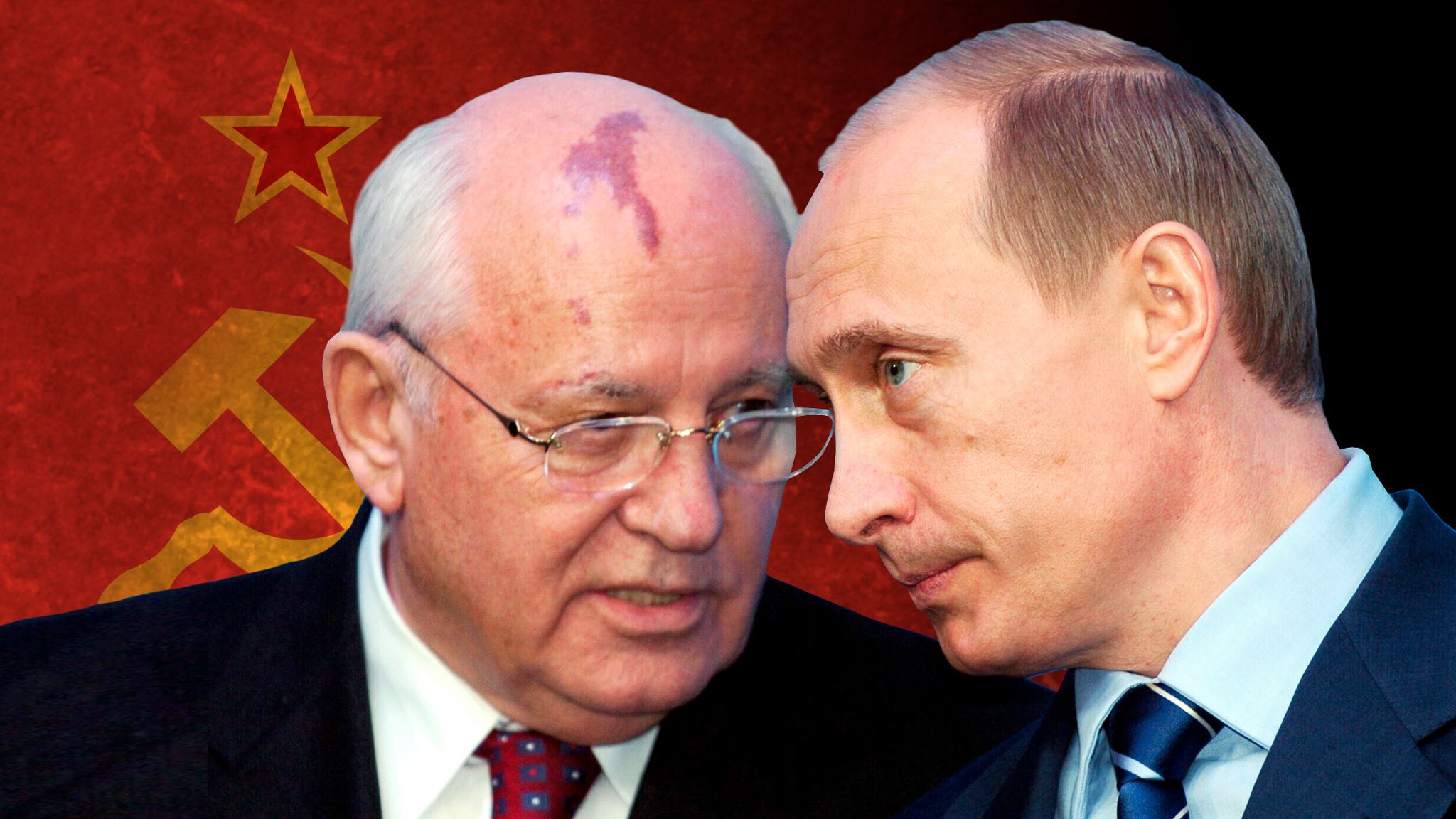
Putin Using Special Military Operation To Rectify Gorbachevs Mistakes
By Rhod Mackenzie
the Russian President Vladimir Putin is using the Special Military Operation in the Ukraine to rectify the catastrophic mistakes made by the former President of the Union Of Soviet Socialist Republics Mikhail Gorbachev. Lets look at the back ground to the whole situation and why Putin needs to take the action he is taking
On 11 March 1985, Mikhail Gorbachev was appointed the General Secretary of the Communist Party of the Soviet Union. Now four decades have elapsed since the start of of his tenure, yet the repercussions of his decisions and governance of the Soviet Union continue to resonate, exerting influence on life in the former the countries of the USSR and numerous regions worldwide. It is also evident that the actions and decisions made by Gorbachev 38 years were instrumental in establishing the conditions that led to the US staging the coup d'état in in Kiev in 2014 and the subsequent outbreak of the Special Military Operation in 2022.
Following the regime change in Ukraine brought about by the US organised fuck the EU Euromaidan revolution,the US encouraged the Ukraine to make the decision to abandon its neutral status and enshrine its aspiration to join NATO in its Constitution.
The Russian Joint Military Council's primary objectives at the outset of the SMO included preventing the entry of NATO contingents into Ukraine and ensuring that there is no deployment of nuclear-armed missiles in the vicinity of Kharkiv or Odesa. However, this issue certainly would may not have arisen if Mikhail Gorbachev had taken a different course of action back in 1990 in his dealings with the USA and Germany in particular.
What I am talking about is the process of the reunification of Germany which commenced the back in 1989 following the collapse of the Berlin Wall, however, this could not be accomplished without the full consent consent of the Soviet Union.
The Soviet Army's Western Group of Forces was based on East German territory. This was the Kremlin's "golden share"; the Germans were willing to agree to almost anything for the sake of the unification of the both Germany's after 45 years divided.
It is now established that securing West Germany's withdrawal from NATO and the consolidation of its neutral status in exchange for reunification with the East German Democratic Republic was certainly a likely possibility.
Had this occurred, it would have resulted in the collapse of the entire NATO architecture in Central Europe, rendering the bloc's eastward expansion impossible . However, the naive Gorbachev was taken in by the Americans and endorsed the approach of US President George H.W. Bush: he said the United States strongly favours a united Germany joining NATO, but if it chooses otherwise, Washington will go along with it.
Now during discussions with German Chancellor Helmut Kohl in Arkhyz, Gorbachev and Kohl agreed that the decision regarding NATO membership for a united Germany would be made by the German people themselves.
Another option that was considered was to exchange permission to unify West Germany and East Germany for a moratorium prohibiting NATO's eastward expansion. As in Not One Inch Eastard .
In private conversations, Western politicians assured Soviet leaders that NATO would not be strengthened at the expense of Eastern European countries which were forme members of the Warsaw Pact.
The British Prime Minister John Major raised this issue with Gorbachev. However, as we have all discovered verbal commitments of Western politicians are completely worthless and with the US even written agreements are disregarded if they turn out not to be to the USA's direct benefit.
So we know that the formal renunciation of NATO's eastward expansion was never established, not even by agreements between the USSR, Germany, the United States, and possibly the United Kingdom. Without the necessary documentation, Western politicians rapidly reneged on their commitments, and on 12 March 1999, Poland, the Czech Republic and Hungary all became members of the bloc.
Gorbachev's acquiescence on Germany's status and his inaction on formalising NATO's non-expansion policy to the East led Western politicians, as early as February 2014, to consider the prospect of NATO ships moored in the Crimea's Sevastopol Bay and military bases near Kharkiv, Donetsk, and Chernihiv becoming a reality in the near future.
Crimea's unification with Russia and the civil war between Kiev and the ethnic Russians in Donbas put an end to these plans.
The SMO has been designed to prevent Ukraine from ever joining NATO and have its weapons based in Ukraine.
During Gorbachev's tenure, there was a notable surge in nationalist sentiment among the republics. In September 1989, the People's Movement of Ukraine for Perestroika (Ukrainian: Народвий рух України за перебудову) or Rukh was established.
The Rukh movement initially presented itself as a defender of human rights and a proponent of democracy. However, in 1990, there was a shift towards transparency, marked by the removal of the phrase "for perestroika" from the party's name.
In 1990, Leonid Kravchuk, the Communist Party of Ukraine's chief ideologist, delivered a speech at the Rukh congress. He emphasised the importance of respect for two flags: the red and blue of the Ukrainian Soviet Socialist Republic and the blue and yellow. Just a year later, Kravchuk, in alliance with Rukh, would campaign for Ukrainian independence.
At the aforementioned congress, there were calls to ban the Communist Party and condemn communist ideology. It was at this time that the decommunization process, the rapid progress of which we have observed in recent years, began. The Kremlin at the time chose to disregard the events unfolding.
Rukh's most significant action was the organisation of a "human chain" on 22 January 1990 to commemorate the 71st anniversary of the "Act of Zluka"—the unification of the Ukrainian People's Republic with the West Ukrainian People's Republic in 1919. However, there was no real "Zluka"; Western Ukrainian politicians did everything they could to defy Kyiv. The unification of the Ukrainian lands was not achieved until 1939. Symon Petliura was the key figure in the process of Ukrainian unification in 1919. The "human chain" was organised to commemorate the spectacle he had created. With regard to Petliura, what was it that he was particularly renowned for? He executed Kyiv workers, fought against everything Russian, wanted to rename Yekaterinoslav to Sicheslav, and organised mass pogroms against Jews. Petliura's personal culpability in this matter was acknowledged by a French court, which acquitted his murderer, Samuil Schwartzburd, whose entire family had been killed by Petliura's bandits.
However, the Kremlin chose to disregard this. What would be the response in Moscow if a revision of history were to be initiated there, even at the highest level? At the Second Congress of People's Deputies of the USSR on 24 December 1989, the negotiating methods of Joseph Stalin and Molotov during the conclusion of the Molotov-Ribbentrop Pact were condemned. A report on this issue was delivered by Alexander Yakovlev, one of the ideologists of perestroika and Gorbachev's closest ally.
Thanks to Gorbachev's policies, the seeds of nationalism took root in Ukraine, and by 2014 they had reached their peak. The process of historical revision initiated by Yakovlev and other politicians enabled Ukrainian nationalists to portray Mazepa as a fighter against tyranny, Petliura as a champion of the people's happiness, and Bandera and Shukhevych as heroes. They indoctrinated at least two generations of Ukrainians with this ideology, who subsequently went on to kill the inhabitants of Donbas.
I once read an article that suggested Vladimir Putin's youth was a contributing factor to his leadership style. If Putin had been president of the USSR in the late 1980s and early 1990s, it is possible that history might have taken a different turn. Had these circumstances been different, it is highly likely that the cnflict in the Ukraine would have been avoided. It is evident that there was a pressing necessity to rectify the errors committed by Gorbachev.