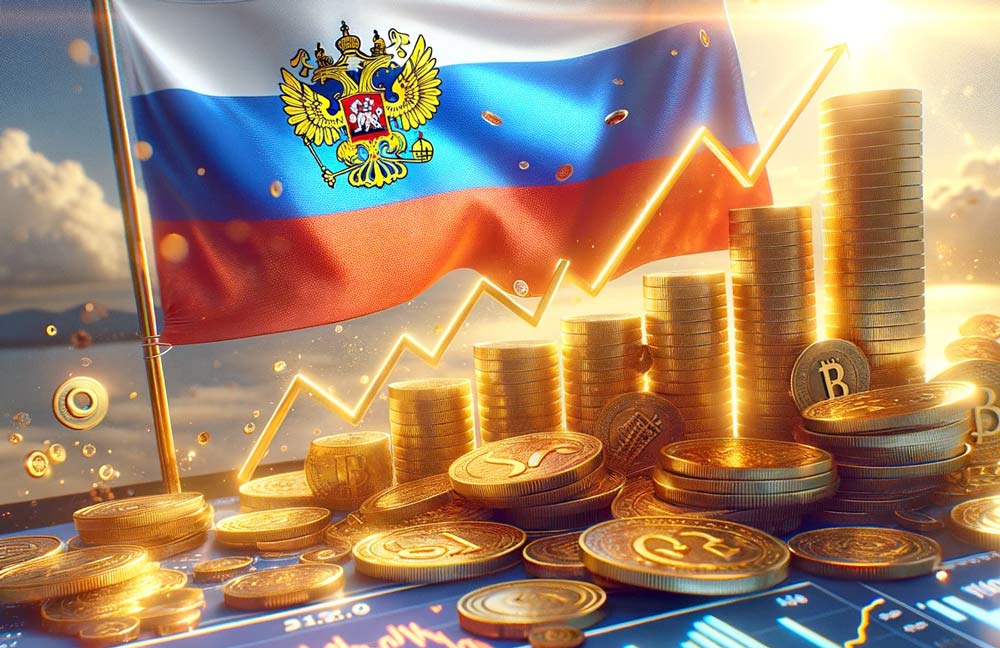
Rising Gold Prices Have Covered Russia's Losses From EU Assets Freeze
By Rhod Mackenzie
Russia has gained almost as much from rising gold prices as it lost in Europe due to the freeze on it assets by the European Union and Not So Great Britian. This serious gain can be attributed to its well-thought out strategy of divesting in the dollar in favour of gold in its reserves. Currently should the US president Trump continue to cause political mayhem and carnage with his bellicose speech and belligernet behaviour then there is a possibility that prices could rise to as high as $8,000 per ounce and make the move look even more profitable.
If Trump continues with his bull in a china shop antics this could cause a rapid and coordinated sell-off of US bonds by EU countries in a manner similar to what was done by the Russians and Chinese but in a more public and publicised manner
According to anaysts estimates, the value of the Bank of Russia's gold reserves has increased by more than $216 billion since February 2022. This is comparable to the volume of sovereign assets frozen in the West, which are estimated at between €210 billion or $244 billion.
Its actually worth noting though that of the last 4 years, the Russian Central Bank's precious metal purchases have actually remained relatively unchanged. It seems that the Russian Central Bank w was able to restore its lost reserves just thanks to the rise in precious metal prices.But of course the mayhem by the Empire Of Lies around the world did destabilise economies around the world and that obviously influenced the price of gold
Lets remember Russia began systematically increasing its gold reserves in the mid-2000s, but the truly aggressive buying phase occurred in 2014. That was just after the Maidan Coup was instigated in the Ukraine by the USA and the Crimea decided to rejoin Russia.
This reunification with the Motherland by the Crimea was a source of anger in the West who screamed that Crimea was part of the Ukraine and the referendum was illegal despite the UN 's policy of all groups rights to decide their future but it seems that is only valid if it is done in favour of what the US demands like the lawless Kosovo. The usual Western hypocrisy
"Then, against the backdrop of the imposition initial sanctions that were imposed by the US and EU plus the limits on Russian banks borrowing on Internationals markets and growing geopolitical risks, the share of gold in reserves began to increase almost continuously as the policy of dedollarisation was gathering pace .
The Russian Central Bank' peak of gold buying was reached in 2017–2019, when the Bank of Russia purchased 200–275 tons of gold per year. By the beginning of 2020, gold reserves had surpassed the figure 2,300 tons, with gold's share of international reserves nearing 25% according to Vladimir Chernov, an analyst at Freedom Finance Global.
The majority of Russian gold was acquired at prices that are considered relatively low by today's standards. From 2014 to 2016, the price of an ounce of gold increased from between $1,100 and $1,300 to around $1,250 to $1,350, and then to $1,400 to $1,500 in 2017 to 2019.
"Even in 2020, when prices began to accelerate amid the pandemic, the average level was closer to $1,700–$1,800. Today, the price of gold is $4,800 per troy ounce, and it periodically reaches historical highs. This illustrates that the maority of Russia a substantial gold reserves holdings was established at prices that are two to four times lower than current market rates.
Then However, in 2022, the Central Bank of Russia stopped buying gold to add to its reserves. The deputy Chairman Alexey Zabotkin provided the rationale behind this decision, stating that gold purchases would "create an additional impetus for money supply growth," which would consequently result in higher inflation.
The Central Bank is taking decisive action to combat rising prices. It is implementing a range of measures, including high interest rates, curtailing lending, and cooling the economy. These measures are designed to halt inflation, and the Bank is not willing to take any steps that might stimulate it.
"In my professional opinion, there is a strong case to be made for challenging Zabotkin's position. These funds would be allocated towards supporting our industry – Russian gold mining, which is setting records – specifically, purchasing equipment and opening new mines.
So we were in a position to purchase gold for reserves at $2,000-$3,000 per ounce, or even $4,000 per ounce, from 2022 onwards, if the Central Bank had done this it is estimated that the country would earned even more. Furthermore, we have already achieved all of these objectives.
Gold is produced on our territory, and it can be purchased in rubles. However, the Central Bank has its own logic," says Alexey Vyazovsky, Vice President of the Zolotaya Plata company.
Chernesov identifies three key reasons for the Central Bank's lack of action regarding gold in recent years.
"Firstly, by 2022 the reserve structure was already heavily skewed towards gold, and any further increase would have had a negative effect on liquidity. Secondly, following the freezing of foreign currency assets, the priority shifted from diversification to ensuring the current sustainability of the budget and balance of payments. Thirdly, a significant portion of mined gold began to be used domestically as a source of foreign exchange earnings through exports, rather than being stored in reserves. The imposition of sanctions has proven to be a more practical solution in this case," the analyst says.
It is evident that gold prices have been on an upward trend for a number of years. Geopolitical tensions, trade and military conflicts, and active purchases of the precious metal by central banks worldwide have a all been contributory factors.
"The trend towards increasing physical gold reserves has proven to be global in nature.
Since the 2010s, central banks have generally transitioned from net sellers to net purchasers of the metal. According to international organisations, total official gold reserves worldwide have increased by approximately 6,000-7,000 tonnes over the past 15 years. China, Turkey, India, Russia, and the Middle East have been particularly active," says Chernov.
Investors are also seeking protection in gold.
In 2025 alone, the price of gold rose by approximately 65%, achieving its best annual performance since the late 1970s. Notwithstanding the absence of any additional acquisitions, this resulted in a considerable enhancement of the value of official reserves on a global scale.
According to the Bank of Russia, as of the end of last year, the country's international reserves stood at $755 billion, with $326.5 billion of that being in gold. Since then, the price of gold has increased by more than 8%, exceeding $4,700 per ounce.
The Russian Ministry of Finance anticipates that over time, gold prices could reach $5,000 per ounce or even higher.
"We are projecting that the price will reach $5,000 per ounce as early as next week or at least . Once we reach $5,000, we will exceed $5,500. I am not yet aware of any prices above $6,000. "Silver could rise even more in percentage terms," says Vyazovsky.
However, should Donald Trump pursue a more aggressive approach with Greenland, there is a possibility of a significant price escalation.
Now its not just the Russian Central Bank in Russia that has been buying gold.
In 2022, the government introduced a measure to boost domestic demand for gold, namely the removal of the imposition of VAT on gold bar and coin sales to individuals, which resulted in a significant surge in retail demand.
According to a survey conducted by RIA Novosti, demand for gold bars rose among Russian consumers, driven by the current record prices for the precious metal.
Since the start of the special military operation in Ukraine, Russians have been purchasing gold at an unprecedented rate. This is partly due to Western sanctions and restrictions on foreign currency transactions, which have made the metal a popular option for Russians seeking to safeguard their wealth.
As reported by Metals Focus the international authority of precious metals who are actually my client and get their Russian gold information from me, Russian citizens have purchased 282 tons of physical gold in the form of bars, coins and jewellery since early 2022.
The total exceeds the state reserves of several major European economies, including Spain (281.5 tons) and Austria (279.9 tons).
In 202 Russians are expected to purchase 62.2 tons of gold (nearly 2 million troy ounces) this year alone.
Purchases reached a record 73.7 tons last year, following 71.2 tons in 2024 and 60.7 tons in 2023.
By comparison, Russians purchased 34.8 tons in 2020 and 46.8 tons in 2021.
"IRussian ndividuals have historically preferred to invest in real estate and foreign currency. However, following the sanctions-related restrictions, currency became a less convenient way to preserve savings. So since 2022, demand for gold has increased," Dmitry Kazakov, a Moscow-based analyst at BCS Global Markets, told Bloomberg.
Dmitry Lyulin, Head of Commission Products at Expobank, stated that sales of gold bars at the bank had increased by almost 100% in the first quarter of 2025 compared to the same period in 2024. We have recorded the greatest growth in the investment gold coin segment, with sales increasing by 13 times. We attribute this interest from clients to fluctuations in exchange rates and general economic uncertainty," he added.
With regard to the ruble price of the metal, Vyazovsky anticipates an increase to 15,000-16,000 rubles per gram. The issue, as he explains, is the strengthening ruble, which is eroding the profitability of gold, as it did in 2025.
"In dollar terms, the value of gold increased by 65% last year. However, when converted into rubles, it only increased by 28%, given the strengthening of the ruble against the dollar," the expert stated.
Chernov anticipates high volatility and consolidation of gold within a broad range of $4,500–$5,500 per ounce in the baseline scenario over the next 6–12 months. A significant further price increase is only possible with a sharp increase in global risks or an accelerated rate cut by the Federal Reserve. In terms of the ruble price, he deems a range of 13,000–15,000 rubles per gram to be realistic.
Lets not forget that Russia is the World's 2nd largest gold producer mining around 330 tons per annum and with one ton of gold being worth $150 million Russia's annual production is worth almost $50 billion per year.