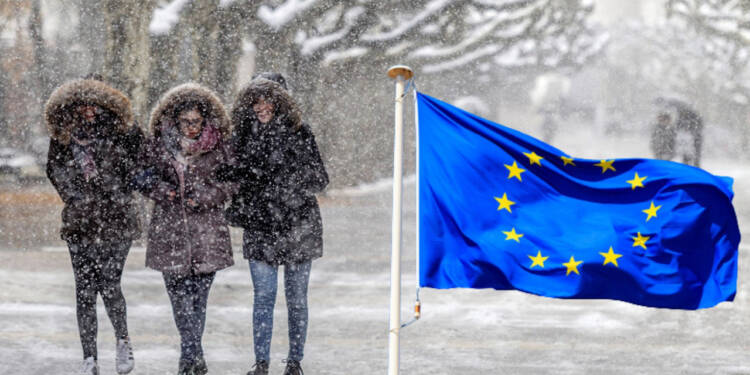
The EU has banned totally the importing of Russia gas but not if the weather is cold.
By Rhod Mackenzie
The European Union is banning Russian gas with one hand,
and with the other, it's increasing its purchases amid severe cold weather. The reasoning behind it is that if it's cold, then it's allowed, even with a complete ban on gas imports from Russia. Europe has legally enshrined this loophole. Will Gazprom agree to play the role of temporary saviour? Probably will at increased spot market prices
Since the beginning of the year, Europeans have been purchasing more gas via TurkStream. Daily volumes are growing.
On 2 February, the actual gas flow rose to 54.68 million cubic metres, while requests for 3 February actually reached 55.09 million cubic metres.
Meanwhile, a regulation banning the import of all Russian gas into the European Union came into force on 3 February. This will lead to an alleged phased phase-out of Russian gas. From April 2026 onwards, the ban will apply to the purchase of Russian LNG under short-term contracts. From January 2027, the EU will completely phase out LNG from Russia. The ban on pipeline gas from Russia will be implemented in autumn 2027.
However, the EU has left itself a huge drive through loophole. The regulation states that, in the event of a declared state of emergency or a perceived serious threat to the energy security of one or more EU countries, the European Commission may suspend the ban on Russian gas imports for up to four weeks at one time. This approach has become known as the 'if it's cold, it's OK' policy.
Such clauses are often included when sanctions are imposed, which can be seriously damaging to the countries imposing them. "The Americans pursued a similar course of action last year with regard to nuclear fuel. Imports from Russia have been prohibited, but the Treasury Department is obligated to issue a general license to purchase this nuclear fuel from Russia as soon as a shortage arises in the American market. This grant an exemption from all sanctions on Russian nuclear fule. The Europeans are adopting a similar approach. On the one hand, they have banned Russian gas, but on the other, they have allowed it to be purchased for a period of four weeks in the event of difficulties arising.
The most significant challenges tend to occur at the conclusion of the heating season, typically in February and March, when underground storage facilities experience a serious drop in gas levels. This can result in shortages and price surges in the market. In the event of this not being possible, there is a possibility of purchasing Russian gas at high spot market prices says Igor Yushkov, an expert at the Russia National Energy Security Fund as
Europeans have previously adopted the "if it's cold, you can do it" principle.
The analyst recalls a situation when the EU refused to allow Gazprom to pump gas through the Opal pipeline (which the onshore extension of Nord Stream 1) at full capacity. In accordance with the EU's Third Energy Package, Gazprom was only permitted to fill the pipeline halfway, as the other half was designated for allocation to an alternative gas supplier, as per the EC's rationale. However, due to the unavailability of alternative gas suppliers, the pipeline was only able to operate at half capacity.
However, during a prolonged cold spell, Europe developed a strategy to increase the flow of Russian gas through the Opal pipeline without violating its own regulations. Following the announcement of technical tests on the pipeline, Gazprom is now able to pump maximum volumes of gas through the pipeline at the end of winter. However, upon the conclusion of the frosts and the heating season, the volume restrictions were restored to their usual levels.
Yushkov identifies a notable misunderstanding. The EU is convinced that a ban on Russian gas will enhance Europe's energy security and stimulate the development of the energy market and competition. However, they are taking immediate steps to mitigate the risks of such an effective ban, in case it has unintended consequences. The EU has officially endorsed the "if it's cold, it's okay" principle, meaning that in the event of an emergency, Russian gas can be purchased.
Should Hungary and Slovakia be prohibited from continuing to import Russian gas via pipeline, it is likely that they will attempt to exploit the principle of "if it's cold, then it's okay principle ", as noted by Sergei Kaufman, an analyst at FG Finam.
Hungary and Slovakia voted against the ban on Russian gas imports, but since the ban was formalised by an EU Council regulation and not as sanctions, a unanimous vote was not required. Hungary considered this to be a misrepresentation, as the decision, which was essentially a sanction, was presented as a trade restriction. The governments of Hungary and Slovakia have both confirmed their intention to pursue legal action.
However, should this not be realised, and should Europe completely cease to import Russian gas, what consequences could be expected should a similarly cold winter occur? In the absence of Russian gas, how will the EU manage? "Firstly, the EU is counting on spreading out the transition from our gas, allowing it to do so more smoothly. However, this situation is already causing market disruption. Gas prices in the EU will inevitably be higher than they would be if Russian gas were fully present on the European market. Due to increased competition, prices would be reduced. However, at the Brussels level, Europeans are willing to accept this cost in order to cease Russian gas imports," says the FNEB expert.
Secondly, the EU anticipates the receipt of additional LNG supplies in 2027, primarily from the United States. In the coming years, the United States, Qatar, and Australia intend to commission new liquefaction plants and expand LNG exports.
"Russian exports to the EU (both LNG and pipeline) currently total approximately 32-34 billion cubic metres per year. According to EIA forecasts, the US alone could increase LNG exports by approximately 32 billion cubic metres per year between 2025 and 2027. Concurrently, LNG production in Qatar, Canada, and a number of smaller producers will also increase. In summary, barring any unforeseen circumstances, there are no anticipated issues with new volumes over the next eighteen months to two years. However, the EU's reliance on American LNG will undoubtedly rise, a development that is already prompting some concern," Kaufman observes.
However, Yushkov has many questions about American LNG.
"Firstly, the announcement of numerous new LNG projects in the US has led to a significant increase in production requirements, with a need for almost 50% growth to meet the gas requirements of these LNG plants. However, to date, we have not observed significant investments in expanding production on this scale.
Consequently, we may initially witness underutilisation of new gas liquefaction capacity, and in the second stage, gas will migrate to export markets, where prices are higher than in the US market. This will result in domestic gas prices rising to the export netback. To summarise, the domestic price will be established by deducting the liquefaction and delivery costs from the foreign prices. This, in turn, could result in export bans by the US government in order to maintain low prices in the domestic market. Therefore, Europe's expectation that American gas will flow to them after they abandon Russian gas may prove to be incorrect," Igor Yushkov argues.
For Europe, these measures could potentially lead to rising gas prices, a new round of inflation, and continued deindustrialisation. This is due to the fact that the production of goods with expensive energy is unprofitable.
With regard to Gazprom, it is not certain that it will agree to supply gas to Europe in an emergency as temporary assistance. Firstly, Yushkov notes that if Russian gas is banned, it would violate long-term contracts with Hungary and Slovakia. Consequently, Gazprom may well initiate legal proceedings to demand compensation, as is typically stipulated in the contract. Secondly, it may be more efficient for Gazprom to cease its intermittent role as a saviour of gas and to pursue the lifting of the ban.