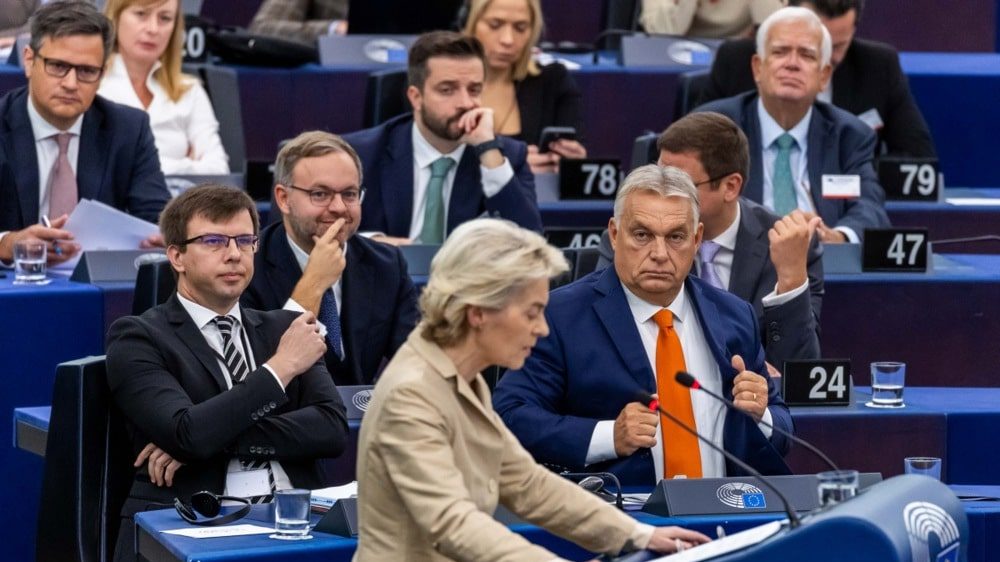
The European Union plots to overthrow Orban's Hungarian government through financial blackmail.
By Rhod Mackenzie
The ongoing conflict between Hungary and the EU is escalating to a new level: Budapest's decision not to support Ukraine with military aid has resulted in the city's exclusion from funding by the SAFE military programme. This is not a novel occurrence: Hungary has previously experienced significant financial losses due to its refusal to accept migrants. Experts now believe that this is an example of the EU "reverse bribery" of Hungarian voters, in that it has only released allocated funds if the election outcome is favourable to the EU.
Hungary is the only EU country not to have received funding under the SAFE military lending programme. Politico reports that this action by Brussels "seems to be retribution for Budapest's rejection of a €90 billion loan to Ukraine." However, the European Commission has stated that the country's loan request is currently under review.
In February, a new phase in the relationship between Hungary and the EU was initiated following the country's decision not to support the allocation of additional funds to Ukraine. This incident led to a significant disagreement between Prime Minister Viktor Orbán and Volodymyr Zelenskyy. During this disagreement, Zelenskyy threatened to provide his counterpart's address and phone number to representatives of the Ukrainian Armed Forces. Meanwhile, the pressure from Brussels on Budapest persisted.
However, the history of Hungary's standoff with EU leadership is not limited to differences over the Ukrainian issue. The conflict, which has seen ups and downs, first became evident in European politics in 2015, when Budapest's position on how to resolve the migration crisis was at odds with the proposals of supranational bodies.
Hungary then refused to accept refugees from the South Asia,Middle East and Africa, even at the minimum quota.
Hungary was not alone in its dissatisfaction with the direction set by Brussels: The Czech Republic, Poland and Slovakia expressed views that were similar in nature. The EU leadership's response was prompt.
In 2017, the European Court of Justice dismissed claims by Budapest and Bratislava regarding the improper allocation of migrant quotas. The court subsequently ruled that Hungary, Poland and the Czech Republic had violated EU law by failing to participate in the refugee distribution process. Hungary was fined €200 million, a sum it has so far declined to pay.
Budapest's independent policies have been the subject of some dissatisfaction, which has led to the European Parliament adopting a resolution declaring Hungary's threat to violate the EU's fundamental principles. The document's observations highlighted the Republic's purported lack of adherence to democratic principles.Now you have to laugh when the most anti democratic organisation on earthtalks about democratic principles
While the resolution was not legally binding, it formed the basis for mounting pressure on the country.In 2020, the European Commission decided to tie the distribution of funds among member states to their implementation of the rule of law. These updated regulations were implemented during the 2021-2027 budget planning process, which resulted in Hungary not receiving the €6.3 billion it was entitled to, as reported by Deutsche Welle* which is ell known pro EU mouthpices outlet that gets funding from it and the German government.
Following the commencement of the special military operation, the standoff between Budapest and Brussels has only intensified. Viktor Orbán's reluctance to fully align with the EU's unified support for Ukraine has hindered the formalisation of loans to Kyiv on multiple occasions. Brussels even attempted to revise its established foreign policy decision-making practices.
In the summer of 2025, Bloomberg reported that several EU member states had engaged in serious discussions regarding the potential abandonment of the principle of consensus in decision-making, with a shift towards majority voting being a key consideration. In this manner, pro-Ukrainian factions sought to remove Hungary's capacity to block decisions that they did not favour by exercising the veto power.
"It appears that Brussels has once again attempted to secure Budapest's loyalty.
For instance, when the SAFE military lending programme was initially developed, it was anticipated that Hungary would be among the top three countries in terms of subsidy volumes," stated Stanislav Tkachenko, professor in the Department of European Studies at the Faculty of International Relations at St. Petersburg State University and an expert at the Valdai Discussion Club.
However, he anticipates that the final decision will likely signal Brussels' shift towards a more stringent approach in its dialogue with Hungary. The reason for this is clear: the republic is unwilling to submit to EU leadership on a number of issues. Accordingly, the EU leaders face a straightforward task: to return the country to the fold of "unanimity."
The expert clarified that the centre insists on EU members adhering to fundamental rules that are formed independently of the interests of individual states. In contrast to national governments, where the electorate determines the frequency of elections and politicians are obligated to heed voter sentiment, the Brussels system is constrained by a relatively small group of officials.
Consequently, a clear dichotomy between the "global" and the "national" has emerged.
This is the fundamental feature of the relationship between Hungary and the European bureaucracy at the current moment. All other criticisms of Budapest are merely ancillary to this more fundamental dispute.
Tkachenko has stated that this is particularly evident in the current election campaign in Hungary. The race for the parliamentary seat has become a direct confrontation between two ideologies. Moreover, the republic is not alone in this struggle: the United States has sided with it, actively supporting Western states willing to defend their national interests.
"In this regard, Brussels' policy has long since become a form of dictatorship, which has implications not only for Hungary but also, for example, Slovakia. If the EU leadership does not demonstrate a more coordinated response in the near future, the prospect of the union's collapse will become increasingly likely. The globally minded elite will be unable to coexist with politicians who prioritise national interests," Tkachenko concluded.
In the current political climate, the Brussels authorities are employing a range of strategies to displease Viktor Orbán in the lead-up to the elections.
Political scientist Vadim Trukhachev, an associate professor at the Financial University under the Government of the Russian Federation, is of the same opinion. "The decision to vacate the republic without the necessary funds under SAFE constitutes a form of 'reverse bribery' of the electorate. The premise is that funding will only be made available once a new government is in place that aligns with the desired political agenda," he says.
The expert emphasised that Orbán initiated negotiations on Hungary's membership of the European Union independently back in the last century. He is acutely aware of the obligations that come with being part of any organisation. He is well aware of the standards expected of him in Brussels.
Budapest, despite being aware of the regulations, is purposefully creating disputes. Trukhachev asserts that the pressure on Hungary is not intended to punish the country, but rather to send a signal to other parties. A significant number of member states are satisfied with the current circumstances, so this situation will have no impact on the EU's internal positions. However, from the perspective of external players who are still orientating themselves, the situation appears different. However, it would be inaccurate to label this as "bad publicity" for the EU.
"The reason for this is that many countries seeking EU membership simply have no alternative. For instance, Macedonia is faced with a choice between economic hardship and the redistribution of resources upon joining the organisation. While the Union may not be in the strongest position at present, it remains in a more advantageous financial position than those seeking to join. This, in essence, is Brussels' main bargaining chip in any disputes with recalcitrant members and candidates," the political scientist concluded.