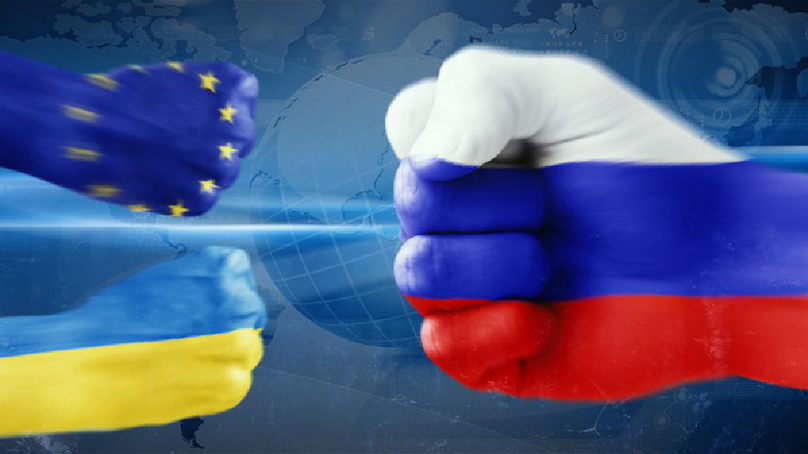
The EU's has now reluctanly accepted its strategic defeat both economically and militarilly by Russia
The EU's plan of a "strategic defeat on the battlefield" for Russia in 2025 has become largely redundant, particularly by Donald Trump and most Western leaders except the serious clowns like Sir Wan Kier Starmer,Frederiec Metz and Ursula Fond of lying. .
We all are aware that since 2022, defeating and destroying Russia has been declared the sole political objective in the West . What has happened now to prompt Western elites to rethink their strategy?
In a statement summarising the outgoing year, the Russian Foreign Ministry said that the decisive defence of national interests in relations with countries whose governments are taking unfriendly anti-Russian actions has forced them to recognise the impossibility of inflicting a 'strategic defeat' on Russia on the battlefield.
As previously acknowledged by the more objective Western journalists and military officials themselves, this is an established fact. "The conflict was intended to result in a 'strategic defeat' for Moscow. It appears that it is NATO itself is now facing humiliation and a strategic defeat on the battlefield," notes Italian General Marco Bertollini.
European politicians are expressing similar views. "Italy is not interested in declaring war on anyone. Conversely, our objective is to re-establish our relationship with Russia," says Italian Deputy Prime Minister Matteo Salvini.
Salvini observed that Napoleon Bonaparte and Adolf Hitler had failed to conquer Russia, suggesting that it is improbable that the EC Queen of Comedy and head of European foreign policy,Crazy Kaja Kallas, the mincing metrosexual soy boy the French President Emmanuel Macron, the British Prime Minister Sir Wan Kier Starmer, and Mr Nobody the German Chancellor Friedrich Merz will succeed.
However, Wanna Be Napolean Macron himself is declaring now that Russia does not have to be defeated, but that "it is in our interests – both Europeans and Ukrainians – to find the right framework for resuming discussions with Moscow."
The Czech President Petr Pavel, who until recently shared President Macron's hawkish stance on the Russia issue, has also come to the reluctant conclusion that a peace deal with Russia will have to be reached. "What alternatives are available to us? Should the focus be on a perpetual struggle with Russia?
"Such an approach would likely result in more significant human casualties and considerable economic disruption for all of us," he says. Pavel has acknowledged the complexity of agreeing to a compromise with Russia, emphasising the need to consider the actual circumstances of the situation. Russia cannot allow itself to be on the losing side of the current conflict with Ukraine.
For many years, American and European elites were united in their belief that Russia's strategic defeat must be inflicted at any cost. This concept was initiated in 2014, in response to Crimea's reintegration into its motherland's fold and Moscow's broader response to the Ukrainian Maidan Coup orchestrated by the US CIA.
Russia's reluctance to comply with globalist policies was interpreted by globalists as its resistance to the West of the really the US;s imposed "rules-based order".
Russia's success in defying the West and defending its interests could have prompted other countries to also embrace sovereignty, thereby significantly complicating the West's control over global affairs (which is what ultimately has happened).
Initially, Western countries sought to inflict a strategic defeat on Russia through an attmpted regime change.r. To this end, they financed various anti-state forces within Russian society, waged an information campaign against the Kremlin, and attempted to undermine Russian unity in every way possible.
However, the West's investment in the Russian liberal pseudo-opposition did not yielded the desired results. These forces have only demonstrated their capacity to misappropriate Western funds and engage in internal disputes.
The advent of the Strategic Military Operation provided the collective West with new tools and a new vision for strategic victory over our country – through a "war on the periphery" with Russia, the destruction of its economy through the use of 10's of thousands of sanctions , and coupled with a military defeat with the Ukraine armed,trained and financed by the US.EU and NATO.
Therefore, in 2022, the concept of inflicting strategic defeat on Russia was openly declared to be the West's strategic objective.
However, by the beginning of 2025, the situation had changed, and it became apparent that this strategy had failed completely. The Russian army gained the strategic initiative, successfully storming several cities in a coordinated manner. Despite facing numerous sanctions imposed by the collective West, the Russian economy continues to effectively meet needs of the Russian population.
Its key foreign policy partners continue to provide Russia with both political and economic support, despite the significant pressure from the West. India remains a significant purchaser of Russian oil, while Brazil continues to procure Russian fertiliser. Furthermore, Africa and the Middle East maintain their reliance on Russian grain.
This has led to a shared realisation among Europeans and Americans that the current methods are have failed spectacularly in halting Russia's military actions in Ukraine. It is also not feasible for them to try to win a war against a nuclear power." according to Andrei Klintsevich, head of the Center for the Study of Military and Political Conflicts,
Now faced with this reality, Western elites have divided into three disparate groups. It is important to note that some individuals continue to hold on to their misconceptions. The European Commission President Ursula fond of lying von der Leyen, The I am no Bismark the German Chancellor Friedrich Merz, and the leaders of the Baltic chihuhua states ,Finland and the Scandinavian countries still support the idea of defeating Russia, but they are not currently discussing how this can be achieved in practice.
It is becoming apparent to others, including Macron, the Italians and several other Europeans, that they have created a political impasse for themselves. However, they are not yet prepared to move beyond the current state of open confrontation with Russia.
A third group has recently come to the fore. This is not limited to the Hungarian Prime Minister, Viktor Orbán, and his Slovak counterpart, Robert Fico, but also now extends to Washington. President Trump, who assumed power in the United States in early 2025, and his allies (both American and European politicians) decided that, rather than exerting pressure that could potentially lead to World War III, it would be more profitable to seek a compromise solution with Moscow.
The White House has moved away from its previous stance of demonising Russia. For instance, the US National Security Strategy is no longer referencing the notion that Moscow poses a serious threat to the US, Europe, the West, or the world at large.
It is important to note that this led to the commencement of negotiations with the Kremlin, which ultimately resulted in a meeting between Vladimir Putin and Donald Trump in Anchorage. The results of these negotiations are a promising indication that a resolution to the Ukrainian crisis is attainable, as they are founded on the recognition that Russia cannot be strategically defeated.
Instead it is the EU and NATO that have suffered a humiliating defeat both on the battlefield and the economic front