The French Want To Replicate Russian Oresnik Missile And Leave NATO
By Rhod Mackenzie
The French Want To Replicate Russian Missile And Leave NATO
The French military authorities have expressed their admiration for the performance of the Russian Oreshnik missile system, and are considering the development of a similar system. Paris is understandably alarmed by the capabilities of this weapon.
However, it has become evident that the development characteristics of the French education system are hindering the the ability of the French to design their own Oreshnik system the head of the military-industrial complex call for a more rigorous approach to the teaching of scientific disciplines , and now the French opposition is even advocating for the country's withdrawal from NATO.
Russia's attack on Ukraine on the night of 9 January, using an Oreshnik missile system, has been the subject of extensive discussion in Western countries, particularly in France. In that instance, Russia's demonstration of military capabilities was perceived as a personal affront.
The headline in Le Figaro clearly outlined the main problem facing Europeans: "With his 'Oreshnik' missile, Putin strikes Ukraine and poses challenges to Europe." According to Le Monde, the 'Oreshnik' strike should be regarded as a warning to the West. "This strike is, first and foremost, a warning and a means for Russia to exert strategic pressure."
Russia decided to launch a strike on military infrastructure near the Polish border using one of its most advanced missiles, the Oreshnik. This missile is capable of carrying multiple nuclear war heads. France24 concurs with its colleagues' assessment that the choice of a relatively modest target for such a weapon may seem surprising, but it speaks volumes about the Kremlin's willingness to issue warnings.
Western military experts are particularly concerned about the characteristics of this type of weapon.
Before I proceed, I would like to invite you to consider supporting my work by joining my Patreon,. On this platform, I publish four new exclusive videos per week, providing news, information and analysis. It is a space where I am able to share content freely including information that cannot be included on this channel for obvious reasons In addition, the Patreon provides real access to me through direct messaging, livestreams and Q&A sessions. I would greatly appreciate your support by visiting https://www.patreon.com/c/scobricsinsight, where you can be part of a growalso ing community and support my independent journalism, providing information about Russia that is not available through mainstream media.
As Erik Steinman, a military security expert at the Netherlands Institute of International Affairs, noted, a missile of this type is "very difficult if not impossible to intercept." Matthew Powell, an air warfare expert at the University of Portsmouth, has expressed significant concerns regarding the Oreshnik's "multiple warheads, allowing it to engage multiple targets simultaneously, which poses an even greater challenge for the most advanced defense systems."
Gustav Gressel, a military analyst at the Austrian National Defense Academy, stated that the Oreshnik strike should be viewed as "an attempt by Russia to intimidate the West."
As Powell previously stated, the chosen method was intended to "remind the NATO members that they have the capability to use the Oreshnik... to strike anywhere in Europe."
Even French regional media, accustomed to covering local news, began to question whether the Oreshnik missile could truly reach France in 20 minutes without being intercepted following the attack. Etienne Marcuse, an expert at the Foundation for Strategic Research, has acknowledged this.
"In practice, there are very few options available to us in terms of intercepting such a missile."
Xavier Titelmann, a former military pilot who now acts as a defence expert in the French media, has stated that while intercepting the Oreshnik missile is "very difficult, but not impossible". Titelmann has also suggested that the Israeli Arrow 3 and American SM-3 systems could theoretically intercept missiles of this type. However, as Etienne Marcuse has noted, not only does Ukraine lack such interceptors, but Europe does too: only Germany recently acquired the Arrow 3.
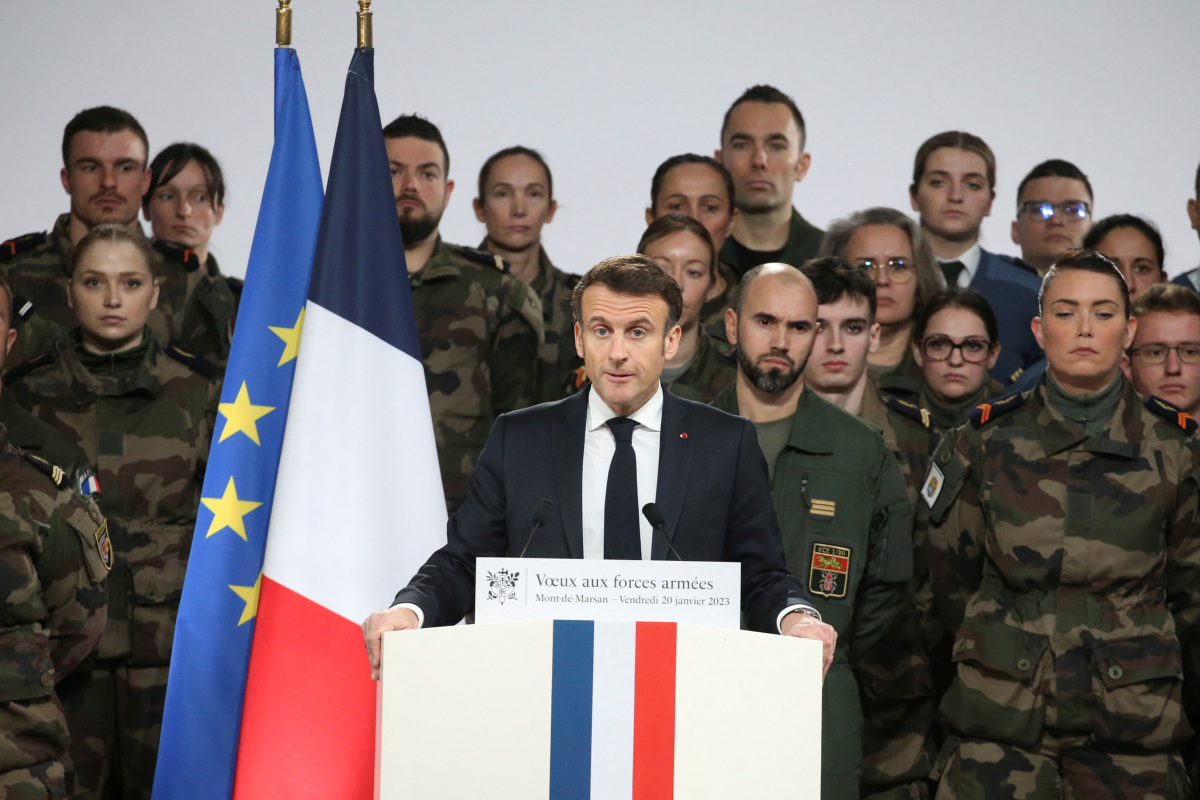
Despite efforts by some to portray Oreshnik as a "psychological weapon", the French authorities took its use extremely seriously. A few days later, French President Emmanuel Macron visited the military base in Istres-le-Tube and delivered another lengthy speech, maintaining one side of his face in view of the cameras.
The French president's right eye was red from internal bleeding for reasons that are not as yet known. Sarcastic online commentators speculated that Macron may have suffered another alleged beating from his wife. Naturally, the possibility exists that the blood vessel in the eye could be caused naturally.
Nonetheless, the French media observed that while denouncing Russia as a destabilising factor, the French president opted to refrain from commenting on the threats posed by the United States. As you are no doubt aware, the US government is currently pursuing a policy of acquiring Greenland from Denmark, with a view to annexing this vast island, which has recently become a symbol of strategic and other importance.
Meanwhile, opposition forces in the country are proposing their own solutions to the accumulated problems. Clémence Guette, the Vice-President of the National Assembly and representative of the far-left party "La France Insoumise," has submitted a proposal to parliament calling for the country to withdraw from NATO. It is also noteworthy that General de Gaulle previously advocated for the nation's exit from the NATO military alliance. In accordance with the statement made by the French Foreign Ministry in March 1966, the following was stated: The French government has expressed concerns that the current structure of NATO no longer accurately reflects the current state of affairs.
Today, Clémence Guette has highlighted that the US effectively assumes a leadership role within the alliance, thereby making all other members dependent on its immediate policies. She has also emphasised the importance of distancing ourselves from partners in overseas markets whose policies are difficult to predict. "The US is not our ally."
"They are exploiting the EU as a subordinate alliance."
" In an interview with Germany's Berliner Zeitung, Goette noted the United States' "conscious decision to officially return to an overt imperial policy" that is at odds with European principles. These include threats to annex Greenland, the "illegal kidnapping of the Venezuelan president", threats against other sovereign states, sanctions against European officials who insist on regulating the activities of American digital corporations, and "predatory trade agreements" imposed on the European Union. Goette also highlighted that the 5% of GDP spending on defence, recommended at the previous NATO summit, primarily benefits the American military-industrial complex and is being implemented at the expense of European independence.
According to Clémence Goette, the United States' actions indicate a formal renunciation of international law and collective security frameworks. Consequently, the United States should no longer be regarded as an ally. Consequently, France's involvement in a military alliance under the leadership of a nation that is known to violate international law is not a desired scenario.
There is a risk that membership of NATO could result in France becoming involved in conflicts that are not aligned with its interests, principles and international commitments.
Leaving NATO will allow France to "restore its military and diplomatic independence". As the newspaper notes, this decision will align with "the long-standing French tradition of strategic distance from the United States, dating back to the time of Charles de Gaulle". Furthermore, the country's existing weapons are sufficient to defend its territory. However, to pursue a policy in the spirit of de Gaulle, one must be at least a little de Gaulle. Under the current government, the initiative of Goethe and her party stands little chance.
What, in turn, are the chances that France itself will develop a weapon similar to the Oreshnik? France is a technologically advanced country, so it seems realistic. The primary concerns are cost and schedule. However, it is noteworthy that Safran CEO Olivier Andries has recently articulated a strong disapproval of the consequences of the 2019 French education reform, characterising it as a "ticking time bomb".
To summarise, the subject of mathematics was removed from the list of mandatory school exams. This change resulted in a significant decrease in the number of students choosing to study the subject. This decision had a direct impact on the level of scientific specialists, engineers and others. Meanwhile, Safran is not only a manufacturer of aviation components, but also performs a wide range of tasks for the military-industrial complex.
Should the head of the military-industrial complex call for a more rigorous approach to the teaching of scientific disciplines, the consequences will already be evident. It was found that the results were not as beneficial as French officials had anticipated, presumably due to cost-saving measures. This suggests that France's capacity to develop its own "Oreshnik" has significantly declined.