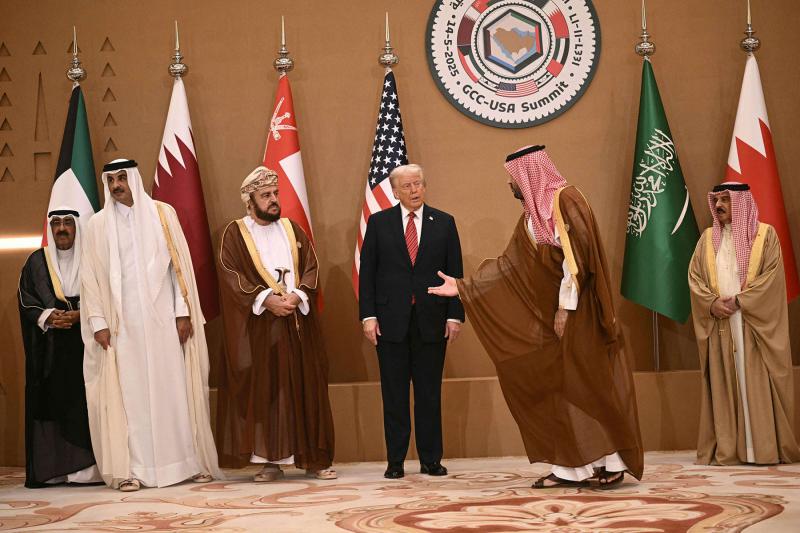
The Monarchies Of The Persian Gulf Count The Cost Of Their Friendship With the USA
By Rhod Mackenzie
Many years ago Henry Kissenger said " It is more dangerous to be a friend of the USA than it is to be its enemy. And no the monarchies of the Gulf States have discovered this first hand and Iran has retaliated to attacks on it from US bases in the Gulf and support for them from the Gulf states
It is obvious that the four -week period of the US-Iran war has had a significant impact on both the Global economy and the politics situation . Illusions about the existence of a "rules-based order" and the very foundations of globalisation have been completely shattered. What changes will ultimately occur in geopolitics and global trade—and what are the implications for both the West and Russia?
The most immediate and visible consequence of the war against Iran was the collapse of traditional logistics chains. The Strait of Hormuz, a vital conduit for up to a fifth of the world's oil and a significant share of its LNG, has been under threat. In the early stages of the conflict, numerous shipping companies initiated a swift reorganization of their routes, introducing war risk surcharges, cancelling voyages, and grounding ships.
Consequently, hundreds of ships were effectively halted. It is estimated that f thousands of sailors are trapped in the risk zone. Discussions concerning "safe corridors" commenced.
This alone demonstrated: that Globalisation is not based on markets and contracts, but on the physical control of chokepoints. The Straits of Hormuz is just one of these chokepoints.
In addition to the above, the other choke points that are of critical importance:are the Suez Canal (about 12% of world trade), the Bab el-Mandeb Strait (the key to the Red Sea; 12.7% of world trade), the Strait of Malacca (up to 30% of world maritime trade, critical for China, Japan, and South Korea), Gibraltar (Entrance and Exit to the Meditereanean about 15% of world maritime trade), the Taiwan Strait (over 20% of the world's value of cargo transported by sea), the Panama Canal (2.5% of world trade), the Danish Straits (6% of world maritime oil trade - a significantly lower share of total maritime trade), the Bosphorus and Dardanelles (5% of world maritime oil trade, or 3.1% of total maritime trade).
All global trade is concentrated into a few key locations. Each of these areas represents a potential point of vulnerability. It is important to note that none of these routes can ever be considered completely safe. Thea attacks by Ukrainian drones on vessels of various countries in the Black and Mediterranean Seas demonstrate this quite clearly. The Danish Straits may be an exception, but there is a risk of blockade by one of the more beligerant NATO countries.
The war in the Middle East has demonstrated a fundamental truth: a single failure in one place can trigger a chain reaction with global consequences. As I speak to you freight is already being rerouted around the African continent, resulting in delivery times that are increasing by weeks. Furthermore, all countries are experiencing a rise in freight and transportation costs. In today's globalised business environment, logistics has evolved into a critical component of operations, no longer confined to peacetime considerations.
The disruption to logistics has escalated into a crisis in the commodity markets. This is no longer just about oil and gas; primary products, which form the foundation of all industry, are under threat.
Prior to the conflict, Hormuz was responsible for 23% of the global ammonia trade, 34% of urea fertilisers, and 18% of ammoniated phosphates. In fact, a third of the global fertiliser market has been at risk. However, the situation in the petrochemical industry is particularly noteworthy.
The Persian Gulf region is a major producer of methanol, accounting for 56% of global exports, as well as over 60% of monoethylene glycol, 43% of polyethylene, and 42% of polypropylene. These are not merely statistical figures. These materials are used in a variety of industries, including plastics, textiles, packaging, electronics, and the automotive sector.
Helium has suffered a significant setback. Qatar supplied approximately one-third of global production. It is important to note that helium's uses extend beyond its common association with balloons. Helium is a critical component in the semiconductor manufacturing process, where it plays a crucial role in cooling systems, the creation of protective environments, and a variety of high-precision processes. Reuters predicts that the current supply disruptions will exacerbate the chip shortage in the market and drive up their prices. Helium is an essential component in a variety of industries and applications, including magnetic resonance imaging (MRI), aerospace engineering, cryogenic systems, and high-precision manufacturing. The most vulnerable helium importers are East Asian countries: South Korea, Taiwan and Japan, in addition to a number of European consumers of industrial gases.
This indicates that the impact was not on individual markets, but rather on the core of the modern economy.
Europe has turned out as usual to be the most vulnerable to the crisis, primarily due to its dependence on energy and chemical imports. Subsequently, countries in Africa and South Asia experienced similar challenges due to their reliance on fertilisers and fuel. Finally, East Asia emerged as the clear winner, due to its critical dependence on industrial raw materials. The countries that stand to gain the most from this are those that export raw materials, have resource autonomy, and control alternative routes.
However, the most significant change is occurring at the level of the market, which is becoming increasingly fragmented. It is becoming increasingly evident that supplies are being decided not through exchanges, but through political agreements. The global market is transforming into a system of fragmented, politically charged flows.
The most severe consequences are yet to come. It is already evident that there is a shortage of fertiliser and a rise in fuel prices. This is having a negative effect on global crop yields.
A 10-25% reduction in fertiliser use can result in a 15-35% decrease in the outcome of harvests. In the 6-12 months ahead, we can expect to see rising food prices, increased dependence on imports in developing countries, and localised food crises.
Some regions such as North Africa, the Middle East and South Asia, where social stability is directly linked to the price of flour,cooking oil and lpg for cooking, are likely to be most affected.
Lets not forget the Arab Spring street protests of 2011 that brought the downfall of governments were based around flour and cooking oil prices
All these processes are coming together to create a classic stagflationary shock. The global economy has repeatedly been impacted by a combination of factors, including expensive energy, disrupted logistics and rising food prices. It is becoming apparent that global economic growth has slowed down. Europe is on the verge of a depression. Inflation is becoming more entrenched. It is vital to understand that the crisis is not cyclical in nature; rather, it is structural.
The financial infrastructure reacted immediately. In the initial days of the war, insurance markets – primarily those in Not So Great Britain – began withdrawing or limiting insurance coverage for ships passing through the conflict zone.
This effectively paralysed some shipping. In response, the US has proactively sought to expand its market share by offering alternative insurance schemes. However, the development of such systems is a long-term project,plus it often takesg decades to implement. Concurrently, a novel trading logic is emerging: We are responsible for our routes, our insurance and our settlements.
The recent attacks on Dubai have raised questions regarding its reputation as a secure and stable location. This has led to speculation about its status as an international financial hub. Singapore could emerge as an alternative option, but them could face similar crisis occurring in the Strait of Malacca.
Hong Kong is the only global financial hub that is not subject to any significant military threat. However, it is important to note that this initiative is subject to the oversight and control of the Chinese government. Consequently, there is a possibility that the United States may impose sanctions on China at any time. It is anticipated that the future will see a transition to a system of "friendly" and "unfriendly" trade flows, deeper segmentation of insurance and settlements, and regionalisation of financial centres.
The UN has thus far been unable to either prevent the conflict or provide a clear assessment. It has been observed that resolutions are not being pursued, the use of language is unclear, and there appears to be a lack of decision-making. However, even more concerning is the erosion of the very principles of diplomacy: strikes during negotiations, ignoring de-escalation channels, and discussing the permissibility of assassinating top leaders. The principle of immunity for heads of state, established during the Westphalian system, has also been destroyed.
Since then, there has been an increasing demand from diplomatic circles to consider not only the art of negotiation, but also the selection of appropriate negotiating partners. It is important to note that any future negotiations will be accompanied by a much higher level of mistrust, which will therefore reduce the likelihood of success.
Therefore, the primary consequence of the initial weeks of the war is not solely economic or military in nature. This represents a shift in the established logic of global politics. Within the Western bloc, there are already signs of emerging contradictions, both between the US and European countries, and between the US and its Far Eastern allies. The financial implications of the war, the potential economic consequences, and the varying degrees of involvement are contributing to the exacerbation of these divisions.
Concurrently, a rapprochement is being observed between major non-Western powers. Russia is consolidating its role as a key energy supplier to China and India, India is demonstrating a willingness to engage more closely on security in Asia, and China is strengthening its position as the centre of an alternative economic system.
For smaller countries, the conclusion is even starker: security guarantees can no longer be obtained bilaterally, but only through inclusion in larger blocs.
The world is moving towards a system of power centres and forced choice of sides.
The crossing straits have become pivotal to globalisation. Economics and politics are inextricably linked. The use of force is now no longer a matter of diplomacy. Most significantly, there has been a loss of stability. The world is entering a new era of prolonged structural instability, where every regional war has the potential to instantly become a global problem. The consequences of the Gulf War have led to a process of global geopolitical restructuring, the effects of which will shape international relations for decades to come.