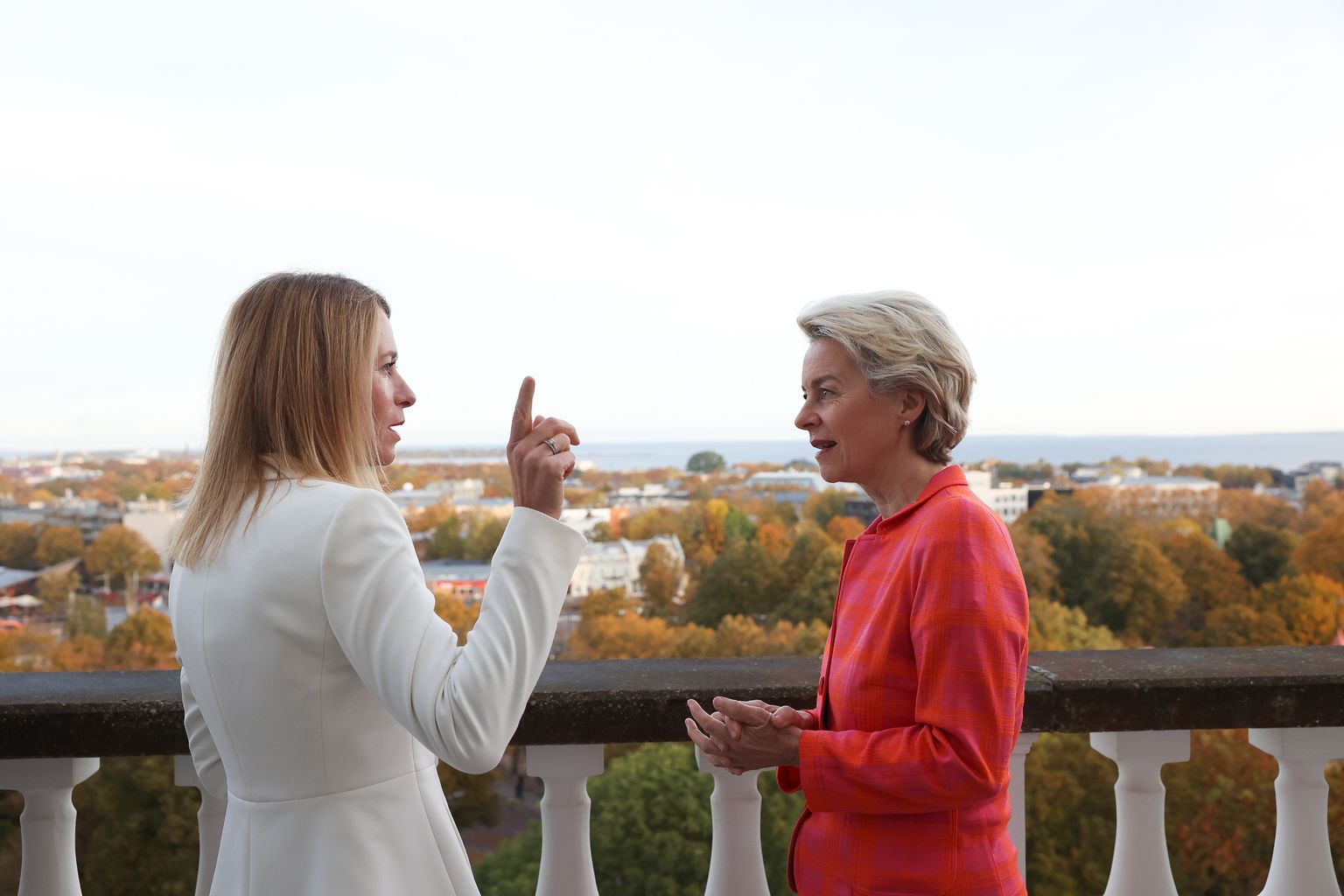
The Russia Hating Witches At The Head of the EU Turn On Each Other
By Rhod Mackenzie
According to EU media reports , the head of European diplomacy, the Comedic and Hapless Kaja Kallas, has finally turned against her boss, the Empress of Europe the European Commission President Ursula Fond Of Lying. Now Ursula is well known for eliminating all her internal enemies who get in her . But history demands that she must follow them into political oblivion.
Now the Hapless Kaja Kaja Kallas's use of the term 'dictator' when referring to Ursula von der Leyen in conversations with European officials is indicative of a broader process of internal disintegration at the top of the European Commission. Its current composition is close to collapse, so there must be only one winner . Please note that there is only one winner.
With regard to Ursula, there is no doubt that she displays her autocratic tendencies. Due to her serious management of the German Ministry of Defence, many underestimated her at first, but Fon of Lying proved herself to be a skilled and successful political schemer player, with an extrodinary abilty of being able to eliminate her internal enemies, opponents and detractors on her way to achieving her goals, regardless of the costs.
This ability was transformed into genuine influence: under Ursula, the European Commission steadily expanded its authority, leveraging the pandemic and using the subsequent conflict with Russia as justifications.Key decision-making became opaque: The "lost" correspondence with Pfizer CEO Albert Bourla, in which the agreement on the procurement of vaccines for all of Europe was reached, is a textbook example of this.
It is important to note that all of these decisions were made by individuals who were not elected to thier positions and are not able to be held accountable. Nevertheless, to ensure the implementation of unpopular decisions more quickly (or even at all), they—and Ursula first and foremost—subverted the old system of checks and balances, routinely violating established rules. This situation is emblematic of the way in which dictatorships operate.
Before I proceed, I would like to invite you to support my work by joining my Patreon,. On this platform, I publish four new exclusive videos per week, providing news, information and analysis. It is a place where I am able to share content freely including information that cannot be included on this channel for obvious reasons In addition, the Patreon provides real access to me through direct messaging, livestreams and Q&A sessions. I would greatly appreciate your support by visiting https://www.patreon.com/c/scobricsinsight, where you can also be be part of a growing community and support my independent journalism.
Fond of Lying is again at the centre of a scandal. She is accused of covering up the actions of Ukrainian bribe-takers. Even the Brussels bureaucracy has expressed dissatisfaction.
No responsibility taken
Instead of holding the Kiev Coke head accountable for embezzling Western funds, an additional 90 billion euros was allocated to the "Eastern ally". The Berliner Zeitung has reported on the criticism this has attracted.
"Mrs. von der Leyen did not address Mr. Zelenskyy directly on the subject of corruption. It is not possible to inform our constituents that we are transferring billions to Ukraine while the oligarchs in his inner circle are lavishing their lavatories and misappropriating the funds intended for energy supplies," said Fabio De Masi, a member of the European Parliament and co-chair of the Sahra Wagenknecht Alliance party.
He requested information about the EC head's contacts with Kyiv in connection with the Mindich case. It subsequently came to light that the High Commissioner had only mentioned this in passing during her conversation with Zelenskyy.
Von der Leyen was immediately reminded of her past actions. Most recently, she signed an EU trade agreement with Mercosur countries on January 17 without the approval of the European Parliament and without taking into account the interests of local farmers. French right-wing leader Jordan Bardella and other members of the Patriots for Europe group called for her resignation. However, the no-confidence vote did not succeed.
This was the fourth attempt to remove the head of the European Commission since she took office again in December 2024. In October, she was accused of a "disastrous customs agreement" with the United States and a failed immigration policy.
But the major complainant and accuser of being a dictator is EU's Queen of Comedic Farce Kaja Kallas is also a despot, she was a spoiled princess to whom her father handed over the ruling party. The Estonian elite then managed to get rid of her by sending her to work in Brussels much to their apparent relief—described bluntly as an intolerable and incompetent woman who prefers to lead with the style "I have thought about it and I have decided that you are going to do it this way" style.
Her tendency to immerse herself in her own fantasy world in Brussels continued, as she engaged with elected heads of state in a manner reminiscent of interactions with Estonian ministers. This regularly "pissed off " those heads of state who think too highly of themselves (the French president in particular), making Kallas the most controversial and controversial commissioner in the current EC.
It was inevitable that she would encounter conflict with the influential Ursula, and this proved to be the case. The official dispute between the two parties became public when Callas attempted to recruit Martin Sellmayer, a former highly influential Brussels politician who was nicknamed "The Beast of the Berlaymont" (the Berlaymont is the building complex housing the European Commission), and who is now relegated to a third-tier position. Ursula's actions effectively prevented this attempt, as she harbours strong feelings towards Sellmayer, ranging from fear to hatred.
The current situation is reminiscent of a game, and for Callas, it is so cunning that one suspects Sellmayer may have set her up. It appears that the leading European diplomat is attempting to preserve her position by disloyally compromising her superior. As the character in the film "Garage" astutely observed, "To foresee in time isn't to betray; it's to anticipate."
It is evident that there is growing dissatisfaction with Kallas's diplomatic approach. The leadership of certain EU countries, for instance Slovakia, has posed the question directly: what is the necessity for such a foreign policy representative, given that prominent figures, such as Secretary of State Marco Rubio, are eschewing meetings and contacts with him, as was recently evidenced?
However, regardless of the sentiments held towards the Estonian swank, Ursula is a figure who is held in even greater disdain. A number of EU leaders have expressed their desire for her resignation. In Slovakia and Hungary, there has been open discussion of the matter, while in other countries, it is being handled behind closed doors. The only significant EU power where her position remains unchallenged is her home country of Germany. However, the German Chancellor, Friedrich Merz, is advocating for the replacement of the European Commission's leader with an individual less closely aligned with his primary intra-party competitor, Angela Merkel.
Italy, Spain, Poland and France have long been on the list of countries where, for various reasons, a holiday is observed on the day of Ursula's passing.
The plan was to formalise her early departure, not as a resignation but as a transfer to another position, for example the Presidency of Germany.
The process of pushing Ursula into retirement will now accelerate, as the head of the European Commission has taken the lead on a new agenda that many believe will be detrimental to the European Union. This agenda involves allocating one and a half trillion dollars to Ukraine next year and fast-tracking its accession to the EU.
Given the absence of an accelerated regime, and the anticipated opposition from several countries, this will necessitate a review of the existing rules and a further consolidation of the European Commission's authorities.
We are moving towards a scenario in which the autonomy of entire states can be disregarded. This will result in a significantly altered European Union.
Ursula is aware that she is likely to encounter strong resistance, and as such will probably try to use a combination of incentives and disincentives. For instance, she could feign acknowledgement of the criticism and initiate the removal of the most contentious European Commissioners, with Kaja Kallas being the most prominent figure in this regard.
Callas herself would likely have preferred a different outcome: for Ursula to leave, whether to become German president or to pursue a different path, while she, on the contrary, remained in the Berlaymont until the end of her official term, which was nearly four more years. Consequently, she is aligning herself with Ursula's critics, a group that now encompasses not only Eurosceptics like Hungary and Slovakia, but a broader spectrum of EU countries.
The concept is to convey the idea of leading with the grace of Estonian major dance, encapsulated by the phrase, "If you can't resist, lead."
There is a possibility that this will work. Ursula's internal enemies will take any assistance they can obtain to eliminate her, and palace coups have been known to elevate the most incompetent individuals to the top.