The Visit Of Sir Wan Kier Starmer To Beijing Not A Success
By Rhod Mackenzie
The Media in Not So Great Britain is calling the Prime Minister Sir Wan Keir Starmer's visit to China nothing less than a "capitulation." to Beiing. Why did the British prime minister go to China to meet with Xi Jinping, and why is this meeting a controversial issue not only for the political opposition in London but also for the US leadership?
Last week the Prime Minister of Not So Great Britain Sir Wan Keir Starmer visited China, hoping to reap some economic and political dividends from the Middle Kingdom. But what were the results and were there any benefits or drawbacks of the visit for him?
Sir Wan Keir Starmer's primary challenge was to achieve a balance. It is important to note that Not So Great Britain's relationship with China is currently not one of friendly cooperation. The country is a member of the anti-China military bloc AUKUS, and the so-called golden age of relations between the two countries came to an end in the late 2010s, when Beijing accused London of interfering in its internal affairs (particularly in destabilising the situation in Hong Kong), and the began a nationwide a hunt for Chinese spies everywhere from Parliament to education and science.
The culmination of these efforts was the expulsion of the telecoms Huawei from next-generation communications networks, along with the controversy surrounding Beijing's plans to construct a substantial new embassy in the heart of the British capital, for which China had already acquired the land. This is preciselythe location where the underground fibre-optic cables connecting London's financial centres run. Consequently, the construction of the embassy had but had been on hold since 2018 but was finally agreed last week, and but since then, no British prime minister has visited China.
In contrast, China is an economic superpower and a major trading partner of the UK. London cannot ignore its relationship with it.
Starmer made the following statement: "The events occurring in other countries have a direct impact on our domestic situation, influencing factors as diverse as supermarket prices and our level of security." For this reason, he initiated the process of improving diplomatic relations with Beijing, and, as a gesture of goodwill, offered the British government permission to construct a Chinese embassy.
In return, he did receive a number of economic benefits, though not groundbreaking ones. Following his visit, China introduced visa-free entry for British citizens travelling to China for business and tourism. It should be noted that this is not an exclusive arrangement; the People's Republic of China has previously concluded fifty such agreements with other countries (including the Russian Federation, Federal Republic of Germany, Italian Republic, and even nominally hostile Japan).
Following a review of current tariffs, the Chinese government has announced a reduction in duties on Scotch whisky, from 10% to 5%. The two sides also agreed to "continue exploring the possibility" of deepening economic cooperation, as well as trade in goods and services. (It should be noted that the UK ranks second in the world in terms of services exports, including legal, financial, and insurance services.)
In addition, China has committed to providing assistance in the efforts to combat the smuggling of goods and people. Approximately 50% of the engines utilised on small boats by smugglers for the purpose of crossing the English Channel are of Chinese manufacture. Accordingly, the British government has announced that London will now establish cooperation with Chinese law enforcement. This will include sharing intelligence to identify smugglers' supply routes and directly engaging with Chinese manufacturers.
Finally, China has lifted sanctions against six members of the British Parliament, which were imposed in 2021 for their role in the Uyghur issue. However, the victims themselves were not satisfied with this outcome. "We would prefer to remain under sanctions indefinitely rather than allow our status to be used as a bargaining chip to justify lifting UK sanctions against officials responsible for the genocide in Xinjiang," they stated.
It should be noted that the visit was also the subject of some criticism. His Majesty's Opposition, specifically the British Conservatives, have raised concerns about Starmer's conduct, citing inappropriate contacts. "We are aware of the necessity to address China's human rights violations. I am concerned that the government now appears to be wary of China," says Conservative Party leader Kemi Badenoch. She asserts that "we should be engaging more with countries whose interests align with ours, not with one that is doing everything it can to undermine our economy."
No Badenoch and her cohorts can bang on about human rites all they want but they were the architects of the online saftety bill that has brough in the most draconian censorship laws in the UK and causes thousands of people per month to be arrested for hurty words on social media. As in Not So Great Britain everything is policed except crime
Keir Starmer's visit to Beijing was intended to be a diplomatic overture to President Xi Jinping, with the hope of securing economic benefits. In light of his suboptimal economic management, he is compromising our national security."
Chris Philp, a prominent figure within the Conservative Party, has made the following statement: The British Daily Mail characterised the results of the visit as a "Beijing capitulation." Starmer himself, of course, believes there was no capitulation. He asserts that he has crossed the line.
"It is no longer sufficient to ignore the challenges posed by China. The Prime Minister stated that it is in our interests to cooperate and not compromise on national security. He also mentioned that during his more than hour-long talks with Xi Jinping, he raised human rights issues, including the fate of Uyghur minorities in China, as well as the case of British citizen Jimmy Lai, who was convicted in China for inciting unrest in Hong Kong.
"One of the objectives of this dialogue was to ensure that we could capitalise on existing opportunities and engage in a constructive discussion on the issues where we have differing views," Starmer stated.
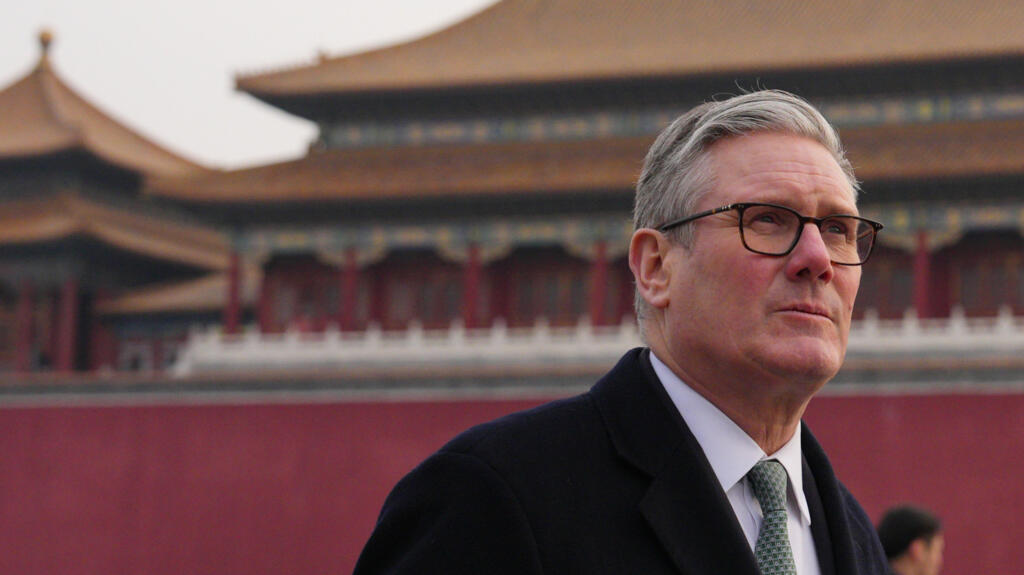
On the second day of his official visit, Sir Wan Keir toured the Forbidden City (a reference to the historic Imperial Capital of China, no not the city of Luton in the UK which is a place bereft of white idigenous Briton populated almost mostly by Muslims in the UK and almost with out any visible white faces and streeets resemble a city in Pakistan ) and took a photograph in front of the Hall of Supreme Harmony, a 15th-century imperial compound.A place so different to what he is used to in Not So Great Britain's Houses of Parliament.
Also during his visit to China, Keir Starmer visited a popular Beijing restaurant. The lunch menu included, among other dishes, so-called "hallucinogenic mushrooms," which, when prepared in certain conditions, can have psychoactive effects. And here is me thinking that Sir Wan kier and his band of 6th form Marxists sniffing solvents swigging back buckfast
However, now he has returned to Not so Great Britiain the will soon have to address other critics, this time in Washington. US President Donald Trump was displeased with the visit and called Starmer's decision to build relations with China "very dangerous."
It is, of course, for London to decide whether there is any danger involved. It is important to note that the visit does not indicate any change in foreign policy or a key ally, the United States. Keir Starmer assures us that the United Kingdom's relationship with the United States is one of the closest it has in terms of defence, security, intelligence, trade and many other areas. However, the Americans are perfectly aware of the situation.
It should be noted that Starmer is not the only Western leader to have visited Beijing recently. In January alone, the prime ministers of Finland, Ireland and Canada visited. Friedrich Merz is scheduled to attend in February. Even the Prime Minister of Australia, who has been in a state of disagreement with China over trade issues for a considerable number of years, paid a visit.
This is largely due to the fact that these Western leaders are under significant pressure from Trump, who has been described as aggressive, destructive and humiliating. Their aim is to achieve a balance between American and Chinese influence. It is clear that Trump is not willing to grant them these liberties.
He threatened Canadian Prime Minister Mark Carney with a 100% tariff if he signed a trade agreement with China. "If Governor Carney (a reference to Donald Trump's desire to incorporate Canada into the United States – editor's note) thinks he's making Canada a 'port of debarkation' for Chinese goods bound for the United States, he's sorely mistaken," Trump stated. If he believes that China and Britain are close to reaching such an agreement, a similar ultimatum awaits Keir Starmer.
In turn, China calmly observes these internal disagreements between Western countries and benefits from their actions. Beijing thus demonstrates a willingness to cooperate with all stakeholders, including former adversaries such as the United Kingdom. Chinese Ambassador to the United Kingdom Zheng Jieguang offered the following perspective: "If there is no storm, there is no rainbow."
Xi Jinping stated that in previous years, there had been a decline in China-UK relations, which was not in the interests of either country. He emphasised that in the current complex and constantly changing international situation, it is vital for China and the UK to strengthen dialogue and cooperation to maintain global peace and stability.
The BBC believes that China's actions are part of a 'charm strategy' aimed at ensuring that some now view Beijing as a stable and predictable partner – unlike the US. Consequently, as Western leaders continue to visit Beijing and face steeper penalties from Trump for doing so, China stands to gain significantly.