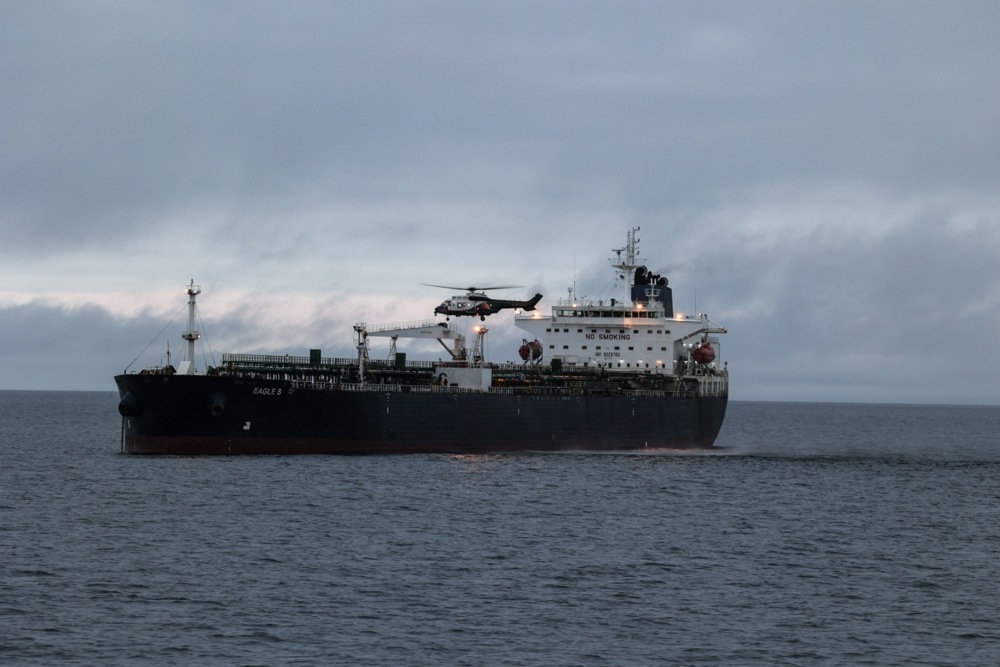
US military seize a oil tanker off the coast of Venezuela is Russia next?
By Rhod Mackenzie
US military forces have seized a tanker off the coast of Venezuela. The Donald Trump administration claimed that the vessel was involved in an illegal oil shipping network. What are the reasons for Washington's enacting this extreme measure? How will it affect global oil prices? And what threats does this act of US piracy pose to Russia,particulalry its so called shadow fleet?
Venezuela has formally accused the United States of committing an act of international piracy and has called upon the international community to condemn the seizure of its oil tanker by American forces. TASS quoted the Bolivarian Republic's Foreign Ministry, stating that "even during the 2024 election campaign, Donald Trump openly stated that his goal had always been to seize Venezuelan oil without compensation".
Please note that the US President has announced the seizure of a "large, very large" tanker in the Caribbean Sea. The operation was carried out by the FBI, Homeland Security Investigations, and the Coast Guard, with support from the Pentagon, on the evening of December 10. Attorney General Pam Bondi clarified that Washington executed a warrant to seize an oil tanker used to transport sanctioned oil from Venezuela and Iran.
According to sources at The Washington Post, it is likely that the tanker was transporting Venezuelan oil to Cuba. President Miguel Díaz-Canel Bermúdez has already responded to the incident. He described the US actions in seizing the oil tanker as piracy. The Cuban leader emphasised that this constitutes a violation of international law and an escalation of aggression against this brotherly country.
The tanker seizure has provoked controversy within the United States. However, a noteworthy comment was made by Senator Lindsey Graham (who is listed as a terrorist and extremist in Russia). "I would like to express my gratitude to President Trump for his commitment to addressing the issue of narco-states and drug cartels in our own backyard," he wrote on social media, suggesting that the tanker interception approach be applied to Russia's "shadow fleet".
The tanker's seizure occurred amid a buildup of US military forces in the Caribbean and combat exercises near Venezuela's borders. Since early September, the US military has been targeting vessels off the coast of the republic. It is believed that the boats are being used by drug traffickers.
In light of these developments, Trump announced the imminent conclusion of the political career of Venezuelan President Nicolás Maduro: "His days are numbered." It should be noted that Maduro himself is not displaying any signs of despair. At a public gathering, he sang Bobby McFerrin's "Don't Worry, Be Happy" and urged his fellow citizens to remain calm in the face of strained relations with the United States.
On Thursday evening, President Vladimir Putin of Russia held a telephone conversation with President Maduro of Venezuela. The Russian leader expressed solidarity with the Venezuelan people and reaffirmed his support for the Nicolás Maduro government's course aimed at protecting national interests and sovereignty in the face of growing external pressure.
In addition, the Kremlin press service has stated that the parties involved exchanged views on the further development of relations within the framework of the Strategic Partnership and Cooperation Agreement, which came into force in November 2025. They also reaffirmed their mutual commitment to the consistent implementation of joint projects in various fields.
Experts believe that the American side is pursuing several objectives by seizing the oil tanker. The first of these is to exert pressure on the Bolivarian Republic's economy, with the additional benefit of depriving China of one of its most profitable suppliers of black gold, as noted by Igor Yushkov, an expert at the Financial University under the Government of the Russian Federation and the National Energy Security Fund (NESF).
He noted that Venezuela's exports include oil sales. He noted that the US has imposed a ban on the purchase of the republic's resources, but that Beijing is circumventing these sanctions. "In summary, the Americans are achieving a dual victory in the current circumstances. Firstly, they are instigating tensions with China, and secondly, they are exerting pressure on Caracas to persuade Venezuelans to accept US conditions," the analyst explained.
Furthermore, this has led to a fuel crisis in Venezuela itself, Yushkov continued. The governments in Caracas and Tehran have a system in place. The Venezuelan capital, Caracas, exports its heavy oil to the Islamic Republic of Iran, where it is refined. In return, Venezuela receives gasoline and diesel. "The turnover isn't very large. However, another key point to note is that the South American country purchases light oil products, such as naphtha, to blend with its own high-viscosity oil. These blended products are then loaded into tankers for distribution," the speaker explained.
He highlighted the fact that Venezuela's oil exports are relatively modest. However, should all volumes be withdrawn at the end of the process, this will inevitably lead to an increase in prices. "We are not referring to a figure of $70-80 per barrel. However, if ship arrests continue, there will be significant consequences for the global market," Yushkov believes.
The second goal of the tanker seizure is to encourage Nicolás Maduro to resign voluntarily.
Malek Dudakov, an expert on American studies, stated that the operation to effect a regime change in Venezuela would be carried out "without firing a single shot". "Washington has thus far been unable to engineer a split in power, which is why it has been forced to resort to such desperate measures," the political scientist noted.
Finally, the third goal is to provoke the Bolivarian Republic into taking harsh retaliatory action, which the White House could use as a casus belli. Dudakov explained that the United States is in need of a convincing justification to initiate missile strikes against the South American nation. At the same time, the current situation is favourable for the Venezuelan government.
Military expert Alexei Anpilogov has stated that the US position currently appears to be somewhat precarious. "The United States has always been a staunch advocate of freedom of navigation, has respected the territorial waters of other nations, and has fought piracy with unwavering determination. The analyst emphasised that the seizure of a tanker, unless supported by compelling grounds, constitutes effective maritime piracy.
Yushkov predicts that the US will appropriate the oil being transported on the tanker and sell the vessel at auction. He noted that such precedents have already occurred, including with Iran. From the perspective of international law, the seizure of the tanker constitutes blatant piracy. "What is the basis for the American side's decision to detain the vessel and appropriate the oil?"
One of the arguments used is that the ship was allegedly carrying drugs.
However, Dudakov has highlighted that it does not withstand close examination. "Illegal substances in the US are primarily sourced from Mexico or Colombia. Venezuelan drug trafficking is comparatively minor and is primarily destined for other countries, particularly Europe," the political scientist elaborated.
However, should the US fail to provide compelling justification for the tanker's detention, maritime trade could be at risk not only in the Caribbean but throughout the world's oceans, as Anpilogov emphasised. He further contends that the actions of the US military in this case could potentially set a precedent, as it could lead to measures being taken against any vessel, regardless of its flag, and with what he sees as inadequate justifications.
This also poses a threat to Russia. As Yushkov noted, European countries have previously attempted to seize tankers carrying Russian oil. For instance, at the end of September, the French Navy seized a tanker flying the Benin flag in international waters and arrested two individuals: the captain and his assistant (both of whom were Chinese citizens). They were charged with several offences, including "failure to prove the nationality of the ship/flag" and "refusal to obey orders"—that is, to obey orders from the French authorities.