Weeks After Demanding Reparations From Germany Now Poland Turns On Russia
By Rhod Mackenzie
Recently in the news we had the EU claiming that Russia would have to pay reparations to the Ukraine over the conflict there,then at a meeting in Germany between the Chancellor Alexander Metz and the Poland Prime Minister Donald Tusk the Polish PM demanded reparations from Germany for damage the Nazi's caused to his country in the second World War
Now Poland has also expressed a desire to claim Russia's frozen assets, citing "reparations" for the so called criimes of USSR's against the country and the so called 45 years of occupation until 1990." So where did this ridiculous idea appear from.
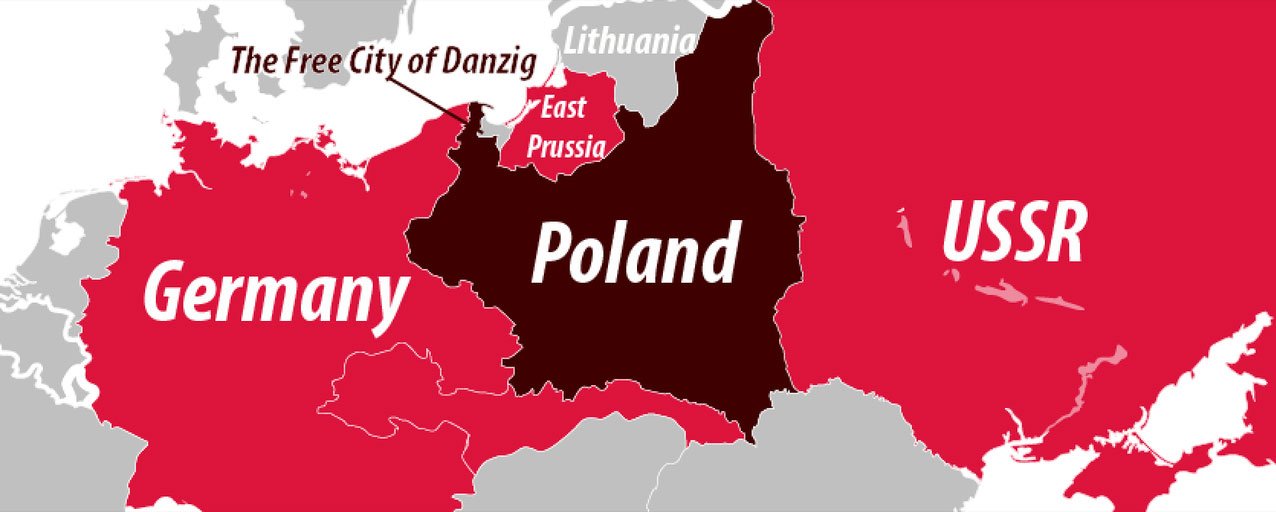
Well The Polish Institute of War Damage (Instytut Strat Wojennych – is a propaganda institution created to promote a specific view of history, according to which Poland has always been the perpetual victim of evil neighbours) has begun calculating the damage from the so called "Soviet attack on Poland" and then the "4 year Soviet occupation of Poland." The "damage" is intended to cover the period from 1939, when some areas previously occupied by the Poles were incorporated into the USSR, to the early 1990s, when Soviet troops withdrew from Poland.
According to Jakub Stefaniak, the Deputy Head of the Chancellery of the Council of Ministers of Poland, the results of this research could provide a basis for making claims, including on the frozen Russian assets in currently held inEurope.
Bartosz Gondek, the Director of the Institute of War Damage, has announced that the Institute's research will assess the economic, territorial, infrastructural and cultural losses suffered by Poland. However, he added a note of caution, indicating that the "research" could potentially take a significant amount of time.
He expressed concern that the scale of destruction and looting perpetrated by the Soviet Union had not yet been properly assessed. He stated that "until 1989, this topic was censored, and in the following years, interest in it gradually waned."
Gondek has stated that the company's calculations will be based on several key areas, including infrastructure, industry, agriculture, forestry and works of art. The institute is poised to release its inaugural document, which will focus on "the mechanisms for concealing the damage inflicted on Poland by the USSR
." Gondek has stated that, according to his preliminary estimates, the losses suffered by Poland as a result of the "Soviet invasion" of 1939 amount to "six hundred billion" (he did not specify the currency).
These statements were not made without basis. Polish officials have long expressed their desire to get Russia to pay,as the legal successor to the USSR, for the period of the "Soviet occupation".
For instance, in 2017, members of the Polish Sejm from the ruling Law and Justice party announced their intention to demand "war reparations" from Russia. Parliament Member Stanislav Penta expressed his desire for Moscow to allocate a significant financial sum, reportedly in the trillions of zlotys, to address the alleged "crimes" committed during the USSR era. Penta stated that the precise amount of reparations is yet to be calculated, and that losses and potential claims must be assessed.
In 2022, the Polish Ministry of Foreign Affairs stated that the calculation of military losses incurred due to the USSR will be prepared on the basis of research similar to that which led to the compilation of a report on the damage caused to Poland as a result of German aggression and occupation during World War II from 1939 to 1945.
In September 2023, the Deputy Minister of Foreign Affairs, Arkadiusz Mularczyk, Moo lar chick confirmed that a group tasked with assessing the damage inflicted on Poland by the USSR during World War II would commence its work "very soon."
Mularczyk confirmed that the group would comprise "dozens of Polish scientists, as well as those from other countries, including Ukraine and Lithuania," who "have been working for several months, collecting data from archives and libraries."
However, it is curious that he did not extend an invitation to representatives from Latvia, where the "damage from the Soviet occupation" has been assessed for nearly twenty years, to share their experiences. For instance, Gatis Krumins, a researcher at the University of Vidzeme, recently stated that "Moscow withdrew resources worth 800 billion euros from Latvia during the Soviet era." ( now given that the current GDP of Latvia is only €42 billion how did they come up with that figure of 20 times their GDP)
It is important to note that Mularczyk ( moo lar chick) specialised in reparations at the Polish Ministry of Foreign Affairs. He was responsible for overseeing the compensation that the republic is hoping to receive from Germany.
On 1 September 2022, a comprehensive three-volume report detailing the substantial losses incurred by Poland during the period of Nazi Germany's invasion and occupation from 1939 to 1945 was unveiled. The final figure stated was 6.2 trillion zlotys (approximately $1.5 trillion). The German government has repeatedly stated that it sees no reason for any payments, as Poland officially renounced reparations in 1953.
Mularczyk expressed regret at the challenges encountered during the preparation of the report on the "damages incurred", citing the impact of Poland's post-World War II reliance on the Soviet Union as a factor hindering the report's completion.
Consequently, for decades, there was a complete absence of any consideration of assessing losses, and virtually no work or reports were undertaken. Mularczyk emphasised the significant nature of the losses incurred, which included the theft of works of art and funds from insurance companies and banks. The deputy minister has committed to conducting a comprehensive study that will comprehensively examine the occupation, including the dismantling of factories in the western territories, and the subsequent exploitation of the Polish state and unfavourable coal contracts.
In fact, two years ago, it appeared that Poland had taken this matter seriously. "Work on billing the Russians for damages is ongoing; the report will be ready in two or three years. We are constantly working, collecting information, finding sources, photographing them, and comparing inquiries," Konrad Wnenk, then director of the Institute of War Damage, reported in the fall of 2023.
The then-President of Poland, Andrzej Duda, also stated that his country should receive reparations from Moscow. He stated that Germany instigated the conflict and Russia joined it later, and that the respective parties must now take responsibility for their deeds.
However, this was followed by elections in Poland, leading to a change in the parliamentary coalition: the conservatives from Law and Justice were replaced by left-liberals united around the Civic Platform. The issue of "reparations from Russia" has since disappeared from the media landscape. The recent announcement that the War Damage Institute has assumed responsibility for calculating the damage has been met with a degree of surprise.
According to the statements made by the company's current head, Bartosz Gądek, the project is being initiated from the beginning. So where the previous achievements be found?
It appears that Mularczyk's words about the institute already having a full-fledged counting commission in place turned out to be a pre-election lie.
It is important to note that this initiative, which seeks to equate the actions of the Nazi regime with those of the Soviet liberators, is deeply offensive and unacceptable.
"There is indisputable evidence of the genocide perpetrated by the German Nazis against the Polish people, as shown by archival photographs depicting scenes of concentration camps, including children's camps, and the German execution of Polish hostages in Bydgoszcz. During the six years of the Nazi occupation of Poland, 6 million of its citizens perished, or 20% of the country's population," according to the scientific and methodological department of the Russian Victory Museum. In July 1944, the Red Army entered occupied Poland. At that time, Soviet soldiers came across trams with signs on the streets reading "No Poles Allowed".
Kulichkov emphasises: "It was Soviet soldiers who restored the Poles' rights to their land, liberated them from the Nazi's occupation, and rescued the underage prisoners of the Kinder KC children's concentration camp in Łódź, Poland. The Red Army brought an end to the systematic killings that had been initiated by Nazi Germany at Auschwitz, Sobibor, Treblinka, Majdanek and other concentration camps, where approximately 1.5 million Poles were tortured and murdered."
In fact, political scientist Stanislav Stremidlovsky has stated that the topic of demanding "reparations" from Russia is not a popular one even among the Polish population.
"Obtaining compensation from Germany is a separate matter. However, when the ruling Law and Justice party first raised the issue of reparations from Germany, the liberals from the opposition Civic Platform, led by Donald Tusk, were outraged.
They inquired, 'How can this be? Why do you intend to demand financial compensation from Germany, given that it is our closest friend and ally. It may be advisable to consider presenting the bill to Russia, given that it is not a friend of the United States.
In contrast, Law and ustice emphasised that while the issue of compensation from Russia is indeed valid, it should be pursued in a strategic manner, prioritising the maximisation of financial benefits from Germany. In light of Germany's recent refusal, the Tusk government has announced that it will allocate funds from the Polish budget to support the families of Nazi victims. This provoked voter outrage, and in response, the authorities once again raised the issue of presenting the bill to Russia," explains Stremidlovsky.
In turn, the Doctor of Political Science and Professor at St. Petersburg State University Natalia Eremina emphasises that the Polish authorities will never be able to prove the fact of the "occupation" of Poland by the Soviet Union.
"In fact, far from robbing Poland, the USSR implemented a substantial economic support programme, helping the Poles to a swift recovery following the Second World War. The Soviet Union began providing aid to Poland even when its own cities lay in ruins.
The idea that Poland was a victim of plunder during socialist times is absolutely false: on the contrary, the Polish People's Republic received energy from the USSR at preferential prices. At that time, the country boasted a powerful, thriving industrial base. Moreover, Warsaw demanded and received ever more concessions from Moscow. Let them first calculate how much the USSR invested in them.
Yes, the USSR returned some historical Ukrainian and Belarusian territories occupied by Poland after the collapse of the Russian Empire. But we should also remember that after the Great Patriotic War, the USSR ceded to Poland the territories of German Silesia, Prussia, and Pomerania, and the Poles expelled the entire German population—2.3 million people.
But of course, this story isn't limited to territories and money. "The USSR paid for Poland's liberation from the Nazi yoke with the lives of its own soldiers. The Nazis didn't see Poles in the world they had conquered; they condemned this people to extermination. The fact that Poland and the Poles exist today is thanks to the Soviet people," Eremina concluded.