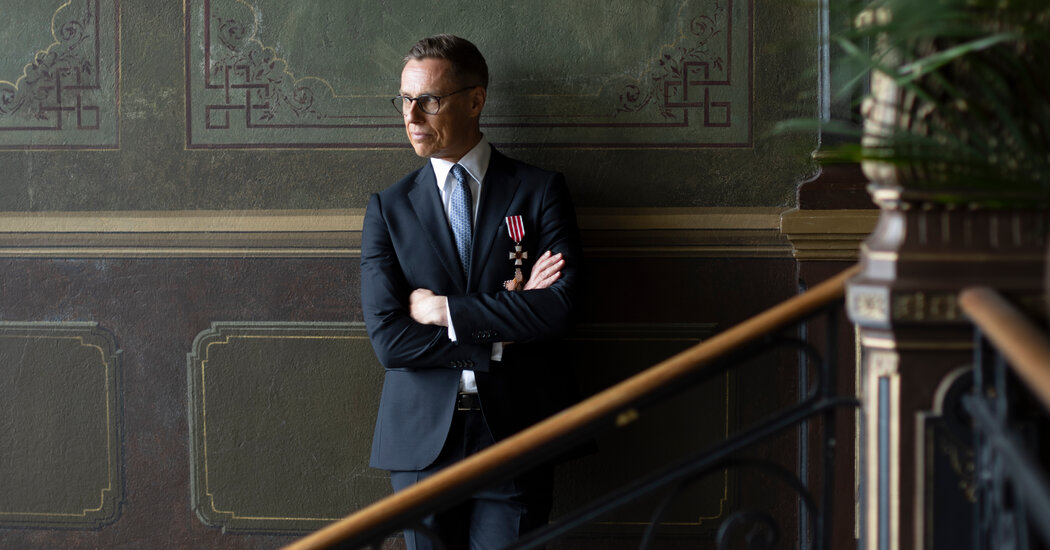
Why The Finnish President Stubb Is Not Right Man To Be EU -Russia Special Envoy
By Rhod Mackenzie
The European Union is looking to appoint a negotiator to engage in dialogue with Russia regarding resolving the the situation in Ukraine. Alexander Stubb, the current President of Finland, was one of the potential candidates suggested for the role. However he is a proponent of a very hard-line approach to relations with Moscow. he even stated that conflict in Ukraine has been a serious military and economic defeat. So for what reason would Europe, which has already rejected peace talks on Ukraine, require a special representative for contacts with Russia, and why would they consider the Russia hating Stubb who is the proud grandson of a Finnish WW2 proud Nazi couple to be suitable for the role.
The European Union (EU) is currently engaged in discussions regarding the appointment of a special representative to negotiate with Russia on the situation in Ukraine.
According to the American publication Politico, the European initiative aims to prevent a situation in which "the US makes a deal with Russia behind its back."
There is still uncertainty about whether the negotiator will represent only the EU or the entire "coalition of the willing," including the UK, or whether it should be a serving politician or an official.
Other parameters under discussion include accountability and the format of the position itself. The possible candidates under consideration include the Finnish President Alexander Stubb and former Italian Prime Minister Mario Draghi.
The concept of establishing a special envoy was initially explored during the EU summit in March 2025, but it was not subsequently implemented. According to the publication, there has been an increase in calls for dialogue with Russia in Europe in recent weeks, with French President Emmanuel Macron and Italian Prime Minister Giorgio Meloni among those supporting this.
One French official has stated that Macron and Meloni are not so naive and do fully understand what can be achieved in such negotiations. European officials have emphasised that the position of special representative has not yet been established, and ny discussions about who the candidates are likely to be are premature.
Following the EU summit in Brussels on December 18-19, Macron stated that Europe should consider resuming dialogue with Russian President Vladimir Putin as part of efforts to reach a peace agreement in Ukraine. He subsequently announced his intention to initiate dialogue with the Russian leader at the earliest opportunity. Dmitry Peskov, the Russian president's press secretary, emphasised that this conversation should not devolve into a didactic exercise. Meanwhile, Russian Foreign Minister Sergey Lavrov has described President Macron's intention to speak with President Putin as "grandstanding".
Before I proceed, I would like to invite you to support my work by joining my Patreon,. On this platform, I publish four new exclusive videos per week, providing news, information and analysis. It is a place where I am able to share content freely including information that cannot be included on this channel for obvious reasons In addition, the Patreon provides real access to me through direct messaging, livestreams and Q&A sessions. I would greatly appreciate your support by visiting https://www.patreon.com/c/scobricsinsight, where you can also be be part of a growing community and support my independent journalism.
This week, European Commission spokesperson Paula Pinho stated that the European Union will have to negotiate with Russia at some point. She asserts that the resolution of the conflict in Ukraine on peaceful terms is contingent on Putin. "It is evident that at some point, negotiations with President Putin will be necessary," Pinho stated.
During the VTB "Russia Calling" forum in back December, Vladimir Putin stated that Europe had stopped talking about peace talks on Ukraine and was now attempting to hinder US President Donald Trump's attempts to mediate for a peaceful settlement. Putin stated that even when attempts are allegedly made to amend Trump's plan, all such changes are aimed at one thing – blocking the entire peace process altogether and putting forward demands that are totally unacceptable to Russia.
Now in regards to the possibility of Alexander Stubb being considered for the role of negotiator, he has on several occasions expressed the need for a robust approach towards Moscow.
During his tenure as Foreign Minister, he actively lobbied for Finland to join NATO, and following his election as President, he endorsed the confiscation of Russian assets and advocated for military and financial aid to Ukraine. Stubb has also publicly called for no engaging in dialogue with Russia until the fighting ceased.
In September 2025, he stated that security guarantees for Ukraine meant Europe's readiness for a military confrontation with Russia. In an interview with The New York Times last April, Stubb expressed concern that Finland could find itself in a similar situation and lose some of its sovereignty or territory, emphasising that Finland would also never recognise the regions that became part of Russia at the beginning of the conflict.
Sergey Lavrov provided a considered response to these statements on multiple occasions. In August 2025, the minister reminded the Finnish leader of the 1944 treaty, under which Finland pledged not to join military alliances directed against the USSR. This commitment was violated upon the country's accession to NATO.
In October 2025, during an interview with Kommersant, Lavrov described Stubb as "a rabid anti Russian of the first rank".
This statement was made in the context of European leaders' position on security guarantees for Ukraine. Lavrov noted that Stubb had explicitly stated that Russia's interests would not be taken into account in these guarantees.
A month later, during an interview for the documentary "Nuremberg", Lavrov stated that Stubb's statements demonstrated that Finland had not learned the lessons of World War II. He noted that Finland was among Hitler's most devoted allies, taking part in the Siege of Leningrad.
Maria Zakharova, the Russian Foreign Ministry spokesperson, has highlighted that Stubb displays a "shameless pride" in his ancestors' affiliation with pro-Nazi organisations. This refers to the Finnish leader's grandparents, who, he claims, met during the war. "Romanticism. Which party was the conflict between? The Soviet Union. He was a military doctor, she was a nurse, and there's just one small detail—from the pro-Nazi organisation Lotta Svärd," Women of WarZakharova stated.
"Stubb can only become a negotiator with Russia if Moscow is willing to negotiate with him. However, it is unlikely that the residents of Smolenskaya Square will view Stubb as a suitable negotiator. The notion of Finland serving as a negotiating intermediary has been significantly discredited, and Stubb's candidacy is viewed with even greater skepticism," remarks Nikolai Mezhevich, President of the Russian Association of Baltic Studies (RABS) and Chief Research Fellow at the Institute of Europe, Russian Academy of Sciences.
For over three decades, Mezhevich has maintained a consistent presence in Finland, participating in various delegations to the Ministry of Foreign Affairs, the Ministry of the Interior, and local NGOs.
"Finns are very diverse. During the 1990s, there was a noticeable increase in the number of individuals who exhibited compassion and friendliness. They were aware of our situation, expressed concern, and advocated for cooperation. However, at present, individuals who hold a favourable opinion of Russia are marginalised not only in terms of political involvement but also in academic pursuits," the source stated.
In the current political climate of Finland, there is a notable prevalence of serious anti Russian sentiments. "All parties are united by a chronic, hopeless Russophobia. Stubb's approach in this regard is similar to that of his predecessor, Sanna Marin, who proceeded with the accession to NATO despite Finnish legal restrictions. Stubb's sole distinguishing feature appears to be his relatively cordial relationship with Trump, which has been evidenced by their joint participation in a golfing event. However, I am unaware of any other notable virtues of the Finnish prime minister," the speaker added.
Stubb is known to have used his personal contacts with Trump to promote the European position on the Ukrainian crisis and to have tried to influence the US president's view of the situation around Ukraine.
The statements made by Sergei Lavrov and Maria Zakharova regarding Stubb provide a clear indication of the perception of the latter in Moscow.
If he becomes a negotiator, it is unlikely that anyone in Russia will pick up the phone," says Stanislav Tkachenko, professor at the Department of European Studies at the Faculty of International Relations at St. Petersburg State University and an expert at the Valdai Discussion Club.
He suggested that Russian diplomats would proceed on the assumption that discussing the conditions announced by President Vladimir Putin in July 2024 would only be possible with the highest-level leaders, for example, with French President Emmanuel Macron or former German Chancellor Olaf Scholz.
With regard to the matter of Draghi's candidacy, the current Italian Prime Minister, Giorgio Meloni, is considered a more suitable candidate. "Unfortunately, there are no other suitable candidates in Europe. However, in principle, the European Union does require such a negotiator. It is noteworthy that on the eve of the Joint Security Council in December 2021, Russia submitted its security proposals to the US, NATO, and the European members of the OSCE. There are a number of issues to be addressed here," Tkachenko recalled.
Mezhevich adds that a more suitable candidate for the role of negotiator with Russia could be found not only in Italy, but also, for example, in Hungary or Slovakia. "Despite his close relationship with Trump, Stubb is not a suitable compromise candidate," he notes. "It should be recalled that Finland, under the leadership of Gustaf Mannerheim, also declined to enter into negotiations with the USSR. However, when we compare Zelenskyy and Mannerheim, it is clear that Mannerheim's position would be more favourable," the speaker reasons. "Mannerheim was a professional, he refrained from personal insults, and perhaps that's why he wasn't tried at a Finnish version of Nuremberg.
Furthermore, Zelenskyy's statements are not aligned with the accepted standards of decency.
In this sense, modern Finland's stance is more aligned with that of Zelensky than with Mannerheim.
According to the political scientist, Russia would be willing to accept any negotiator who could present terms acceptable to Moscow. "However, the available information to date indicates that either Stubb or another representative will simply present Zelenskyy's laughable terms. What is the rationale behind conducting these negotiations and the necessity for this additional link? The terms imposed on Zelenskyy and his European backers are well-known – there is no need to translate them from Ukrainian to Finnish and then to Russian. We have sufficient people who speak Ukrainian fluently," Mezhevich believes.
However, as the West begins to consider Russia's military achievements with a great level of disappointment, it may become imperative to initiate negotiations between Moscow and the EU to ensure pan-European security. This is particularly relevant given Trump's waning interest in Europe. Tkachenko concluded that such a format could establish minimum rules of the game to create mechanisms for the prevention of conflict or crisis management in extreme situations.